
Your Gym Should Miss You. It Shouldn’t Need You.
Being valuable to your gym is not the same as being required for its routine functioning. A durable martial arts business develops instructors, standards, culture, and systems that continue working when the owner leaves the room.
A lot of martial-arts gym owners tell me some version of the same thing:
“When I’m not there, the gym goes down.”
Attendance drops.
Energy drops.
Students ask when the owner is teaching again.
Staff members seem less engaged.
Little problems stop getting handled.
And eventually the owner starts feeling something dangerous:
“I always need to be there.”
At first, that can even feel flattering.
You are the founder.
You built the place.
You know the students.
You are probably the most experienced instructor.
You may be the best teacher.
Maybe you are the most charismatic person in the room.
People may have joined because they wanted to learn from you.
Of course things are different when you are gone.
But there is a line where that stops being a compliment.
If the gym repeatedly loses momentum whenever you leave, the issue is no longer just:
“My students really like me.”
It may be:
“I have built an organization that does not know how to function without me.”
And that is a very different problem.
I Had to Learn This on Construction Sites
Before I ever thought about building a consulting business for martial-arts gym owners, I spent decades in construction.
I ran electrical crews on large commercial and industrial projects.
These were not simple jobs.
They were fast-moving.
Complex.
Constantly changing.
On major projects, one delay could create problems for multiple trades.
Plans changed.
Materials did not arrive.
Other contractors got in the way.
Inspections changed priorities.
Something that looked simple on Monday could become a completely different problem by Wednesday.
And I had another priority that mattered just as much:
I did not want my career to destroy my marriage.
I had watched too many men allow work to consume everything.
The job always needed one more hour.
One more Saturday.
One more emergency.
One more project.
Then one day they looked around and the family they said they were working for was gone.
I did not want that life.
Amy and I were taking three-week trips once or twice a year.
If I wanted to keep doing that, I needed to be able to leave a complicated job site for three weeks without spending the entire vacation wondering what was falling apart back home.
That meant I had a leadership problem to solve:
How do I build a crew that can keep moving when I am not standing there telling everybody what to do?
Teaching a Crew Was Not That Different From Teaching on the Mat
Eventually, I started seeing similarities between teaching martial arts and developing a construction crew.
When you teach a martial-arts class, your goal cannot simply be:
“Everybody does exactly what I tell them while I am watching.”
You want students to learn how to train.
They need to understand the standards.
They need to know how to practice safely.
They need to take care of their training partners.
They need to help each other learn.
They need enough understanding that they can perform reps without the instructor correcting every movement.
If the instructor has to stand over every pair for the entire class, something is wrong.
Developing my electrical crews worked the same way.
I had to give people ownership.
Not pretend ownership.
Real ownership.
When someone had a project, I wanted them to understand:
This is yours.
Do not slough it off onto somebody else the second it becomes inconvenient.
Figure out what you can figure out.
Ask intelligent questions when you genuinely need help.
Know what the next step is.
And help the other people on the crew do the same.
Give People More Than One Thing to Do
One of the practical things I learned was never to leave somebody with only one possible task.
Construction does not work that way.
A worker might be installing something and suddenly discover:
another trade has blocked access;
material has not arrived;
a drawing needs clarification;
an inspection has not happened;
another task has to finish first.
If that person only knows one assignment, the work stops.
Then you get somebody standing around waiting for the boss.
So I wanted my guys to know:
If this gets blocked, here are the other things you can move to.
There was always productive work available.
Before I left for a trip, I would deliberately give the crew more work than I expected them to complete.
Not because I expected them to kill themselves trying to finish everything.
The point was the opposite.
I wanted them to have enough direction and enough options that nobody ever had to say:
“I didn’t know what to do because Chuck wasn’t here.”
If the big boss walked onto the job while I was away, I did not want him seeing six electricians standing around waiting for me to come back from vacation.
They had projects.
They had priorities.
They had standards.
They knew what good work looked like.
And they knew they were expected to think.
Culture Is What Happens When You Are Not There
That may be one of the simplest definitions of culture I know:
Culture is what your people do when the boss is not standing in the room.
Anybody can behave correctly while the owner is watching.
The real question is:
What happens when you leave?
Do your instructors still start on time?
Do they still greet beginners?
Do they know how students should be treated?
Do they maintain your safety standards?
Do they teach within the school’s philosophy?
Do they notice when someone looks lost?
Do they take responsibility for problems?
Do they help each other?
Or does everything subtly relax because:
“The owner isn’t here today.”
That is culture.
Not the values statement hanging on the wall.
Not your Instagram captions.
Not the speech you give during promotions.
What people repeatedly do when you are absent.
Is Your Culture Explicit — or Just Implied?
This is where I think a lot of small gym owners get caught.
The owner has been doing everything for so long that the standards seem obvious.
Of course we greet new students.
Of course we take care of white belts.
Of course we clean the mats properly.
Of course we do not embarrass beginners.
Of course instructors follow up when someone gets hurt.
Of course coaches communicate schedule changes.
Of course we teach students this way.
But is that actually written down?
Has it been taught?
Has it been practiced?
Has anybody been observed doing it?
Has anybody been corrected when they did not?
Or is the entire culture based on:
“They should know how I want it done.”
That is not a system.
That is mind reading.
Attendance Dropping When You Leave Is a Signal
Owners often tell me attendance drops when they are not teaching.
There are reasonable explanations for some of that.
If you are the founder and the highest-ranked instructor, some students will naturally prefer your classes.
That is normal.
If you are an exceptional teacher, people should want to train with you.
The goal is not to make yourself irrelevant.
But a major attendance drop should make you curious.
Because if students repeatedly treat every other instructor as a disappointing substitute for you, several things may be happening:
your instructors have not been developed enough;
students do not understand what each instructor brings to the room;
your culture may over-glorify the owner;
your staff may not carry consistent standards;
class quality may vary too much;
students may have built their entire relationship with the school around one person;
your systems may not create continuity when leadership changes.
That is not merely a charisma problem.
It is a systems problem.
If Your Other Instructors Bring No Value, Why Are They Teaching?
This is another uncomfortable question.
Sometimes owners unconsciously communicate:
“I am the real instructor. These people cover for me.”
Then they are surprised when students believe them.
Your assistant instructors may not have your rank.
They may not have your experience.
They may not teach exactly like you.
Good.
Why should they?
They should bring something valuable of their own.
One instructor may be exceptional with beginners.
Another may understand competition preparation.
Another may connect especially well with parents.
Another may be excellent at details.
Another may create an incredible training atmosphere.
Another may be the coach who notices the quiet student in the corner.
If your staff brings no meaningful value except keeping the doors open until you return, the problem is not that your students do not respect your instructors.
The problem is that you have not built instructors worth respecting.
And if they do bring value, part of your job as owner is to make that value visible.
Ownership Cannot Be Faked
One thing I learned on construction crews was that people know when they have real responsibility and when they are simply being told to pretend they do.
You cannot say:
“Take ownership.”
Then override every decision.
You cannot tell instructors:
“Make this your class.”
Then punish them every time they teach differently from you.
You cannot ask people to think independently and then train them to ask permission for everything.
Real ownership needs boundaries.
People need to know:
what they own;
what standards are non-negotiable;
what decisions they can make themselves;
when they should escalate something;
what a good result looks like;
what absolutely cannot happen.
Inside those boundaries, let them work.
That is how people develop judgment.
Standards Create Freedom
Some owners hear systems and imagine turning their dojo into a sterile franchise.
That is not what I am talking about.
A standard does not mean every instructor becomes a clone.
Standards actually create freedom.
On the construction site, the standard might be:
The installation must be safe, code-compliant, clean, complete, and ready for the next trade.
There may be several legitimate ways to get there.
In a martial-arts school, the standards might be:
beginners are treated with respect;
students train safely;
nobody is humiliated to make the instructor look powerful;
classes begin and end on time;
instructors understand the day’s objective;
students know what they are practicing and why;
problems are communicated rather than hidden;
the environment reflects the values of the school.
Inside those standards, instructors can still have personality.
They can still teach differently.
They can still bring their own strengths.
The goal is not sameness.
The goal is consistency where consistency matters.
Some People Will Not Fit the Culture
That is okay too.
When I ran crews, I had standards for how I expected people to work.
Take responsibility.
Do good work.
Think.
Help the team.
Do not hide from problems.
Do not make somebody else clean up your mess.
Some electricians loved that environment.
Others did not.
That was useful information.
A real culture makes it easier for people to decide:
“This is how I want to work.”
or:
“This is not for me.”
Trying to make everybody comfortable usually creates a culture nobody can clearly describe.
The Three-Week Test
Here is the test I eventually had to pass on construction projects:
Can I leave for three weeks and trust the crew to keep moving?
Not perfectly.
Not exactly as if I were there.
Not without a single question.
But:
Can the work continue?
Can problems get handled?
Can people think?
Can the standards survive?
Can leadership emerge from people other than me?
Can I spend time with my wife without constantly wondering whether the job site is on fire?
Martial-arts gym owners should probably ask themselves a similar question:
What happens if you disappear for two or three weeks?
Do classes continue?
Does attendance remain reasonably stable?
Do students still feel taken care of?
Do instructors make good decisions?
Does your staff know what matters?
Can the school solve normal problems without calling you every twenty minutes?
Can you actually enjoy the trip?
If not, that does not mean you have failed.
It means you have discovered the next thing you need to build.
You Want to Be Valuable — Not Required
There is an important distinction here.
I am not telling gym owners:
“Build a business that does not need you because you do not matter.”
Quite the opposite.
You should matter enormously.
Your judgment matters.
Your relationships matter.
Your teaching matters.
Your vision matters.
Your presence should improve the room.
Students should be happy when you are there.
But there is a difference between being valuable and being required for routine functioning.
If every class, every decision, every relationship, every problem, and every ounce of energy has to flow through you, you have created something incredibly fragile.
And sooner or later, that dependency starts limiting your choices.
Have You Built an Asset — or a Job With Your Name on It?
This is where the business question becomes unavoidable.
If your gym cannot operate successfully without you physically present, what exactly have you built?
You may own the LLC.
You may own the mats.
You may own the lease.
You may own the brand.
But operationally, you may have created:
A job with your name on it.
A real business asset should become increasingly capable of producing value beyond the direct labor of the founder.
That does not happen overnight.
And it does not mean the owner stops contributing.
But over time, the gym should accumulate things that remain when you leave the room:
standards;
capable instructors;
leadership;
relationships;
systems;
traditions;
shared expectations;
institutional knowledge;
student-to-student connection;
a recognizable way of doing things.
Those are assets.
Your charisma can help build them.
But your charisma cannot substitute for them forever.
An Owner Self-Audit
Answer honestly.
Not the version you want to be true.
The version your students and staff would describe if you were not in the room.
1. What visibly changes when I am not teaching?
Attendance?
Energy?
Class quality?
Student engagement?
Follow-up?
If you do not know the answer, that is itself useful information.
2. Can every instructor explain the standards of the school?
Not just techniques.
How do we treat people here?
Can they articulate it clearly without needing you standing next to them?
3. Are those standards written somewhere?
Or does everybody need access to the owner’s brain?
4. What decisions can my instructors make without asking me?
If the answer is almost none, they do not have much ownership.
They have a permission structure.
5. Does each instructor have a recognizable strength?
Can students explain why training with that person is valuable beyond:
“They are not the owner.”
6. What happens when something goes wrong?
Do staff solve appropriate problems?
Or do they freeze until the owner responds?
7. Do people know what to do when the original plan becomes impossible?
Do they have a bench of useful next actions?
Or does every blocked task produce a dead stop?
8. Do I routinely override people after giving them responsibility?
If so, I may be training dependence.
They learn that real decisions still route through me.
9. Can the school maintain its identity when individual staff members leave?
What survives?
If one popular instructor leaves and a large portion of the student base follows, that tells you something important about how much of their loyalty was attached to that individual rather than to the school itself.
10. Could I leave for three weeks without dreading what I will find when I return?
If not, what specific dependency makes that impossible?
Name it.
That may be your next thing to build.
The Goal Is Not to Escape Your Gym
The point is not:
Build systems so you never have to teach again.
Most martial-arts gym owners opened schools because they love the art, the students, the mat, and the community.
You may want to teach for the rest of your life.
Great.
Teach.
But there is a massive difference between:
“I am teaching tonight because this is where I want to be.”
and:
“I have to teach tonight because everything goes downhill if I don’t.”
One is choice.
The other is dependency.
And over time, dependency can turn something you love into something you resent.
Build Something That Can Carry Your Values Without Carrying Your Body
A mature martial-arts school should become capable of carrying more and more of the founder’s values without requiring the founder’s physical presence every hour of every day.
That is what leadership development does.
That is what culture does.
That is what systems do.
Your instructors should not become copies of you.
Your staff should not become robots.
Your students should not stop caring whether you show up.
The goal is much simpler:
When you leave the room, the standards stay.
The culture stays.
The care stays.
The training stays.
The relationships stay.
The work keeps moving.
Then when you come back, you are not walking into something you rescued.
You are walking back into something you built.

Are You Really Building Community — or Are You Just Convenient?
Your students may like your instructors, schedule, and facility—but what would they actually feel they were losing if they left? That difference separates a convenient martial arts gym from a community that feels like home.
Almost every martial-arts school says some version of the same thing.
“We’re a family.”
“We have an amazing community.”
“Come train with your new best friends.”
Sometimes that is true.
A lot of the time, I am not sure it is.
Sometimes what we call community is really just convenience with friendly people attached to it.
The school is close.
The class is at the right time.
The instructor is good.
The price works.
You know a few names.
People smile when you walk through the door.
That is all good.
But is that community?
I learned the difference because I have experienced both.
What Twenty Years in One Dojo Taught Me
For roughly twenty years, Grandmaster Han’s International Hapkido Federation was not simply a place where I trained.
It felt like home.
And I do not mean everything was easy.
Far from it.
There were training plateaus.
There were instructors I sometimes struggled with.
There were fellow students I did not always get along with.
There were frustrations.
There were injuries.
At one point, I took a hit that ruptured my spleen and put me in the ER and ICU.
None of that means unsafe training, bad coaching, or unhealthy relationships should simply be tolerated.
But even through the normal difficulties that come with years of training, the idea of leaving the IHF barely registered as an option.
I came back.
Not because the training was always comfortable.
Not because everybody was my best friend.
Not because every class was amazing.
I came back because I belonged there.
That school had become part of the structure of my life.
In some ways, it literally anchored me to West Los Angeles.
When I was an electrical apprentice in the early 1990s, other apprentices talked about going to Kuwait because there was serious money to be made.
Other electricians would tramp around the country, going wherever the work was hot when things slowed down at home.
There were legitimate reasons I could have left Los Angeles.
But leaving LA also meant leaving my Hapkido family.
And I could not really imagine doing that.
That is what community can do.
It creates gravity.
Not captivity.
Not dependency.
Gravity.
There is something there that you do not casually replace just because somebody down the street has a nicer schedule.
The Problem With Convenience
I have trained at other gyms since then.
Some of them were good gyms.
Some had talented instructors.
Some had good facilities.
Some had people I genuinely liked.
I have even stayed at some for extended periods.
But none never became home.
They were places where I trained because they were convenient.
And convenience is fragile.
If the schedule stops working, you leave.
If your favorite instructor leaves, you reconsider.
If the coaching becomes inconsistent, you reconsider.
If another school opens closer to home, you reconsider.
If the environment keeps changing, eventually you ask:
“Why am I still here?”
That is very different from:
“This is where I belong.”
I have noticed this contrast especially strongly in BJJ.
One of the challenges I have experienced is the roller coaster that can happen when instructors, coaching styles, staff, schedules, expectations, or training environments keep changing.
One month things feel settled.
Then something shifts.
A coach leaves.
Another instructor takes over.
The training emphasis changes.
The people you regularly see disappear.
New people arrive.
Then they disappear.
The staff changes.
The rhythm changes.
Eventually, students can begin behaving the same way.
They revolve too.
That should not surprise us.
If the environment repeatedly communicates:
“People come and go around here,”
students may begin to learn:
“Then I can come and go too.”
The revolving door can become cultural.
And the owner may still look around the room and say:
“We have such a great community.”
Maybe.
But if the relationships, rituals, coaching environment, leadership, standards, and sense of belonging are not durable enough to survive inconvenience or change, you may have something much thinner than community.
Friendly Is Not the Same as Community
A gym can be extremely friendly without having strong community.
Your front desk can know everyone’s name.
People can laugh before class.
Members can follow each other on Instagram.
You can have a BBQ outside the gym.
You can take a big group photo after promotions.
Those things can support community.
They are not proof of it.
Community starts showing itself when things become inconvenient.
A student’s schedule changes.
They get injured.
They hit a training plateau.
Their favorite training partner disappears.
They get frustrated.
They are not progressing as quickly as they hoped.
Money gets tight.
They have a disagreement with someone.
Their favorite instructor leaves.
Another gym opens ten minutes closer.
What happens then?
If the only glue holding them to you was convenience, convenience will eventually lose.
The Question Is Not “Do They Like Us?”
A better question may be:
What would this person feel they were losing if they left?
Would they lose a room with mats in it?
Or would they lose relationships?
Would they lose an instructor?
Or would they lose mentors who know their story?
Would they lose classes?
Or would they lose a place where people notice when they disappear?
Would they lose workouts?
Or would they lose a meaningful part of their identity and weekly life?
That is different.
Grand Master Han’s school was not interchangeable to me.
There may have been other martial-arts schools.
There may have been different instructors.
There may even have been easier or more convenient options.
But they were not my dojo.
That is the distinction.
Community Is Built Through Consistency
I do not think owners create community by telling people they are a family.
They create it through hundreds of repeated experiences.
Ask yourself:
Who greets the beginner?
Who notices when someone has not trained for two weeks?
Does the coaching environment feel stable?
Do students know what the school stands for?
Are instructors reinforcing the same standards or contradicting one another?
Do longtime students have meaningful roles?
Do beginners have people helping them become part of the room?
Do students form relationships that extend beyond their transactional relationship with the owner?
Are there rituals people recognize?
Are there stories everybody knows?
Are there shared experiences people remember years later?
Can members contribute something back?
Does somebody care when they disappear?
That is community.
And none of those require pretending everyone is best friends.
My Hapkido family included people who annoyed me.
That is what families do.
Belonging does not mean constant harmony.
In fact, one sign of real community may be that people can go through conflict, frustration, disappointment, and change without immediately deciding the relationship is disposable.
Your Staff May Be Teaching Students Whether the Gym Is Permanent
This is an uncomfortable one.
If your instructors are constantly changing, your students notice.
If every coach creates a completely different experience, they notice.
If policies change depending on who is working, they notice.
If the front desk turns over constantly, they notice.
If nobody seems to know what happened to the instructor who disappeared last month, they notice.
If leadership feels temporary, students may begin treating membership as temporary too.
You cannot demand loyalty from your students while modeling instability from the organization.
That does not mean employees can never leave.
Of course they will.
Life changes.
People move.
Businesses evolve.
But the environment itself has to remain recognizable even as individuals change.
The student should still know:
This is who we are.
This is how we treat people.
This is how we train.
This is what matters here.
This is my place.
The Convenience Test
Gym owners could probably learn a lot by asking themselves one uncomfortable question:
If a competent competitor opened five minutes closer to every one of my students tomorrow, what would keep them here?
Not what should keep them.
What actually would?
If the answer is:
“Our instructors are better.”
“Our mats are nicer.”
“We have more classes.”
“Our prices are competitive.”
Those are advantages.
But they are vulnerable advantages.
Someone can build a nicer gym.
Hire another black belt.
Add another class.
Run a promotion.
Undercut your price.
Community is harder to copy.
Twenty years of shared history cannot be copied next month.
Trust cannot be installed over a weekend.
Relationships cannot be purchased with Facebook ads.
Belonging does not arrive because you painted “OHANA” on the wall.
How Do You Know If You Actually Have It?
Here is a self-audit.
Answer honestly.
Not the version you want to be true.
The version your students would describe if you were not in the room.
1. What happens when a student disappears?
Does anyone know?
Does anyone reach out?
Does anyone genuinely care, or does the absence just quietly close in the schedule?
2. Do students build relationships with each other, or only with the instructor?
If every relationship routes through the owner, that may be an audience more than a community.
3. Can the environment survive a staff change?
If one popular instructor leaves and twenty students follow, what did those students actually belong to?
4. Do members contribute?
Do experienced students help beginners?
Welcome people?
Organize things?
Share knowledge?
Support each other outside of class?
5. Are there shared rituals, stories, and standards?
Does the gym have recognizable traditions and ways of behaving that connect different generations of students?
6. Can your people survive conflict?
If every interpersonal problem results in somebody disappearing, belonging may be shallow.
7. Do students identify with the school beyond their transaction?
Do they say:
“The gym I train at.”
Or does it feel more like:
“My dojo.”
“My team.”
“My people.”
8. Would students stay through reasonable inconvenience?
A worse commute.
A temporary schedule problem.
An injury.
A training plateau.
A new competitor.
9. Does leadership provide continuity?
Even when individual employees change, does the school still feel like the same school?
10. What would a five-year member say they received besides martial-arts instruction?
Their answer may tell you whether you have built community or merely sold classes.
Community Is Not a Retention Hack
I need to be explicit about this.
I am not suggesting you manufacture “family” because it improves lifetime customer value.
Students can smell fake belonging.
Community cannot merely be a churn-reduction strategy.
It has to be a genuine consequence of how you choose to run the school.
But if you genuinely create a place where people belong, retention often becomes a natural side effect.
Because when somebody thinks about leaving, they are no longer comparing:
$179 versus $199.
Three classes versus five.
Ten minutes versus twenty.
They are deciding whether they want to leave part of their life behind.
That is a completely different decision.
The Owner’s Real Job
Maybe one of the deeper jobs of a martial-arts school owner is not simply:
Teach martial arts.
It is:
Create an environment where people can practice martial arts long enough for the art — and the people around it — to become part of their lives.
Grand Master Han did that for me.
I stayed through injuries.
I stayed through frustration.
I stayed through training plateaus.
I stayed through personalities I did not always enjoy.
I stayed when other opportunities could have pulled me somewhere else.
Not because I felt trapped.
Because I felt rooted.
There is a world of difference between the two.
So when you tell prospects that your gym is a community or a family, ask yourself:
If you removed the convenience, would they still feel like this was home?
If the answer is yes, protect that fiercely.
If you are not sure, do not put another “family” slogan on the wall.
Start building something worth belonging to.
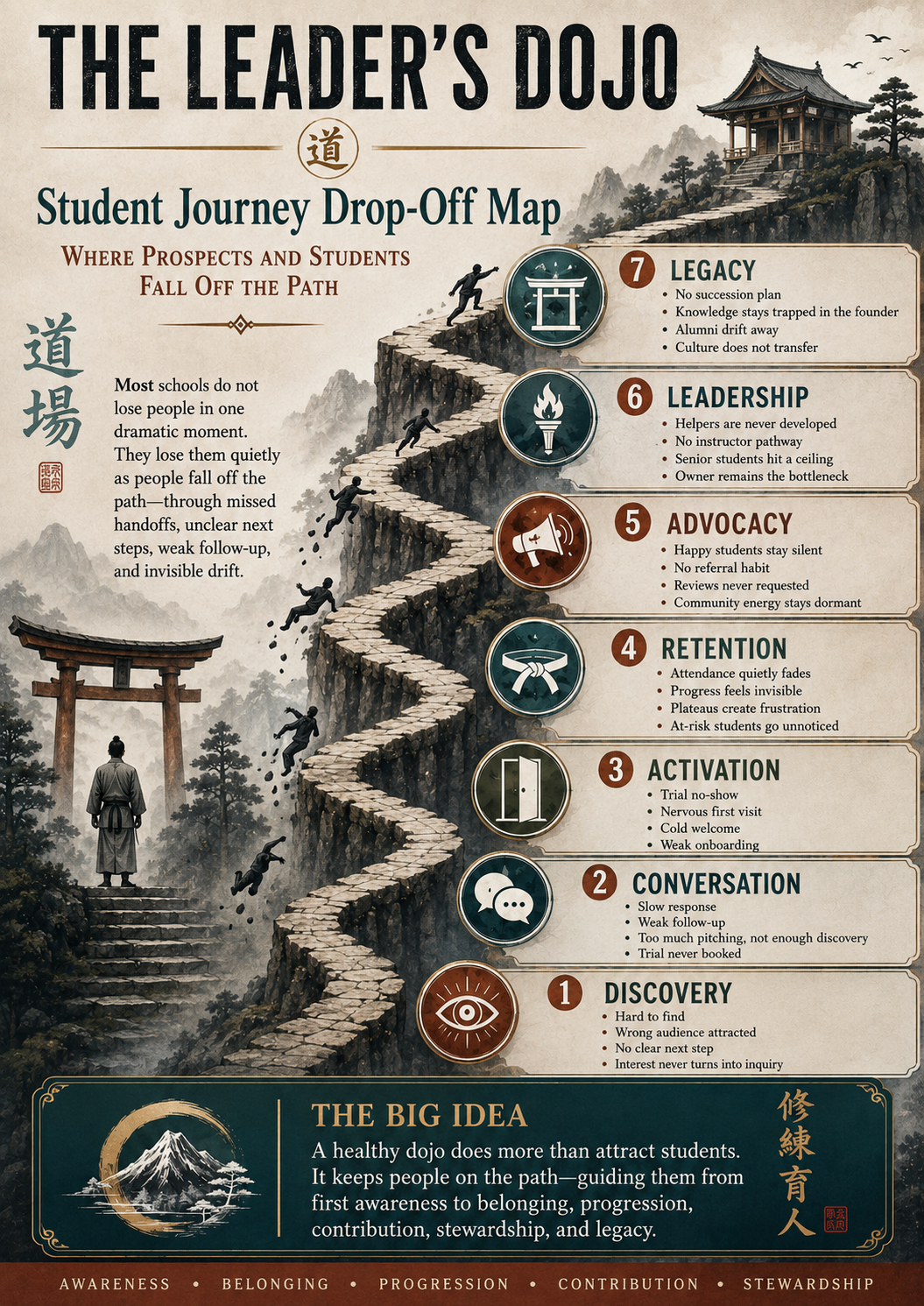
Stop Building a White-Belt Factory
If your martial-arts school is always chasing more leads but still feels thin, overworked, and dependent on the owner, the problem may not be acquisition.
It may be where students keep falling off the path from beginner to committed student, leader, and eventual steward of the school.
Why more leads won’t fix a school that keeps losing people on the way from beginner to leader.
If you run a martial-arts school and something feels off, there’s a good chance you’ve already diagnosed the problem as:
I need more leads.
More Facebook ads
More Google traffic
More trial students
More people walking through the front door
And sometimes that’s right.
If nobody knows you exist, acquisition is absolutely your constraint.
You cannot retain people who never walked in.
But I keep talking to gym owners who have a different problem hiding underneath the one they named.
They are getting people through the door.
They just are not keeping enough of them moving up the mountain.
And then they wonder why the owner is exhausted, the staff is stretched thin, the culture feels weaker than it used to be, and there never seem to be enough senior students around to help carry the school.
They keep pouring more people into the bottom.
But people keep falling off the path.
So they pour even more.
That can create what I think of as:
The White-Belt Factory
Lots of beginners.
Lots of trials.
Lots of onboarding.
Lots of repeating the same basic explanations.
Lots of hand-holding.
Lots of people who need attention.
Very few people who have been around long enough to give some of that attention back.
Beginners are not the problem.
Beginners are the lifeblood of a school.
A healthy school should always have new people discovering the art and starting their journey.
The problem is a system that can only produce beginners.
Because here is what happens next.
A beginner consumes significant attention:
explanation;
reassurance;
correction;
supervision;
relationship-building.
There is nothing wrong with that.
It is necessary.
But over time, healthy students should become progressively more capable and more contributive.
Some become trusted training partners.
Some become mentors.
Some become culture carriers.
Some become assistant instructors.
Then instructors.
Then program leaders.
Then senior leaders.
A few become stewards of the school itself.
That creates organizational capacity.
The school develops the human infrastructure to help the next generation of beginners without the owner personally carrying every handoff.
If students continually fall off before reaching those stages, the owner starts the development process from zero, over and over.
The academy ends up with many beginners and a thin middle and upper bench.
The owner remains responsible for far too much.
That is an exhausting way to build a school.
More Leads Can Make a Bad System Hurt Worse
Imagine a bucket with holes in it.
The water level is low.
You decide the answer is:
Pour water faster.
Technically, that may raise the water level for a while.
But you have not fixed the bucket.
And now you need to keep pouring forever.
That is what some martial-arts schools are doing with leads.
They lose people between awareness and inquiry.
Between inquiry and conversation.
Between conversation and trial.
Between trial and enrollment.
Between enrollment and becoming a regular.
Between regular and committed practitioner.
Between practitioner and contributor.
Between contributor and instructor.
Between instructor and senior leader.
Between senior leader and eventual steward of the school.
Every one of those transitions is a handoff.
And every handoff is a place where someone can fall through.
If enough people fall off early enough, the owner eventually creates a structural problem.
There are always new people at the bottom.
Almost nobody reaches the top.
Before you assume your next problem is more leads, understand what is happening to the people already entering your school.
If the path is badly broken, adding more traffic may amplify the underlying operational problem.
It may give you more work without giving you more depth.
Look at Your Mat
Here is a question worth asking:
What does the belt distribution in your academy actually look like?
Not what you hope it looks like.
Not what it looked like three years ago.
Right now.
How many brand-new people?
How many students have trained six months?
A year?
Three years?
Five years?
How many senior students?
How many people can safely help a nervous beginner?
How many people can:
lead a warm-up;
help teach fundamentals;
welcome somebody new;
model the culture;
run a class if you are not there;
mentor somebody through the frustrations they experienced themselves three years ago?
And then go another step.
How many of those people can eventually become:
instructors;
program leaders;
managers;
location leaders;
business partners;
your successor?
If the answer gets thinner and thinner the farther up the journey you go, that is information.
Your school may not simply need more people entering.
It may need more people surviving the journey.
Every Drop-Off Creates More Work for the Owner
Retention is not only about keeping tuition revenue.
It is about building capacity.
A student who stays becomes more capable.
Then more independent.
Then potentially useful to other students.
Eventually, some become culture carriers.
Some become mentors.
Some become instructors.
A few become senior leaders.
Maybe one day somebody becomes capable of running the place without you.
That is how a school compounds.
But when students constantly disappear, that compounding never happens.
The owner stays stuck doing beginner-level work.
Another inquiry.
Another sales call.
Another trial.
Another orientation.
Another person who does not know how to tie their belt.
Another person who needs to learn the etiquette.
Another person who needs reassurance that being terrible at martial arts during their first month is normal.
There is nothing wrong with that work.
But a healthy ecosystem cannot be only that work.
Imagine a construction company where every employee had been on the job for three weeks.
Who trains them?
Who catches mistakes?
Who leads the crew?
Who teaches the shortcuts that are not written in the manual?
Who becomes the next foreman?
Eventually the owner is doing everything.
That is not a team.
That is one person surrounded by apprentices.
The Journey Does Not End at Enrollment
This is one of the biggest mistakes I think school owners make.
Marketing thinks the finish line is:
Enrollment.
It is not.
Enrollment is barely the beginning.
A healthy martial-arts school should be able to help someone travel a much longer road.
Discovery
They learn you exist.
The website is findable.
The next step is clear.
The right people recognize themselves in what you say.
Conversation
They raise their hand.
Someone responds.
Someone learns what they actually need, not just what you want to sell.
Activation
They cross the threshold and begin training.
The first visit is not cold.
Onboarding is not just paperwork.
Someone learns their goal and introduces them to the room.
Retention
Training becomes something they do, and eventually part of who they are.
Attendance is noticed.
Progress is visible.
Plateaus are met with support, not silence.
The student who starts fading does not go unnoticed.
Advocacy
They begin telling other people.
They leave reviews.
They bring friends.
They make the community stronger without being asked because they genuinely want other people to experience what they experienced.
Leadership
They become mentors, instructors, staff members, and culture carriers.
There is a visible pathway.
They know what the next step is.
They know what they are building toward.
Legacy
Some eventually become senior leaders, partners, successors, or lifelong members of the extended dojo family.
The knowledge does not die with the founder.
The culture transfers.
That is a radically different way to think about the business.
The question stops being:
How many leads did we get this month?
And becomes:
How well are we helping people move along the path?
The Leak at the Top of the Mountain
This does not only apply to white belts.
Some established schools have a hidden leak much farther up the mountain.
They have students.
They have black belts.
They have instructors.
They may even have multiple locations.
But they have not created an obvious next mountain for the people who have already succeeded.
What does a great assistant instructor become next?
What does an instructor become?
What does a senior instructor become?
Can they:
lead a program;
manage a location;
develop other instructors;
help design curriculum;
participate in strategy;
share economically in growth they helped create;
become a partner;
eventually own a location;
become a successor?
Or is the roadmap basically:
Student → Black Belt → Teach Classes → Teach More Classes → Teach Even More Classes → End
If your capable, ambitious people cannot see a future inside your organization, don’t be surprised when they eventually create one outside of it.
That is not simply a retention problem.
That is a leadership and legacy drop-off.
It just happens higher up the mountain.
How This Creates Owner Burnout
Now trace the whole thing from the owner’s perspective.
If nobody stays long enough to become capable, then capable students do not become contributors.
If contributors are not developed, they do not become leaders.
If leaders are not given meaningful pathways, the owner never develops real organizational depth.
So who carries everything?
You do.
You answer the leads.
You teach the beginner.
You teach the advanced student.
You handle the upset parent.
You chase the late payment.
You notice somebody disappeared.
You clean up after class.
You post on Instagram.
You organize the seminar.
You train the new hire.
You answer every important question.
You make every meaningful decision.
And then, when you are exhausted, somebody tells you:
You need more leads.
More leads into that system may just give you more work.
The deeper constraint may be that the organization is failing to develop enough people who can eventually help carry the organization.
Fix the Path, Not Just the Front Door
This does not mean stop marketing.
It means stop pretending marketing can repair operational and leadership problems.
Acquisition matters.
But acquisition is only the first stage of a much longer journey.
You need to see the entire mountain.
Where are people falling off?
Where is the handoff weak?
Where is the next step confusing?
Where does somebody stop feeling seen?
Where does progress become invisible?
Where does belonging disappear?
Where does a senior student hit a ceiling?
Where does an instructor realize there is nowhere else to go?
Where does everything eventually flow back to the owner?
Those are business questions.
They are also leadership questions.
Because a martial-arts school should not merely acquire students.
It should develop people.
And if you develop people well enough and long enough, some of those people eventually help develop the next generation.
That is the flywheel.
A nervous beginner walks through your door.
Someone welcomes them.
Years later, maybe they are the person welcoming the next nervous beginner.
Maybe they are teaching them.
Maybe they are leading the program.
Maybe someday they are protecting the culture you created when you are no longer standing on the mat every day.
That is legacy.
Look for the Missing People
Here is a simple exercise.
Stand at the edge of your mat this week and do not teach for a moment.
Just look.
Ask yourself:
Who is here?
Who is not?
Where are the people who joined last year?
Who made it?
Who disappeared?
Where did they disappear?
Who are your emerging leaders?
Do they know they are emerging leaders?
What happens next for them?
Who can run a class when you are gone?
Who can carry the culture?
Who can develop the next person?
Who could eventually help carry the school?
Then ask yourself:
Where are people falling off the path?
Because if you do not know where the path is breaking, buying more traffic for the bottom of the mountain is not a strategy.
It is just pouring faster.
Maybe you do not need another hundred leads.
Maybe you need to help more of the people already inside your school make it to the next stage.
Then help some of them reach the stage after that.
Then a few become mentors.
A few become instructors.
One becomes a real leader.
And someday, maybe one becomes the person who helps carry the school forward.
That is how you stop building a white-belt factory.