The Right Help Depends on the Knowing the Right Problem
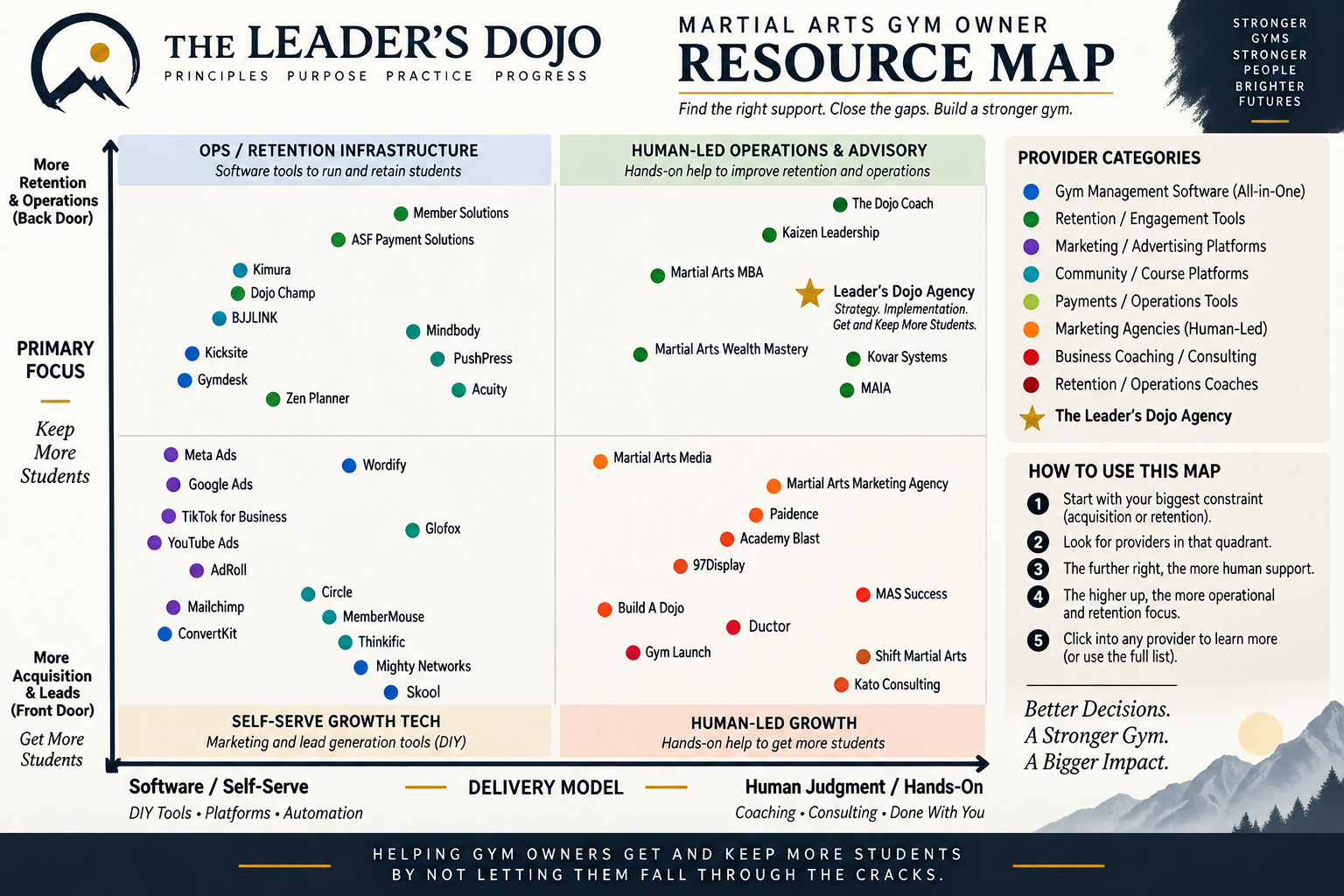
Martial arts school business resource map comparing software, marketing, coaching, and consulting solutions
If you own a martial arts school, there is no shortage of people willing to help you grow it.
There are software companies, marketing agencies, lead-generation firms, billing specialists, business coaches, consultants, CRM platforms, web designers, retention tools, sales trainers, and probably several people sitting in your inbox right now telling you they have finally cracked the system that solves everything.
The problem is not that there are too few options.
The problem is that there are so many options that it can become difficult to tell which kind of help actually fits the problem in front of you, especially when every provider naturally explains the problem through the lens of the thing they sell.
That distinction matters because there is no universally best solution for a martial arts school without first understanding the problem the school is actually trying to solve.
I started mapping the martial arts business-services landscape for exactly that reason.
I was not trying to figure out who The Leader’s Dojo needed to beat; I wanted to understand the landscape well enough that, when I am talking with a gym owner and realize I am not the right person to help, I can point them toward somebody who may be.
Depending on your problem, The Leader’s Dojo may not be the answer, and I think that is worth saying plainly.
“I Need More Students” Is Usually Not the Real Problem
Imagine a gym owner tells me, “I need more students,” because although that sounds like a clear business problem, it can actually describe a dozen very different situations requiring very different kinds of help.
Maybe nobody in the neighborhood knows the school exists, which would point toward a visibility problem.
Maybe plenty of people visit the website but almost nobody requests a trial, which is closer to a conversion problem.
Maybe leads arrive consistently, but nobody responds until the next afternoon, which makes the problem operational rather than promotional.
The same phrase could also mean prospects book introductory classes but fail to show, students attend a trial and never enroll, new members disappear during their first few months, payments fail and nobody follows up, or the entire business depends on the owner personally remembering and handling everything.
Those are different problems occurring at different points in the student journey, so it would be strange to assume that the same provider, software platform, marketing campaign, or coaching program should solve all of them.
This is why I increasingly believe that shopping for solutions before identifying the problem is backwards, because a powerful tool aimed at the wrong constraint is still the wrong tool.
Two Questions Make the Landscape Much Easier to Understand
As I researched the companies serving martial arts school owners, the market became easier to understand when I stopped thinking primarily in terms of companies and began thinking in terms of two questions.
The first question is where the problem lives?
Does the school primarily need help at the front door of the business, meaning awareness, leads, trials, bookings, and enrollments, or does the problem live farther inside the school, meaning onboarding, attendance, billing, retention, staff execution, student experience, and the operating processes that keep people from falling through the cracks?
The second question is what kind of help the owner actually needs?
Does the owner mainly need software and automation to make an existing process easier to manage, or does the situation require human judgment, diagnosis, coaching, or hands-on implementation?
Those two questions create a useful map because they shift the conversation away from “Who is the best company?” and toward the much more useful question of “What kind of help fits this particular problem?”
Sometimes the Right Answer Is Better Software
Some martial arts schools are still running important parts of the business through spreadsheets, text messages, notebooks, memory, and disconnected tools that were never designed to work together, which means the owner may be fighting an infrastructure problem before they ever reach a strategy problem.
Platforms such as Kicksite and Gymdesk are designed around martial arts and gym management, including areas such as member records, billing, attendance, scheduling, rank progression, communication, and lead management.
If the real problem is that information is scattered everywhere and nobody can consistently see what is happening, then improving the underlying software may create more value than hiring someone to diagnose a business process the owner cannot yet measure reliably.
The point is not that software solves everything; the point is that sometimes software really is the correct tool for the job, and paying for something more complicated would simply add cost before fixing the foundation.
Sometimes the School Needs More People Through the Front Door
Another part of the market focuses primarily on marketing, visibility, websites, advertising, lead generation, and turning online attention into actual conversations with prospective students.
Companies such as 97Display and Academy Blast work heavily in this part of the ecosystem, helping martial arts schools improve areas such as websites, search visibility, advertising, lead follow-up, CRM automation, and trial booking.
If a school delivers an excellent student experience, retains members well, follows up consistently, and converts trials effectively but simply does not have enough qualified people discovering the academy, then a marketing specialist may be exactly what that owner needs.
In that situation, paying somebody to redesign the retention process would be solving the wrong problem, even if that retention expert happens to be excellent at what they do.
Sometimes the Real Problem Is Revenue Recovery
There is another category that deserves to be treated separately because the expertise is much more specialized and the financial consequences can be unusually direct.
If a school is losing meaningful revenue every month through failed payments, expired cards, billing issues, chargebacks, or inconsistent collections, then the school may be dealing with a billing and revenue-recovery problem rather than a marketing or retention problem.
Companies such as Member Solutions and ASF Payment Solutions specialize in areas of membership billing, payment processing, account management, and revenue recovery for gyms and martial arts schools.
If that is where the money is leaking, I would much rather tell an owner to speak with a company that spends every day solving those problems than pretend The Leader’s Dojo should become the expert in something outside our lane.
Sending someone toward the right specialist is not losing a client; it is helping an owner choose the right tool for the job they actually need done.
Sometimes the Entire Business Needs a Broader Operating System
There are also martial arts business organizations that work across a much wider range of problems, including student acquisition, retention, staff development, leadership, operations, profitability, and long-term business growth.
Kovar Systems, for example, operates much more broadly across the martial arts business than a company focused primarily on one tool or one part of the customer journey.
For an owner whose real problem sounds more like, “My entire business needs to become more professional, I need stronger systems, and I want ongoing coaching across several areas,” a comprehensive coaching organization may make far more sense than a narrow diagnostic engagement.
That does not make one model better than another, because the scope of the problem should influence the scope of the help.
Where Is The Leader’s Dojo’s Fit
The Leader’s Dojo is not trying to replace gym-management software, become another advertising agency, handle billing, or build a giant operating system that tells every martial arts owner how to run every part of the business.
What I am currently building is much narrower and much more human.
A gym owner knows something is not working, but the problem is not yet clear enough to know which tool or intervention makes sense.
Prospects may be falling through the cracks, trials may not be showing, new students may be disappearing, staff may not be following the agreed process, or the owner may simply have a persistent feeling that the business should be performing better without knowing exactly where the breakdown occurs.
That is The Leader’s Dojo will be useful.
The working approach is intentionally bounded: find one commercially important constraint, understand what is actually happening, identify where the process breaks, install one reasonable repair, create one simple scoreboard, and then let the evidence tell us what changed.
Sometimes that process may reveal that the owner needs different software, while another school may need a better marketing partner, a billing specialist, or a broader business coach.
Sometimes there may not be enough evidence yet to recommend anything confidently, which is also useful to know before spending money.
And sometimes the problem may be exactly the kind of problem The Leader’s Dojo can help the owner work through.
That is the role I want to earn: not being the answer to everything, but becoming useful enough to help an owner figure out what kind of answer the situation actually requires.
The Martial Arts Gym Owner Resource Map
To make the landscape easier to navigate, I built a resource map of companies serving martial arts schools.
The map is not a ranking, and it does not claim that one provider is better than another. Where a company appears reflects my interpretation of how that provider publicly positions its services, and the goal is simply to help owners understand the different kinds of help available.
The map looks at providers through the same two questions discussed in this article: where in the business does the provider primarily help, and how much of the solution depends on software versus human judgment and implementation?
Some of the companies on the map compete with one another, some overlap, some solve completely different problems, and some may eventually become useful referral partners for The Leader’s Dojo, which is exactly why I want them represented on the same map.
Some of the many businesses and services that can help you grow your gym
The resource map is intended as a navigation aid rather than an endorsement, ranking, or independent academic market study. The Leader’s Dojo appears on the map as one of the providers, and all placements reflect my interpretation of publicly available information. Owners should speak directly with any provider they are considering and perform their own due diligence before making a purchasing decision.
Before You Buy Anything, Get Clear About What Is Actually Happening
Before hiring another consultant, buying another software platform, changing the website, increasing ad spend, or signing up for another business program, I think a gym owner should be able to answer a few basic questions.
What is happening right now that you wish were not happening, and where in the student journey does it occur?
How often does the problem happen, and what evidence tells you that it is actually important rather than merely annoying or noticeable?
What have you already tried, and what happened when you tried it?
Is the problem primarily visibility, lead generation, follow-up, booking, show rate, enrollment, onboarding, attendance, retention, billing, staff execution, leadership, or something else entirely?
Do you need a better tool, a specialist, broader coaching, or somebody to help you diagnose the problem before choosing a solution?
Those questions are not complicated, but answering them honestly can prevent a great deal of wasted time, money, and energy.
Walking into the market asking, “What is the best business solution for a martial arts school?” is a little like walking into a hardware store and asking, “What is the best tool?”
There is no useful answer until somebody knows what you are trying to build or repair, because a hammer is an excellent tool when you need a hammer and a terrible substitute when the job actually requires a screwdriver.
This Map Should Keep Changing
This is an early version of the resource map, and I expect it to evolve as companies change their services, new providers enter the market, others disappear, categories overlap, and I discover organizations that deserve to be included but are missing today.
That does not make the map a failure, because it simply means the market itself is alive.
I would actually like gym owners, coaches, consultants, software companies, and other service providers to help improve it over time. If you know a company that should be included, if I have misunderstood how a provider works, or if you believe a company belongs somewhere else on the map, tell me why.
The goal was never to create a leaderboard; the goal is to create a useful navigation tool that helps martial arts school owners match the right kind of help to the problem they actually have.
Start With the Problem, Then Choose the Tool
There is no universally best software platform, marketing company, consultant, coach, or operating system for every martial arts school, because there is only a better or worse fit between the problem you actually have and the help you choose to address it.
Before buying another tool or hiring another expert, spend enough time understanding what is really happening inside the business.
If you already know the problem, the resource map may help you identify the category of provider worth exploring. If you do not yet know what the problem is, then diagnosis itself becomes the first job.
That is the part of this work I am increasingly interested in, because getting the diagnosis right before choosing the solution may be one of the highest-leverage decisions a martial arts school owner can make.
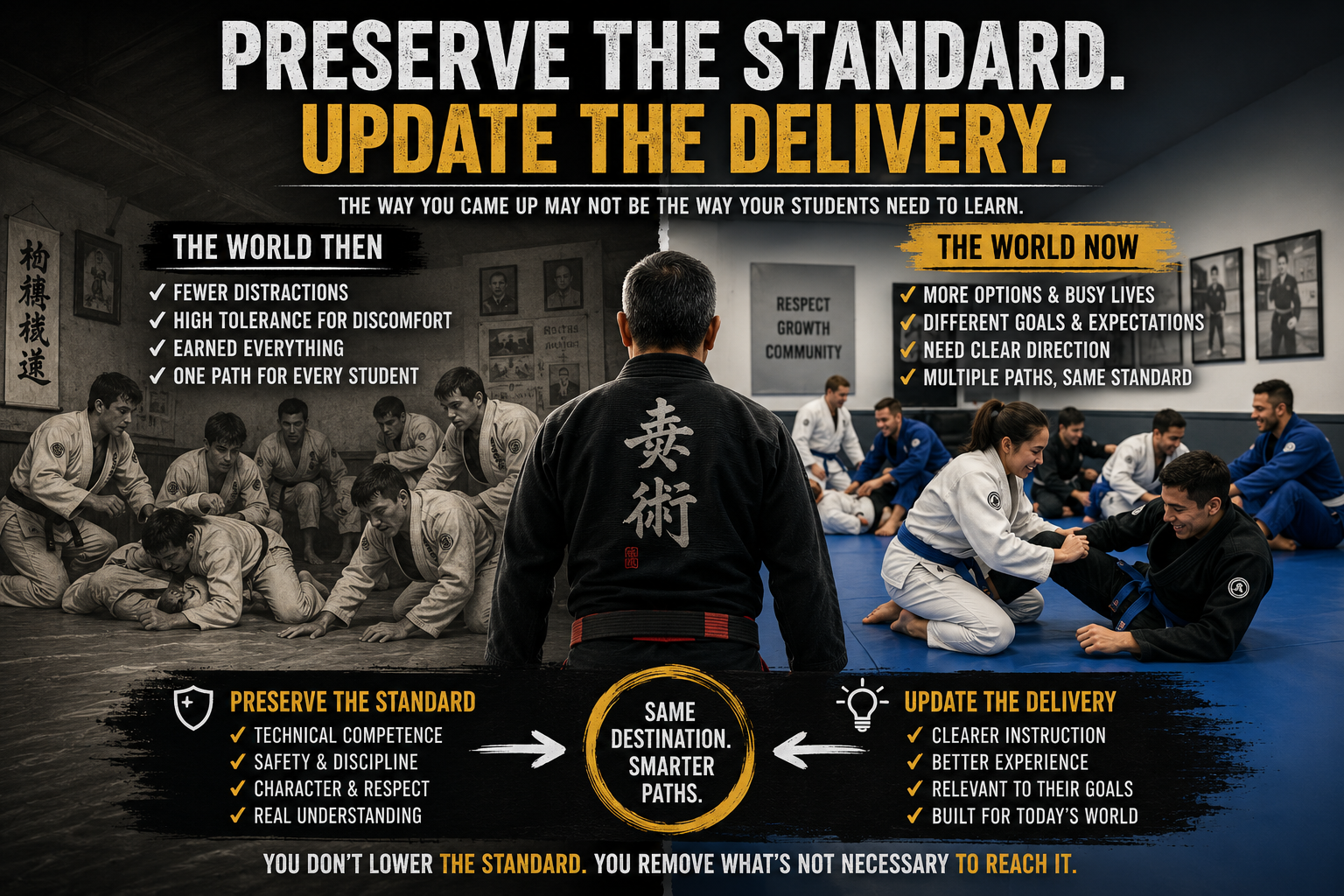
Preserve the Standard. Update the Delivery.
Strong martial arts standards and modern teaching methods are not opposites. The goal is to preserve technical competence, discipline, safety, and character while removing unnecessary friction from the learning process.
When you have been in martial arts long enough, you start hearing some version of this:
“Students today are different.”
Usually it is not meant as a compliment.
They are softer.
They do not want to train as hard.
They do not have the discipline.
They want everything handed to them.
They do not understand what we had to go through.
Sometimes there is truth buried inside those complaints.
But there is also a dangerous assumption:
Because this is how I came up, this must be how everybody else needs to come up too.
I am not convinced that is true.
And I think martial-arts school owners need to be very careful about confusing the way they were developed with the actual standard they are trying to preserve.
The Fearsome Foursome
Grandmaster Han had four early students, senior instructors that we called the Fearsome Foursome:
Eric Friske
Mark Gannon
Richard Carpenter
Danny Cruz
They started training with him in the 1970s and became the first group of students who went all the way from white belt to first dan (and beyond) under him.
They stayed connected with Grand Master Han for decades, through his passing in 2007.
These guys were badass.
And I used to ask them about it.
“What was training like back then?”
How hard was Grand Master Han on you?
How hard did you train with each other?
What did you have to do to get promoted?
What was the dojo like?
From everything I heard, they trained hard.
Very hard.
Grand Master Han demanded a lot from them.
They demanded a lot from each other.
And that environment helped forge some extremely capable martial artists.
It would be easy to look at them and conclude:
“That is the formula.”
If it created these guys, that is how we should train everybody.
But I think that misses something.
The World They Trained In Has Changed
Those students came through martial arts in the 1970s.
The culture was different.
The expectations were different.
The marketplace was different.
The reasons people walked into martial-arts schools were different.
What people tolerated from teachers was different.
How people spent their free time was different.
What alternatives they had were different.
Even what people expected from a business was different.
That does not mean modern students are better.
It does not mean they are worse.
It means they are different.
And if you run a martial arts school today, you are not teaching students in 1975.
You are teaching the person standing in front of you now.
Grand Master Han Faced the Same Conflict
I remember Grandmaster Han sometimes lamenting how successful some larger martial-arts organizations had become compared with his International Hapkido Federation.
They had figured out a model that could expand.
They could build large schools with lots of students and lots of instructors.
And I would remind him of the other side of that decision.
He did not want to water down his art.
He did not want to become a belt factory.
He cared deeply about what one of his promotions meant.
He could look at the instructors he promoted and feel proud of the standard behind those belts.
That mattered.
And I respected him for it.
But there is a real business tension buried inside that story.
If your standards are so difficult, your culture so rigid, or your training environment so demanding that very few people can or want to participate, you may preserve something extraordinary.
You may also struggle to keep the doors open.
On the other hand, if you change everything simply because it makes selling memberships easier, eventually the thing you are selling may stop meaning anything.
Neither extreme solves the problem.
The Question Is Not “Hard or Easy?”
I think gym owners sometimes frame this as:
Hard training versus easy training.
Old school versus modern.
Standards versus money.
That is too simple.
A better question is:
What actually needs to remain difficult?
Learning timing may be difficult.
Developing judgment may be difficult.
Building real technique may require thousands of repetitions.
Learning how to stay calm under pressure may take years.
Becoming a trustworthy training partner takes maturity.
You cannot shortcut those things just because a customer would prefer them to be easier.
But other things may simply be artifacts of how you learned.
Did the beginner really need to be embarrassed?
Did they need to train injured?
Did nobody need to explain why they were doing something?
Did instructors need to act mysterious?
Did every student need to compete?
Did every student need to train with the same intensity?
Did a student need to spend years guessing what the instructor wanted before someone finally explained it?
Maybe some of those things built toughness.
Maybe some of them simply made learning harder than it needed to be.
Those are not the same thing.
Do Not Confuse Friction With Value
This happens outside martial arts too.
People sometimes become proud of the difficulty they survived.
“I had to figure it out myself.”
“Nobody helped me.”
“We used to work twelve-hour days.”
“We trained until somebody could not stand up.”
Then the suffering itself becomes evidence of legitimacy.
But if you can create the same capability — or better — with less unnecessary friction, why would you not?
The goal of a martial-arts instructor is not to reproduce your suffering.
The goal is to reproduce the capability the useful parts of that suffering produced.
That is a very different standard.
Standards and Methods Are Not the Same Thing
This may be the most important distinction in the whole article.
A standard answers:
What must eventually be true?
A method answers:
How are we going to help this particular student get there?
Suppose your standard for a blue belt is that the student demonstrates:
dependable fundamentals;
safe training habits;
basic positional understanding;
composure under resistance;
responsibility toward training partners;
enough technical skill to handle appropriate live training.
Great.
Those standards can remain demanding.
But does every student have to acquire them through exactly the same class structure?
The same intensity?
The same coaching style?
The same timeline?
The same competitive experience?
The same physical punishment?
Probably not.
Consistency of outcome does not require identical experience.
Meet the Student Where They Are
This is where the business side and teaching side collide.
Your student probably does not want to open a martial arts school.
They may not want what you wanted.
One person wants to compete.
Another wants to lose thirty pounds.
Another wants to feel safer walking to their car at night.
Another wants confidence.
Another wants a healthy hobby.
Another wants friends.
Another wants something meaningful to do with their child.
Another is fascinated with mastery and wants to train for twenty years.
Those people can all train in the same art.
They do not necessarily need the same journey.
A common owner mistake is assuming:
“If you truly understood martial arts, you would eventually want what I want.”
Maybe not.
Your job is not necessarily to turn every student into a version of you.
Your job is to understand:
Where are they trying to go?
And then ask:
How can this art genuinely help them get there without violating the standards that make the art worth teaching?
You Are the Guide, Not the Hero
In a good story, the guide does not steal the journey.
Gandalf does not decide Frodo’s life should become Gandalf’s life.
The guide has experience.
The guide sees things the student cannot yet see.
The guide challenges them.
The guide sometimes tells them something they do not want to hear.
But the journey still belongs to the person taking it.
That is an important distinction for gym owners.
Your students are not joining your school so they can recreate your martial-arts biography.
You are helping them use martial arts to build theirs.
Your Best Students Can Become Your Biggest Blind Spot
This one is worth sitting with.
The students who survived your traditional system are the ones still standing in front of you.
Of course they think it worked.
They survived it.
That can create selection bias.
What about everyone who left?
Maybe some should have left.
Not everybody belongs in every dojo.
But did some potentially excellent long-term students disappear because the environment demanded things that had little to do with actually learning the art?
If twenty people start and two become extraordinary black belts, you can reasonably be proud of those two.
But as a business owner and teacher, you should also be curious about the other eighteen.
Were they incapable of learning?
Or was there unnecessary friction in the way you were teaching?
That is not watering down the standard.
That is questioning the process.
Market Adaptation Is Not Automatically Selling Out
Martial artists can get uncomfortable talking about customers.
They prefer students.
I understand that.
But if someone pays you money every month to receive instruction, they are also a customer.
And customers have alternatives.
You can dislike that reality.
It remains reality.
Adapting does not mean:
“Give people whatever they want.”
That would be irresponsible.
If a student wants a black belt after six months, the answer can be no.
If they want to spar dangerously, the answer can be no.
If they want promotion without competence, the answer can be no.
If they want you to compromise the art, the answer can be no.
But if they want:
clearer instruction;
more predictable coaching;
a healthier training environment;
different intensity levels;
better onboarding;
more explanation;
a path that fits being a forty-five-year-old hobbyist rather than a twenty-two-year-old competitor;
that may not be watering down anything.
That may simply be better teaching.
An Owner Self-Audit
Answer honestly.
Not the version you want to be true.
The version your students and your retention numbers would confirm.
1. What standards are genuinely non-negotiable?
Can you clearly name them?
Or have standards and traditions blurred together?
2. Which parts of your training exist because they produce capability?
And which exist primarily because:
“That is how my instructor did it.”
3. Are you teaching the student in front of you — or the younger version of yourself?
Your students are not you.
Their reasons for training are not necessarily your reasons.
4. Do you know why your students actually train?
Have you asked?
Not why you want them to train.
Why they showed up.
5. Does your program allow different students to pursue different legitimate goals?
Competition
Fitness
Self-defense
Mastery
Community
Confidence
Healthy recreation
Can they all find a home here?
6. Where does unnecessary friction exist?
Confusing onboarding
Unclear expectations
A needlessly intimidating culture
Inconsistent instruction
Training intensity that fits only one type of student
7. When someone quits, do you automatically assume they were not tough enough?
Or do you investigate whether the environment failed them?
8. Are your instructors evaluated on how closely they imitate you?
Or on whether they produce safe, capable, engaged students while maintaining the school’s standards?
9. What have you changed in the last ten years because your students changed?
If the answer is nothing, is that discipline —
or rigidity?
10. What would you refuse to change even if it cost you money?
That answer may reveal the actual soul of your school.
Protect that.
But be honest about what the rest is.
Preserve the Art. Update the Delivery.
Grand Master Han gave me something extraordinary.
Part of why it meant so much was that he refused to treat rank casually.
The people he promoted represented him.
The standard mattered.
I would never want martial arts schools to abandon that simply because a looser standard might be easier to sell.
But I also do not think honoring our teachers means freezing the world at the moment they taught us.
Every generation inherits something.
Then it has to decide:
what is essential;
what deserves protection;
what needs adaptation;
what can be improved;
what was simply the best answer available at the time.
The Fearsome Foursome became extraordinary martial artists through the environment Grand Master Han created in the 1970s.
That history deserves respect.
But your students are walking into your school today.
Your responsibility is not to recreate the 1970s.
It is to create the conditions in which the students standing in front of you can become capable martial artists now.
Hold onto the standard.
Hold onto the integrity.
Hold onto what makes your art worth preserving.
But do not confuse preservation with repetition.
Preserve the standard.
Keep improving the way you help people reach it.
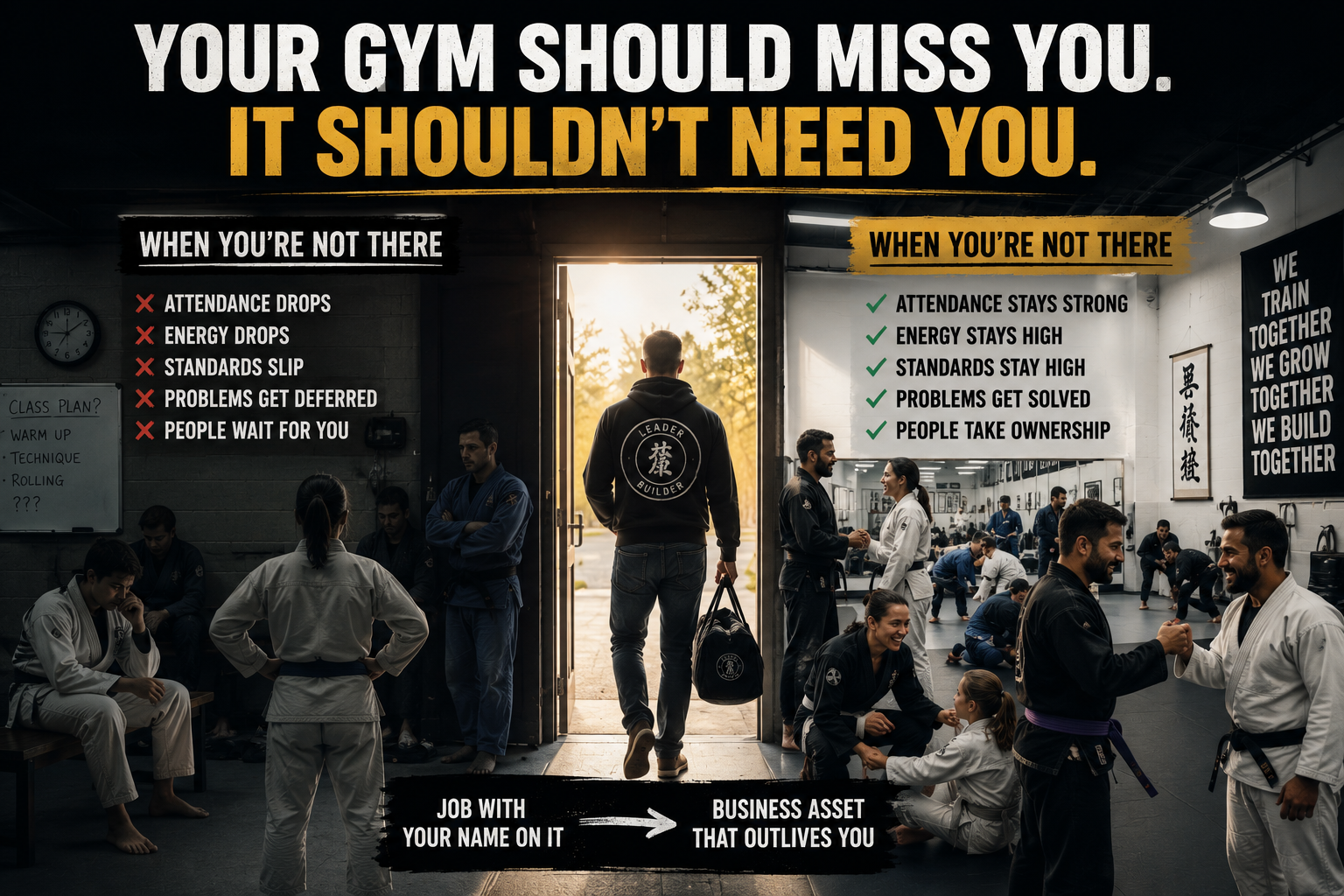
Your Gym Should Miss You. It Shouldn’t Need You.
Being valuable to your gym is not the same as being required for its routine functioning. A durable martial arts business develops instructors, standards, culture, and systems that continue working when the owner leaves the room.
A lot of martial-arts gym owners tell me some version of the same thing:
“When I’m not there, the gym goes down.”
Attendance drops.
Energy drops.
Students ask when the owner is teaching again.
Staff members seem less engaged.
Little problems stop getting handled.
And eventually the owner starts feeling something dangerous:
“I always need to be there.”
At first, that can even feel flattering.
You are the founder.
You built the place.
You know the students.
You are probably the most experienced instructor.
You may be the best teacher.
Maybe you are the most charismatic person in the room.
People may have joined because they wanted to learn from you.
Of course things are different when you are gone.
But there is a line where that stops being a compliment.
If the gym repeatedly loses momentum whenever you leave, the issue is no longer just:
“My students really like me.”
It may be:
“I have built an organization that does not know how to function without me.”
And that is a very different problem.
I Had to Learn This on Construction Sites
Before I ever thought about building a consulting business for martial-arts gym owners, I spent decades in construction.
I ran electrical crews on large commercial and industrial projects.
These were not simple jobs.
They were fast-moving.
Complex.
Constantly changing.
On major projects, one delay could create problems for multiple trades.
Plans changed.
Materials did not arrive.
Other contractors got in the way.
Inspections changed priorities.
Something that looked simple on Monday could become a completely different problem by Wednesday.
And I had another priority that mattered just as much:
I did not want my career to destroy my marriage.
I had watched too many men allow work to consume everything.
The job always needed one more hour.
One more Saturday.
One more emergency.
One more project.
Then one day they looked around and the family they said they were working for was gone.
I did not want that life.
Amy and I were taking three-week trips once or twice a year.
If I wanted to keep doing that, I needed to be able to leave a complicated job site for three weeks without spending the entire vacation wondering what was falling apart back home.
That meant I had a leadership problem to solve:
How do I build a crew that can keep moving when I am not standing there telling everybody what to do?
Teaching a Crew Was Not That Different From Teaching on the Mat
Eventually, I started seeing similarities between teaching martial arts and developing a construction crew.
When you teach a martial-arts class, your goal cannot simply be:
“Everybody does exactly what I tell them while I am watching.”
You want students to learn how to train.
They need to understand the standards.
They need to know how to practice safely.
They need to take care of their training partners.
They need to help each other learn.
They need enough understanding that they can perform reps without the instructor correcting every movement.
If the instructor has to stand over every pair for the entire class, something is wrong.
Developing my electrical crews worked the same way.
I had to give people ownership.
Not pretend ownership.
Real ownership.
When someone had a project, I wanted them to understand:
This is yours.
Do not slough it off onto somebody else the second it becomes inconvenient.
Figure out what you can figure out.
Ask intelligent questions when you genuinely need help.
Know what the next step is.
And help the other people on the crew do the same.
Give People More Than One Thing to Do
One of the practical things I learned was never to leave somebody with only one possible task.
Construction does not work that way.
A worker might be installing something and suddenly discover:
another trade has blocked access;
material has not arrived;
a drawing needs clarification;
an inspection has not happened;
another task has to finish first.
If that person only knows one assignment, the work stops.
Then you get somebody standing around waiting for the boss.
So I wanted my guys to know:
If this gets blocked, here are the other things you can move to.
There was always productive work available.
Before I left for a trip, I would deliberately give the crew more work than I expected them to complete.
Not because I expected them to kill themselves trying to finish everything.
The point was the opposite.
I wanted them to have enough direction and enough options that nobody ever had to say:
“I didn’t know what to do because Chuck wasn’t here.”
If the big boss walked onto the job while I was away, I did not want him seeing six electricians standing around waiting for me to come back from vacation.
They had projects.
They had priorities.
They had standards.
They knew what good work looked like.
And they knew they were expected to think.
Culture Is What Happens When You Are Not There
That may be one of the simplest definitions of culture I know:
Culture is what your people do when the boss is not standing in the room.
Anybody can behave correctly while the owner is watching.
The real question is:
What happens when you leave?
Do your instructors still start on time?
Do they still greet beginners?
Do they know how students should be treated?
Do they maintain your safety standards?
Do they teach within the school’s philosophy?
Do they notice when someone looks lost?
Do they take responsibility for problems?
Do they help each other?
Or does everything subtly relax because:
“The owner isn’t here today.”
That is culture.
Not the values statement hanging on the wall.
Not your Instagram captions.
Not the speech you give during promotions.
What people repeatedly do when you are absent.
Is Your Culture Explicit — or Just Implied?
This is where I think a lot of small gym owners get caught.
The owner has been doing everything for so long that the standards seem obvious.
Of course we greet new students.
Of course we take care of white belts.
Of course we clean the mats properly.
Of course we do not embarrass beginners.
Of course instructors follow up when someone gets hurt.
Of course coaches communicate schedule changes.
Of course we teach students this way.
But is that actually written down?
Has it been taught?
Has it been practiced?
Has anybody been observed doing it?
Has anybody been corrected when they did not?
Or is the entire culture based on:
“They should know how I want it done.”
That is not a system.
That is mind reading.
Attendance Dropping When You Leave Is a Signal
Owners often tell me attendance drops when they are not teaching.
There are reasonable explanations for some of that.
If you are the founder and the highest-ranked instructor, some students will naturally prefer your classes.
That is normal.
If you are an exceptional teacher, people should want to train with you.
The goal is not to make yourself irrelevant.
But a major attendance drop should make you curious.
Because if students repeatedly treat every other instructor as a disappointing substitute for you, several things may be happening:
your instructors have not been developed enough;
students do not understand what each instructor brings to the room;
your culture may over-glorify the owner;
your staff may not carry consistent standards;
class quality may vary too much;
students may have built their entire relationship with the school around one person;
your systems may not create continuity when leadership changes.
That is not merely a charisma problem.
It is a systems problem.
If Your Other Instructors Bring No Value, Why Are They Teaching?
This is another uncomfortable question.
Sometimes owners unconsciously communicate:
“I am the real instructor. These people cover for me.”
Then they are surprised when students believe them.
Your assistant instructors may not have your rank.
They may not have your experience.
They may not teach exactly like you.
Good.
Why should they?
They should bring something valuable of their own.
One instructor may be exceptional with beginners.
Another may understand competition preparation.
Another may connect especially well with parents.
Another may be excellent at details.
Another may create an incredible training atmosphere.
Another may be the coach who notices the quiet student in the corner.
If your staff brings no meaningful value except keeping the doors open until you return, the problem is not that your students do not respect your instructors.
The problem is that you have not built instructors worth respecting.
And if they do bring value, part of your job as owner is to make that value visible.
Ownership Cannot Be Faked
One thing I learned on construction crews was that people know when they have real responsibility and when they are simply being told to pretend they do.
You cannot say:
“Take ownership.”
Then override every decision.
You cannot tell instructors:
“Make this your class.”
Then punish them every time they teach differently from you.
You cannot ask people to think independently and then train them to ask permission for everything.
Real ownership needs boundaries.
People need to know:
what they own;
what standards are non-negotiable;
what decisions they can make themselves;
when they should escalate something;
what a good result looks like;
what absolutely cannot happen.
Inside those boundaries, let them work.
That is how people develop judgment.
Standards Create Freedom
Some owners hear systems and imagine turning their dojo into a sterile franchise.
That is not what I am talking about.
A standard does not mean every instructor becomes a clone.
Standards actually create freedom.
On the construction site, the standard might be:
The installation must be safe, code-compliant, clean, complete, and ready for the next trade.
There may be several legitimate ways to get there.
In a martial-arts school, the standards might be:
beginners are treated with respect;
students train safely;
nobody is humiliated to make the instructor look powerful;
classes begin and end on time;
instructors understand the day’s objective;
students know what they are practicing and why;
problems are communicated rather than hidden;
the environment reflects the values of the school.
Inside those standards, instructors can still have personality.
They can still teach differently.
They can still bring their own strengths.
The goal is not sameness.
The goal is consistency where consistency matters.
Some People Will Not Fit the Culture
That is okay too.
When I ran crews, I had standards for how I expected people to work.
Take responsibility.
Do good work.
Think.
Help the team.
Do not hide from problems.
Do not make somebody else clean up your mess.
Some electricians loved that environment.
Others did not.
That was useful information.
A real culture makes it easier for people to decide:
“This is how I want to work.”
or:
“This is not for me.”
Trying to make everybody comfortable usually creates a culture nobody can clearly describe.
The Three-Week Test
Here is the test I eventually had to pass on construction projects:
Can I leave for three weeks and trust the crew to keep moving?
Not perfectly.
Not exactly as if I were there.
Not without a single question.
But:
Can the work continue?
Can problems get handled?
Can people think?
Can the standards survive?
Can leadership emerge from people other than me?
Can I spend time with my wife without constantly wondering whether the job site is on fire?
Martial-arts gym owners should probably ask themselves a similar question:
What happens if you disappear for two or three weeks?
Do classes continue?
Does attendance remain reasonably stable?
Do students still feel taken care of?
Do instructors make good decisions?
Does your staff know what matters?
Can the school solve normal problems without calling you every twenty minutes?
Can you actually enjoy the trip?
If not, that does not mean you have failed.
It means you have discovered the next thing you need to build.
You Want to Be Valuable — Not Required
There is an important distinction here.
I am not telling gym owners:
“Build a business that does not need you because you do not matter.”
Quite the opposite.
You should matter enormously.
Your judgment matters.
Your relationships matter.
Your teaching matters.
Your vision matters.
Your presence should improve the room.
Students should be happy when you are there.
But there is a difference between being valuable and being required for routine functioning.
If every class, every decision, every relationship, every problem, and every ounce of energy has to flow through you, you have created something incredibly fragile.
And sooner or later, that dependency starts limiting your choices.
Have You Built an Asset — or a Job With Your Name on It?
This is where the business question becomes unavoidable.
If your gym cannot operate successfully without you physically present, what exactly have you built?
You may own the LLC.
You may own the mats.
You may own the lease.
You may own the brand.
But operationally, you may have created:
A job with your name on it.
A real business asset should become increasingly capable of producing value beyond the direct labor of the founder.
That does not happen overnight.
And it does not mean the owner stops contributing.
But over time, the gym should accumulate things that remain when you leave the room:
standards;
capable instructors;
leadership;
relationships;
systems;
traditions;
shared expectations;
institutional knowledge;
student-to-student connection;
a recognizable way of doing things.
Those are assets.
Your charisma can help build them.
But your charisma cannot substitute for them forever.
An Owner Self-Audit
Answer honestly.
Not the version you want to be true.
The version your students and staff would describe if you were not in the room.
1. What visibly changes when I am not teaching?
Attendance?
Energy?
Class quality?
Student engagement?
Follow-up?
If you do not know the answer, that is itself useful information.
2. Can every instructor explain the standards of the school?
Not just techniques.
How do we treat people here?
Can they articulate it clearly without needing you standing next to them?
3. Are those standards written somewhere?
Or does everybody need access to the owner’s brain?
4. What decisions can my instructors make without asking me?
If the answer is almost none, they do not have much ownership.
They have a permission structure.
5. Does each instructor have a recognizable strength?
Can students explain why training with that person is valuable beyond:
“They are not the owner.”
6. What happens when something goes wrong?
Do staff solve appropriate problems?
Or do they freeze until the owner responds?
7. Do people know what to do when the original plan becomes impossible?
Do they have a bench of useful next actions?
Or does every blocked task produce a dead stop?
8. Do I routinely override people after giving them responsibility?
If so, I may be training dependence.
They learn that real decisions still route through me.
9. Can the school maintain its identity when individual staff members leave?
What survives?
If one popular instructor leaves and a large portion of the student base follows, that tells you something important about how much of their loyalty was attached to that individual rather than to the school itself.
10. Could I leave for three weeks without dreading what I will find when I return?
If not, what specific dependency makes that impossible?
Name it.
That may be your next thing to build.
The Goal Is Not to Escape Your Gym
The point is not:
Build systems so you never have to teach again.
Most martial-arts gym owners opened schools because they love the art, the students, the mat, and the community.
You may want to teach for the rest of your life.
Great.
Teach.
But there is a massive difference between:
“I am teaching tonight because this is where I want to be.”
and:
“I have to teach tonight because everything goes downhill if I don’t.”
One is choice.
The other is dependency.
And over time, dependency can turn something you love into something you resent.
Build Something That Can Carry Your Values Without Carrying Your Body
A mature martial-arts school should become capable of carrying more and more of the founder’s values without requiring the founder’s physical presence every hour of every day.
That is what leadership development does.
That is what culture does.
That is what systems do.
Your instructors should not become copies of you.
Your staff should not become robots.
Your students should not stop caring whether you show up.
The goal is much simpler:
When you leave the room, the standards stay.
The culture stays.
The care stays.
The training stays.
The relationships stay.
The work keeps moving.
Then when you come back, you are not walking into something you rescued.
You are walking back into something you built.

Are You Really Building Community — or Are You Just Convenient?
Your students may like your instructors, schedule, and facility—but what would they actually feel they were losing if they left? That difference separates a convenient martial arts gym from a community that feels like home.
Almost every martial-arts school says some version of the same thing.
“We’re a family.”
“We have an amazing community.”
“Come train with your new best friends.”
Sometimes that is true.
A lot of the time, I am not sure it is.
Sometimes what we call community is really just convenience with friendly people attached to it.
The school is close.
The class is at the right time.
The instructor is good.
The price works.
You know a few names.
People smile when you walk through the door.
That is all good.
But is that community?
I learned the difference because I have experienced both.
What Twenty Years in One Dojo Taught Me
For roughly twenty years, Grandmaster Han’s International Hapkido Federation was not simply a place where I trained.
It felt like home.
And I do not mean everything was easy.
Far from it.
There were training plateaus.
There were instructors I sometimes struggled with.
There were fellow students I did not always get along with.
There were frustrations.
There were injuries.
At one point, I took a hit that ruptured my spleen and put me in the ER and ICU.
None of that means unsafe training, bad coaching, or unhealthy relationships should simply be tolerated.
But even through the normal difficulties that come with years of training, the idea of leaving the IHF barely registered as an option.
I came back.
Not because the training was always comfortable.
Not because everybody was my best friend.
Not because every class was amazing.
I came back because I belonged there.
That school had become part of the structure of my life.
In some ways, it literally anchored me to West Los Angeles.
When I was an electrical apprentice in the early 1990s, other apprentices talked about going to Kuwait because there was serious money to be made.
Other electricians would tramp around the country, going wherever the work was hot when things slowed down at home.
There were legitimate reasons I could have left Los Angeles.
But leaving LA also meant leaving my Hapkido family.
And I could not really imagine doing that.
That is what community can do.
It creates gravity.
Not captivity.
Not dependency.
Gravity.
There is something there that you do not casually replace just because somebody down the street has a nicer schedule.
The Problem With Convenience
I have trained at other gyms since then.
Some of them were good gyms.
Some had talented instructors.
Some had good facilities.
Some had people I genuinely liked.
I have even stayed at some for extended periods.
But none never became home.
They were places where I trained because they were convenient.
And convenience is fragile.
If the schedule stops working, you leave.
If your favorite instructor leaves, you reconsider.
If the coaching becomes inconsistent, you reconsider.
If another school opens closer to home, you reconsider.
If the environment keeps changing, eventually you ask:
“Why am I still here?”
That is very different from:
“This is where I belong.”
I have noticed this contrast especially strongly in BJJ.
One of the challenges I have experienced is the roller coaster that can happen when instructors, coaching styles, staff, schedules, expectations, or training environments keep changing.
One month things feel settled.
Then something shifts.
A coach leaves.
Another instructor takes over.
The training emphasis changes.
The people you regularly see disappear.
New people arrive.
Then they disappear.
The staff changes.
The rhythm changes.
Eventually, students can begin behaving the same way.
They revolve too.
That should not surprise us.
If the environment repeatedly communicates:
“People come and go around here,”
students may begin to learn:
“Then I can come and go too.”
The revolving door can become cultural.
And the owner may still look around the room and say:
“We have such a great community.”
Maybe.
But if the relationships, rituals, coaching environment, leadership, standards, and sense of belonging are not durable enough to survive inconvenience or change, you may have something much thinner than community.
Friendly Is Not the Same as Community
A gym can be extremely friendly without having strong community.
Your front desk can know everyone’s name.
People can laugh before class.
Members can follow each other on Instagram.
You can have a BBQ outside the gym.
You can take a big group photo after promotions.
Those things can support community.
They are not proof of it.
Community starts showing itself when things become inconvenient.
A student’s schedule changes.
They get injured.
They hit a training plateau.
Their favorite training partner disappears.
They get frustrated.
They are not progressing as quickly as they hoped.
Money gets tight.
They have a disagreement with someone.
Their favorite instructor leaves.
Another gym opens ten minutes closer.
What happens then?
If the only glue holding them to you was convenience, convenience will eventually lose.
The Question Is Not “Do They Like Us?”
A better question may be:
What would this person feel they were losing if they left?
Would they lose a room with mats in it?
Or would they lose relationships?
Would they lose an instructor?
Or would they lose mentors who know their story?
Would they lose classes?
Or would they lose a place where people notice when they disappear?
Would they lose workouts?
Or would they lose a meaningful part of their identity and weekly life?
That is different.
Grand Master Han’s school was not interchangeable to me.
There may have been other martial-arts schools.
There may have been different instructors.
There may even have been easier or more convenient options.
But they were not my dojo.
That is the distinction.
Community Is Built Through Consistency
I do not think owners create community by telling people they are a family.
They create it through hundreds of repeated experiences.
Ask yourself:
Who greets the beginner?
Who notices when someone has not trained for two weeks?
Does the coaching environment feel stable?
Do students know what the school stands for?
Are instructors reinforcing the same standards or contradicting one another?
Do longtime students have meaningful roles?
Do beginners have people helping them become part of the room?
Do students form relationships that extend beyond their transactional relationship with the owner?
Are there rituals people recognize?
Are there stories everybody knows?
Are there shared experiences people remember years later?
Can members contribute something back?
Does somebody care when they disappear?
That is community.
And none of those require pretending everyone is best friends.
My Hapkido family included people who annoyed me.
That is what families do.
Belonging does not mean constant harmony.
In fact, one sign of real community may be that people can go through conflict, frustration, disappointment, and change without immediately deciding the relationship is disposable.
Your Staff May Be Teaching Students Whether the Gym Is Permanent
This is an uncomfortable one.
If your instructors are constantly changing, your students notice.
If every coach creates a completely different experience, they notice.
If policies change depending on who is working, they notice.
If the front desk turns over constantly, they notice.
If nobody seems to know what happened to the instructor who disappeared last month, they notice.
If leadership feels temporary, students may begin treating membership as temporary too.
You cannot demand loyalty from your students while modeling instability from the organization.
That does not mean employees can never leave.
Of course they will.
Life changes.
People move.
Businesses evolve.
But the environment itself has to remain recognizable even as individuals change.
The student should still know:
This is who we are.
This is how we treat people.
This is how we train.
This is what matters here.
This is my place.
The Convenience Test
Gym owners could probably learn a lot by asking themselves one uncomfortable question:
If a competent competitor opened five minutes closer to every one of my students tomorrow, what would keep them here?
Not what should keep them.
What actually would?
If the answer is:
“Our instructors are better.”
“Our mats are nicer.”
“We have more classes.”
“Our prices are competitive.”
Those are advantages.
But they are vulnerable advantages.
Someone can build a nicer gym.
Hire another black belt.
Add another class.
Run a promotion.
Undercut your price.
Community is harder to copy.
Twenty years of shared history cannot be copied next month.
Trust cannot be installed over a weekend.
Relationships cannot be purchased with Facebook ads.
Belonging does not arrive because you painted “OHANA” on the wall.
How Do You Know If You Actually Have It?
Here is a self-audit.
Answer honestly.
Not the version you want to be true.
The version your students would describe if you were not in the room.
1. What happens when a student disappears?
Does anyone know?
Does anyone reach out?
Does anyone genuinely care, or does the absence just quietly close in the schedule?
2. Do students build relationships with each other, or only with the instructor?
If every relationship routes through the owner, that may be an audience more than a community.
3. Can the environment survive a staff change?
If one popular instructor leaves and twenty students follow, what did those students actually belong to?
4. Do members contribute?
Do experienced students help beginners?
Welcome people?
Organize things?
Share knowledge?
Support each other outside of class?
5. Are there shared rituals, stories, and standards?
Does the gym have recognizable traditions and ways of behaving that connect different generations of students?
6. Can your people survive conflict?
If every interpersonal problem results in somebody disappearing, belonging may be shallow.
7. Do students identify with the school beyond their transaction?
Do they say:
“The gym I train at.”
Or does it feel more like:
“My dojo.”
“My team.”
“My people.”
8. Would students stay through reasonable inconvenience?
A worse commute.
A temporary schedule problem.
An injury.
A training plateau.
A new competitor.
9. Does leadership provide continuity?
Even when individual employees change, does the school still feel like the same school?
10. What would a five-year member say they received besides martial-arts instruction?
Their answer may tell you whether you have built community or merely sold classes.
Community Is Not a Retention Hack
I need to be explicit about this.
I am not suggesting you manufacture “family” because it improves lifetime customer value.
Students can smell fake belonging.
Community cannot merely be a churn-reduction strategy.
It has to be a genuine consequence of how you choose to run the school.
But if you genuinely create a place where people belong, retention often becomes a natural side effect.
Because when somebody thinks about leaving, they are no longer comparing:
$179 versus $199.
Three classes versus five.
Ten minutes versus twenty.
They are deciding whether they want to leave part of their life behind.
That is a completely different decision.
The Owner’s Real Job
Maybe one of the deeper jobs of a martial-arts school owner is not simply:
Teach martial arts.
It is:
Create an environment where people can practice martial arts long enough for the art — and the people around it — to become part of their lives.
Grand Master Han did that for me.
I stayed through injuries.
I stayed through frustration.
I stayed through training plateaus.
I stayed through personalities I did not always enjoy.
I stayed when other opportunities could have pulled me somewhere else.
Not because I felt trapped.
Because I felt rooted.
There is a world of difference between the two.
So when you tell prospects that your gym is a community or a family, ask yourself:
If you removed the convenience, would they still feel like this was home?
If the answer is yes, protect that fiercely.
If you are not sure, do not put another “family” slogan on the wall.
Start building something worth belonging to.
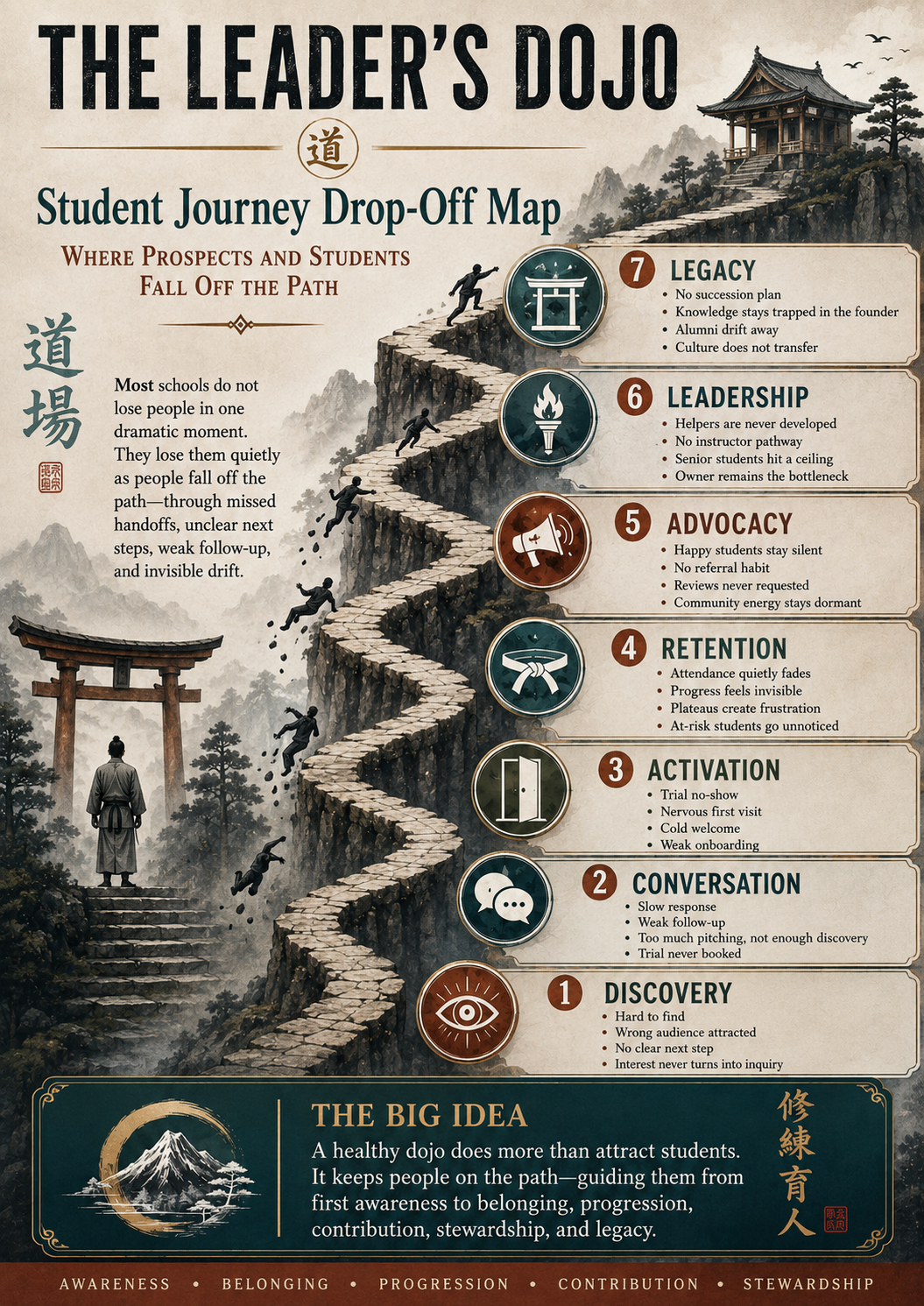
Stop Building a White-Belt Factory
If your martial-arts school is always chasing more leads but still feels thin, overworked, and dependent on the owner, the problem may not be acquisition.
It may be where students keep falling off the path from beginner to committed student, leader, and eventual steward of the school.
Why more leads won’t fix a school that keeps losing people on the way from beginner to leader.
If you run a martial-arts school and something feels off, there’s a good chance you’ve already diagnosed the problem as:
I need more leads.
More Facebook ads
More Google traffic
More trial students
More people walking through the front door
And sometimes that’s right.
If nobody knows you exist, acquisition is absolutely your constraint.
You cannot retain people who never walked in.
But I keep talking to gym owners who have a different problem hiding underneath the one they named.
They are getting people through the door.
They just are not keeping enough of them moving up the mountain.
And then they wonder why the owner is exhausted, the staff is stretched thin, the culture feels weaker than it used to be, and there never seem to be enough senior students around to help carry the school.
They keep pouring more people into the bottom.
But people keep falling off the path.
So they pour even more.
That can create what I think of as:
The White-Belt Factory
Lots of beginners.
Lots of trials.
Lots of onboarding.
Lots of repeating the same basic explanations.
Lots of hand-holding.
Lots of people who need attention.
Very few people who have been around long enough to give some of that attention back.
Beginners are not the problem.
Beginners are the lifeblood of a school.
A healthy school should always have new people discovering the art and starting their journey.
The problem is a system that can only produce beginners.
Because here is what happens next.
A beginner consumes significant attention:
explanation;
reassurance;
correction;
supervision;
relationship-building.
There is nothing wrong with that.
It is necessary.
But over time, healthy students should become progressively more capable and more contributive.
Some become trusted training partners.
Some become mentors.
Some become culture carriers.
Some become assistant instructors.
Then instructors.
Then program leaders.
Then senior leaders.
A few become stewards of the school itself.
That creates organizational capacity.
The school develops the human infrastructure to help the next generation of beginners without the owner personally carrying every handoff.
If students continually fall off before reaching those stages, the owner starts the development process from zero, over and over.
The academy ends up with many beginners and a thin middle and upper bench.
The owner remains responsible for far too much.
That is an exhausting way to build a school.
More Leads Can Make a Bad System Hurt Worse
Imagine a bucket with holes in it.
The water level is low.
You decide the answer is:
Pour water faster.
Technically, that may raise the water level for a while.
But you have not fixed the bucket.
And now you need to keep pouring forever.
That is what some martial-arts schools are doing with leads.
They lose people between awareness and inquiry.
Between inquiry and conversation.
Between conversation and trial.
Between trial and enrollment.
Between enrollment and becoming a regular.
Between regular and committed practitioner.
Between practitioner and contributor.
Between contributor and instructor.
Between instructor and senior leader.
Between senior leader and eventual steward of the school.
Every one of those transitions is a handoff.
And every handoff is a place where someone can fall through.
If enough people fall off early enough, the owner eventually creates a structural problem.
There are always new people at the bottom.
Almost nobody reaches the top.
Before you assume your next problem is more leads, understand what is happening to the people already entering your school.
If the path is badly broken, adding more traffic may amplify the underlying operational problem.
It may give you more work without giving you more depth.
Look at Your Mat
Here is a question worth asking:
What does the belt distribution in your academy actually look like?
Not what you hope it looks like.
Not what it looked like three years ago.
Right now.
How many brand-new people?
How many students have trained six months?
A year?
Three years?
Five years?
How many senior students?
How many people can safely help a nervous beginner?
How many people can:
lead a warm-up;
help teach fundamentals;
welcome somebody new;
model the culture;
run a class if you are not there;
mentor somebody through the frustrations they experienced themselves three years ago?
And then go another step.
How many of those people can eventually become:
instructors;
program leaders;
managers;
location leaders;
business partners;
your successor?
If the answer gets thinner and thinner the farther up the journey you go, that is information.
Your school may not simply need more people entering.
It may need more people surviving the journey.
Every Drop-Off Creates More Work for the Owner
Retention is not only about keeping tuition revenue.
It is about building capacity.
A student who stays becomes more capable.
Then more independent.
Then potentially useful to other students.
Eventually, some become culture carriers.
Some become mentors.
Some become instructors.
A few become senior leaders.
Maybe one day somebody becomes capable of running the place without you.
That is how a school compounds.
But when students constantly disappear, that compounding never happens.
The owner stays stuck doing beginner-level work.
Another inquiry.
Another sales call.
Another trial.
Another orientation.
Another person who does not know how to tie their belt.
Another person who needs to learn the etiquette.
Another person who needs reassurance that being terrible at martial arts during their first month is normal.
There is nothing wrong with that work.
But a healthy ecosystem cannot be only that work.
Imagine a construction company where every employee had been on the job for three weeks.
Who trains them?
Who catches mistakes?
Who leads the crew?
Who teaches the shortcuts that are not written in the manual?
Who becomes the next foreman?
Eventually the owner is doing everything.
That is not a team.
That is one person surrounded by apprentices.
The Journey Does Not End at Enrollment
This is one of the biggest mistakes I think school owners make.
Marketing thinks the finish line is:
Enrollment.
It is not.
Enrollment is barely the beginning.
A healthy martial-arts school should be able to help someone travel a much longer road.
Discovery
They learn you exist.
The website is findable.
The next step is clear.
The right people recognize themselves in what you say.
Conversation
They raise their hand.
Someone responds.
Someone learns what they actually need, not just what you want to sell.
Activation
They cross the threshold and begin training.
The first visit is not cold.
Onboarding is not just paperwork.
Someone learns their goal and introduces them to the room.
Retention
Training becomes something they do, and eventually part of who they are.
Attendance is noticed.
Progress is visible.
Plateaus are met with support, not silence.
The student who starts fading does not go unnoticed.
Advocacy
They begin telling other people.
They leave reviews.
They bring friends.
They make the community stronger without being asked because they genuinely want other people to experience what they experienced.
Leadership
They become mentors, instructors, staff members, and culture carriers.
There is a visible pathway.
They know what the next step is.
They know what they are building toward.
Legacy
Some eventually become senior leaders, partners, successors, or lifelong members of the extended dojo family.
The knowledge does not die with the founder.
The culture transfers.
That is a radically different way to think about the business.
The question stops being:
How many leads did we get this month?
And becomes:
How well are we helping people move along the path?
The Leak at the Top of the Mountain
This does not only apply to white belts.
Some established schools have a hidden leak much farther up the mountain.
They have students.
They have black belts.
They have instructors.
They may even have multiple locations.
But they have not created an obvious next mountain for the people who have already succeeded.
What does a great assistant instructor become next?
What does an instructor become?
What does a senior instructor become?
Can they:
lead a program;
manage a location;
develop other instructors;
help design curriculum;
participate in strategy;
share economically in growth they helped create;
become a partner;
eventually own a location;
become a successor?
Or is the roadmap basically:
Student → Black Belt → Teach Classes → Teach More Classes → Teach Even More Classes → End
If your capable, ambitious people cannot see a future inside your organization, don’t be surprised when they eventually create one outside of it.
That is not simply a retention problem.
That is a leadership and legacy drop-off.
It just happens higher up the mountain.
How This Creates Owner Burnout
Now trace the whole thing from the owner’s perspective.
If nobody stays long enough to become capable, then capable students do not become contributors.
If contributors are not developed, they do not become leaders.
If leaders are not given meaningful pathways, the owner never develops real organizational depth.
So who carries everything?
You do.
You answer the leads.
You teach the beginner.
You teach the advanced student.
You handle the upset parent.
You chase the late payment.
You notice somebody disappeared.
You clean up after class.
You post on Instagram.
You organize the seminar.
You train the new hire.
You answer every important question.
You make every meaningful decision.
And then, when you are exhausted, somebody tells you:
You need more leads.
More leads into that system may just give you more work.
The deeper constraint may be that the organization is failing to develop enough people who can eventually help carry the organization.
Fix the Path, Not Just the Front Door
This does not mean stop marketing.
It means stop pretending marketing can repair operational and leadership problems.
Acquisition matters.
But acquisition is only the first stage of a much longer journey.
You need to see the entire mountain.
Where are people falling off?
Where is the handoff weak?
Where is the next step confusing?
Where does somebody stop feeling seen?
Where does progress become invisible?
Where does belonging disappear?
Where does a senior student hit a ceiling?
Where does an instructor realize there is nowhere else to go?
Where does everything eventually flow back to the owner?
Those are business questions.
They are also leadership questions.
Because a martial-arts school should not merely acquire students.
It should develop people.
And if you develop people well enough and long enough, some of those people eventually help develop the next generation.
That is the flywheel.
A nervous beginner walks through your door.
Someone welcomes them.
Years later, maybe they are the person welcoming the next nervous beginner.
Maybe they are teaching them.
Maybe they are leading the program.
Maybe someday they are protecting the culture you created when you are no longer standing on the mat every day.
That is legacy.
Look for the Missing People
Here is a simple exercise.
Stand at the edge of your mat this week and do not teach for a moment.
Just look.
Ask yourself:
Who is here?
Who is not?
Where are the people who joined last year?
Who made it?
Who disappeared?
Where did they disappear?
Who are your emerging leaders?
Do they know they are emerging leaders?
What happens next for them?
Who can run a class when you are gone?
Who can carry the culture?
Who can develop the next person?
Who could eventually help carry the school?
Then ask yourself:
Where are people falling off the path?
Because if you do not know where the path is breaking, buying more traffic for the bottom of the mountain is not a strategy.
It is just pouring faster.
Maybe you do not need another hundred leads.
Maybe you need to help more of the people already inside your school make it to the next stage.
Then help some of them reach the stage after that.
Then a few become mentors.
A few become instructors.
One becomes a real leader.
And someday, maybe one becomes the person who helps carry the school forward.
That is how you stop building a white-belt factory.
And Start Building a Dojo That Can Outlive You
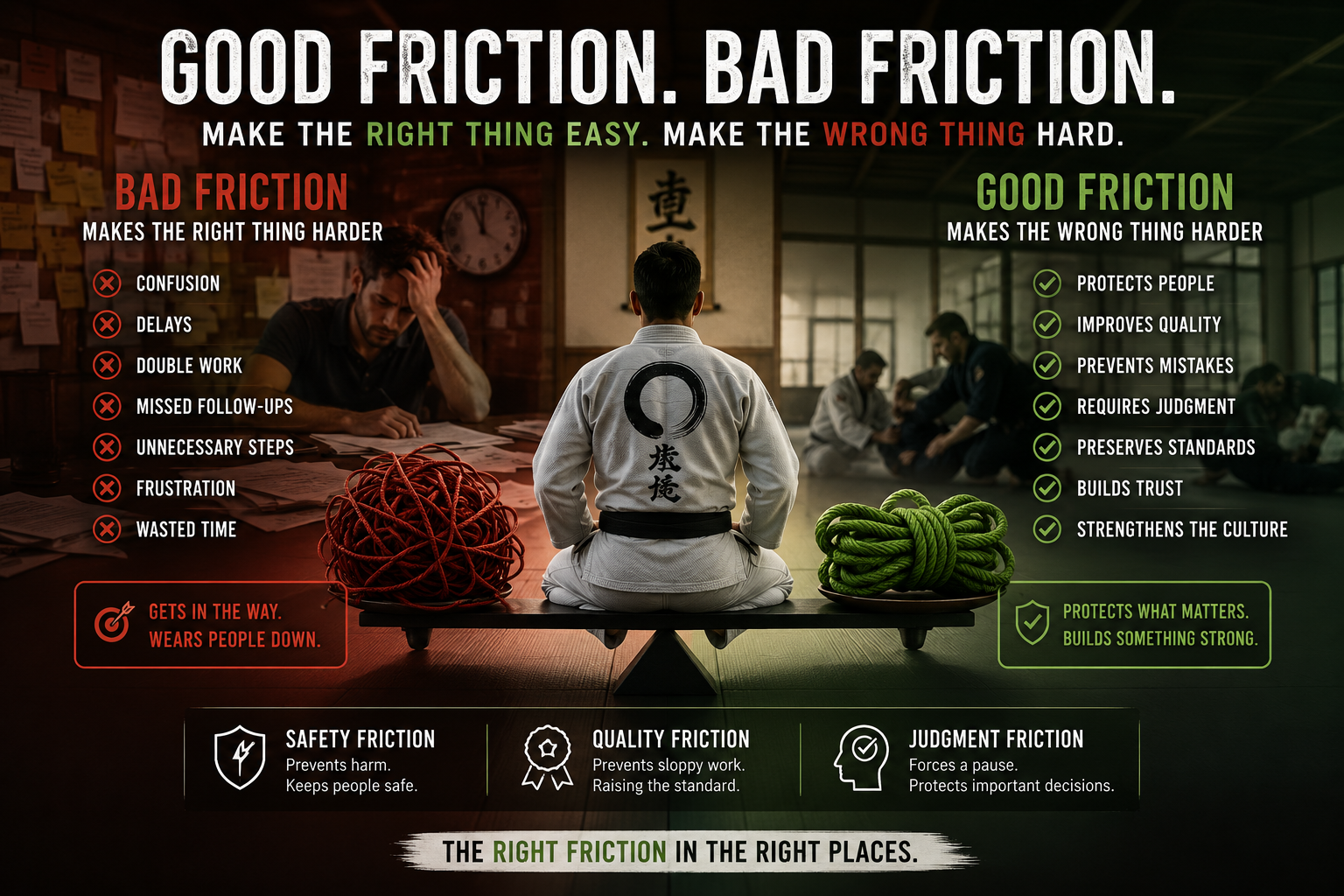
Your Business Needs Friction. Just Not the Kind You Think.
Your business doesn’t need zero friction—it needs the right friction. Learn how to remove the delays that wear people down while keeping the safeguards that protect safety, quality, trust, and your school’s culture.
Martial artists already understand good friction.
You do not let a brand-new student walk into the academy, throw on gloves, and immediately start trying to knock somebody out.
You do not teach an armbar and then tell them to crank it as hard and fast as possible.
You have rules.
Tap when something hurts
Control your partner
Trim your nails
Wear clean gear
Learn the movement before adding speed
Show that you can control yourself before someone gives you more freedom.
All of those things create friction.
They slow people down.
And that is exactly why they exist.
The friction protects the student. It protects the training partner. It protects the school.
So the problem in your business is not friction itself.
The problem is friction in the wrong places.
A badly run school often makes the good things difficult and the bad things easy.
A well-run school tries to do the opposite.
Bad Friction Makes the Right Thing Harder
Bad friction gets in the way of ordinary, useful actions.
Here is what it looks like inside a martial arts school.
A parent has to ask three people to get a simple answer.
A new student does not know where to go or what to bring on their first day.
An instructor cannot find the information they need before teaching a class.
Nobody knows who is supposed to follow up after a trial.
Staff have to ask the owner about routine decisions.
The same information gets entered twice because two systems do not talk to each other.
A student wants to update a credit card and has to jump through five steps.
None of those things feel like a crisis.
Individually, each one is small.
But together they add up to delay, confusion, frustration, and wasted time.
The work gets harder.
People find ways to avoid it.
Mistakes increase.
The owner ends up doing everything personally because handing anything off takes longer than just doing it yourself.
That is bad friction.
It does not protect anything.
It just wears people down.
Good Friction Makes the Wrong Thing Harder
But not all friction is bad.
Some friction exists on purpose, and removing it would make things worse.
A brand-new student cannot jump directly into hard sparring.
Someone cannot promote themselves simply because they feel ready.
A staff member cannot give away a large discount without approval.
A cancellation does not disappear because somebody forgot to write it down.
A student complaint cannot get buried because nobody wants to deal with it.
A big expense requires a second look before it goes through.
All of those things slow someone down.
Intentionally.
The small pause protects something important.
Good friction falls into three simple categories.
Safety Friction
The pause prevents somebody from getting hurt.
Mat rules
Waivers
Equipment checks
Sparring rules
Instructor approval before more dangerous training
These safeguards exist for a reason.
They reduce the chance that somebody gets hurt or that a preventable mistake becomes a serious problem.
Quality Friction
The pause prevents sloppy work.
Checking that a new student's information is correct before they start
Reviewing an important message before it goes out
Making sure the instructor knows about an injury or a parent concern
Walking through the school before opening to check the mats, the bathrooms, and the front area
The extra minute saves you from looking careless later.
Judgment Friction
The pause forces a human to think before something important happens.
Discounts
Refunds
Complaints
Student discipline
Contract changes
Sending sensitive messages
Major purchases
Anything that is hard or expensive to undo
A second set of eyes. A moment of consideration.
A rule that says "this kind of decision cannot happen automatically."
The common thread is simple.
Good friction protects something you can name.
Safety. Quality. Money. Trust.
A relationship.
A decision that is difficult to reverse.
If you cannot name what the friction is protecting, you should question why it exists.
What the Job Site Taught Me
I spent years as an electrician working on complex commercial and industrial projects.
On job sites, many of the rules that looked like friction existed because mistakes could hurt people or cost enormous amounts of money.
Lockout and tagout procedures
Permits before starting certain work
Testing before energizing equipment
Inspecting work before covering it up
Checking drawings before installing something that would be difficult to move later
You could make the job faster by eliminating those steps.
You could also kill somebody.
That is useful friction.
But walking half a mile across the site because nobody staged the material where the work was happening?
Waiting two hours because nobody coordinated the trades?
Searching for information that should already be in someone's hand?
Stopping because a decision that should have been made last week still has not been made?
That is bad friction.
One protects the work.
The other gets in the way of the work.
The difference is not whether something slows you down.
The difference is what the slowdown is protecting.
This translates directly to running a martial arts school.
How to Tell the Difference
When you find friction in your school, ask one question.
Does this friction protect something important?
If the answer is no, remove it or reduce it.
The information that lives only in someone's head.
The step that requires the owner for no good reason.
The handoff that nobody owns.
The form that asks for the same thing twice.
The process where everyone makes it up as they go.
If the answer is yes, ask what it protects.
Safety? Quality? Money? Trust? A relationship? A decision with real consequences?
Then keep only as much friction as you actually need to protect that thing.
A lot of schools have more friction than necessary, even when the friction is well-intentioned.
A refund policy needs a human check. It probably does not need the owner personally reviewing every twelve-dollar transaction.
A promotion needs instructor judgment. It probably does not need three people to sign off before a student can test for their next stripe.
Good friction has a purpose.
It does not need a ceremony.
The Right Friction for the Right People
There is another way to use this idea.
Not every student who walks through your door interacts with your school the same way.
You probably already know this.
Some students strengthen your school every time they show up. They train consistently. They treat other students well. They pay on time. They do not complain about small things. They make the culture better just by being there.
Many students are still finding their place. They show up when it is convenient. They pay when reminded. They are not causing problems and they are not building your culture yet. With clear expectations and good coaching, many of them will grow into strong members of the school.
And some people, through repeated behavior, work against the culture you are trying to build. Chronic disrespect. Repeated demands for exceptions. Late or missed payments without communication. Unsafe training. Drama with other students or parents. Behavior that makes your best students uncomfortable.
Here is where friction gets interesting.
For students who strengthen the school, remove every piece of unnecessary friction. Make it easy to sign up. Easy to pay. Easy to refer friends. Easy to stay. They should feel like the school was built for them, because in a real sense it was.
For students still finding their place, normal friction is fine. Standard processes. Clear expectations. A fair chance to grow into the culture.
For people whose repeated behavior damages the culture, intentional friction belongs in the process. Clear policies that are enforced consistently. A trial period that asks for commitment. Standards that do not bend every time someone complains. The goal is not to punish anyone. The goal is to stop making harmful behavior easier than good behavior.
Some schools accidentally do the opposite.
The student who complains, demands exceptions, and creates drama gets discounts and special attention because the owner is afraid of losing a membership.
The student who quietly shows up, trains hard, and treats people well gets taken for granted. Eventually they notice the pattern.
Fix the friction, and the culture begins to correct itself.
Make it easy to be a great student at your school.
Do not make it easy to be a harmful one.
The Warning
Do not let this turn into bureaucracy.
Too much good friction becomes bad friction.
If the owner personally approves every purchase, no matter how small, that is not quality control. That is a slowdown wearing a mask.
If a student needs three signatures to change class times, that is not protecting the school. That is making someone's life harder for no reason.
The test is the same question: what are we protecting?
If there is no clear answer, the friction probably does not belong there.
If the answer is "we have always done it this way," that is not a reason. That is a habit pretending to be a rule.
You are not building a fortress.
You are building a school where standards are clear and the right things are easy to do.
The goal is clarity, not hostility.
The Dojo Drill
If you want to apply this in your school, here is where to start.
Pick one process that frustrates you.
Something you do regularly that feels harder than it should. Responding to new inquiries. Onboarding a new student. Handling a cancellation. Processing a payment change. Whatever it is.
For one repetition, do not immediately try to fix it.
Just watch it.
At every place the process slows down, ask:
Is this slowdown protecting something important, or is it just making the work harder?
Label each one.
Bad friction. Remove it or reduce it. The extra step that serves no purpose. The handoff that creates confusion. The information that is missing. The owner approval that is not actually needed.
Good friction. Keep it on purpose. Name what it protects. Make sure everyone involved knows why it exists.
Then ask one more question:
Can we make this good friction simpler without making it weaker?
Maybe a refund under a certain amount can be handled by a senior staff member instead of the owner. The protection remains. The unnecessary delay disappears.
Maybe a promotion still requires instructor judgment, but the conversation can happen during regular class time instead of a separate meeting. The standard stays. The friction shrinks.
Once you have done this with one process, the same lens applies everywhere.
Where is friction protecting something you can name?
Where is it just making good work harder?
Make the right thing easy. Make the wrong thing hard.
What You Are Actually Building
Your goal is not a frictionless school.
A completely frictionless martial arts school would be chaos.
Anyone could spar at any intensity. Anyone could promote themselves. Anyone could issue refunds. Anyone could change the schedule. Anyone could send any message to any student.
No one would check anything.
That is not a dojo.
That is a free-for-all with mats.
What you want is a school where ordinary things are easy, important things get attention, and dangerous mistakes are hard to make.
A parent who needs a simple answer gets one quickly.
A student who wants to skip straight to hard sparring hits a deliberate pause.
A staff member who needs to handle a routine task can do it without tracking down the owner.
A discount that would set a bad precedent requires a conversation first.
A student who strengthens the culture feels at home.
A student whose behavior repeatedly damages it finds that the school's standards do not bend.
Bad friction removed where it was just slowing good people down.
Good friction kept where it was actually protecting something.
Intentional friction placed where it helps protect the culture you are building.
That is not a frictionless business.
It is a business with the right friction in the right places.
And that is a much stronger system.

Friction, Flow, and the Flywheel You Didn't Know You Built
Your martial arts school may not need more effort. It may need less friction. Learn how smoother systems create better flow, fewer dropped handoffs, and a stronger business flywheel.
You teach a beginner a basic technique.
An armbar
A wrist lock
A hip throw
Whatever it is, the first few repetitions are rough.
The student has to think about everything separately.
Where do my feet go?
Where do my hands go?
Which way do I turn?
When do I move?
What comes next?
They stop between steps. They tense up. They use too much effort.
They forget one piece while thinking about another.
The technique feels like ten different jobs.
Then they practice.
With good repetition, the pieces begin to connect.
The feet and hands start working together.
The pauses disappear.
The student uses less wasted effort.
The same technique that once felt complicated begins to feel natural.
Eventually it flows.
The student may not be any stronger. The technique itself did not change. The wasted effort between the steps began to disappear.
Here is the part we do not always notice.
Every good repetition made the next repetition a little easier.
The first one was a fight. The tenth one was smoother. The hundredth one felt like breathing.
That is the beginning of a flywheel.
Think of a heavy wheel.
The first push is hard. It barely moves.
But once it starts spinning, each push helps the next one.
You do not need to push as hard because the wheel is already turning.
The work that was hard at the beginning becomes easier as it builds on itself.
The same thing happens inside a martial arts school.
A school can contain hardworking owners, excellent instructors, caring staff, and loyal students while still making simple things much harder than they need to be.
The problem may not be effort.
The problem may be friction.
What Thirty-Five Years on a Job Site Taught Me
I spent thirty-five years as an IBEW union electrician working on complex commercial and industrial projects.
Here is something I saw over and over.
A construction crew could be filled with hardworking, skilled, experienced people and still produce poorly.
Not because anyone was lazy.
Because the conditions around the work made the work harder than it needed to be.
Materials were not staged. Information arrived late. Trades collided because nobody planned the order of work. Workers constantly stopped and restarted. People waited for decisions. Tools were in the wrong place. The person who knew the answer was across the site and unreachable.
Telling everyone to work harder did not solve any of that.
The workers were already working hard.
The environment kept interrupting effort before it could turn into finished work.
A good foreman does not solve that by yelling. A good foreman removes obstacles and helps the work flow.
The right material. The right information. The right people. In the right order. At the right time.
When that happens, the crew may not feel like they are working harder at all.
Yet more useful work gets done.
The exact same thing plays out inside a martial arts school.
The owner may not see it because the friction is not physical.
Nobody is waiting for a forklift. But people are waiting all the time.
What Friction Actually Costs
Friction costs more than time.
That is the thing most owners miss.
It raises the effort required just to start.
When following up with a new student means opening three different places, remembering what was said, finding the right information, and deciding what to say from scratch, you will find reasons to do it later.
Your brain quietly adds up the cost of starting and looks for a way out.
It is not laziness.
It is friction wearing you down.
Friction makes repeated work mentally expensive.
Every time someone has to re-decide how to handle the same situation, they burn attention that should be saved for moments that actually need it.
Friction increases mistakes and dropped handoffs.
The more steps between starting and finishing, the more places something can fall through the cracks.
Friction makes it harder to hand work to someone else.
If only you know where the information lives, how the process works, what to say, and what happens next, you cannot give the work to anyone else without a long explanation.
So you keep doing it yourself.
Eventually the owner gets the diagnosis wrong.
The problem feels like:
“I need to work harder.”
The real question is:
Why is this work so hard to do consistently?
The Flywheel You Did Not Know You Built
Every martial arts school develops flywheels.
Patterns of cause and effect that build on themselves over time.
The question is whether they are working for the owner or against the owner.
Here is the negative version. I have seen it in gyms. I have lived inside it on job sites. You may recognize it in your own school.
Friction makes the work harder.
Harder work gets postponed, done inconsistently, forgotten, or handled differently every time.
That creates missed opportunities, weak follow-up, unclear handoffs, students who drift away without anyone noticing, administrative chaos, staff confusion, and an owner who is drowning.
Those failures then create even more work.
The missed opportunity requires emergency attention.
The dropped handoff requires an apology and a fix.
The absent student may eventually cancel, and now you need to replace them.
The staff confusion creates a problem that you personally have to resolve.
The owner loses faith in the system.
So the owner starts checking everything personally.
Now the school depends even more on the owner.
That creates more friction for everyone else because they are waiting for the owner to weigh in before they can act.
That is a flywheel.
It is just spinning in the wrong direction.
Every turn makes the next one harder to stop.
The positive version works the opposite way.
Remove unnecessary friction.
The work flows more naturally.
Staff and owner do the right things more consistently.
Fewer things get dropped.
Better information becomes available.
Better decisions become possible.
How the school runs improves.
Everything depends less on the owner.
Less friction.
Every turn makes the school easier to operate while making it more capable.
When you stop treating friction as just part of running a business and start treating it as the thing you are actually fighting, the school begins to work differently.
The owner may find more space to train, to teach, to lead.
The business stops feeling like a weight and starts feeling like something that feeds itself.
A flywheel does not care whether it is helping you or hurting you.
It builds on whatever pattern you keep repeating.
Where Friction Hides in a Martial Arts School
I want to make this concrete.
Here are places where friction quietly builds inside gyms.
People who ask about classes and wait too long for a response.
Responding means checking several places to find the question, remembering the trial schedule, writing a reply from scratch, and hoping nothing got missed.
By the time the reply goes out, they may have already visited another school.
New students who finish a trial and nobody knows what happens next.
They seemed interested.
Nobody is sure who is supposed to follow up, what to say, or when to say it.
So nobody says anything.
The student drifts away.
Students who miss several classes without anyone noticing.
Attendance exists somewhere.
Maybe in a notebook.
Maybe in a system nobody checks.
Maybe in the owner's head.
By the time the pattern becomes obvious, the student may already be halfway out the door.
Information that does not reach the right person.
A parent mentioned something important at drop-off.
It never made it to the instructor teaching the class.
Now the instructor looks uninformed and the parent feels unheard.
Multiply that by twenty parents and you have a reputation problem nobody can see forming.
Everything living in one person's phone or memory.
If that person gets sick, goes on vacation, or leaves, the school's memory disappears with them.
This is also how schools become dependent on one person. Everything routes through them because nobody else can find the information.
Different staff handling the same situation differently.
One instructor follows up within two hours.
Another follows up within two weeks.
A third never follows up at all because nobody told them it was part of the job.
The student experience depends on which person they happen to get.
That is not a system.
That is a gamble.
Common questions that get answered from scratch every time.
What do we say when a trial cancels?
What do we say when a student hits thirty days?
What do we say when someone asks about pricing?
If every answer has to be created fresh, every answer costs more than it should.
And the owner ends up making every one of them.
Not every school has every problem.
But many schools have more friction than the owner realizes because friction becomes invisible when you live inside it.
You get used to the extra steps.
You stop noticing the switching cost.
You assume this is just what running a gym feels like.
It does not have to be.
Find the Friction. Create Flow. Let the Flywheel Build.
There is a simple path here.
It does not require new software or a giant overhaul.
First, find the friction.
Where does the owner or staff stop, search, wait, switch, repeat decisions, or have to find information again?
Do not guess.
Watch one real process from start to finish.
Write down every place the work pauses for a reason that has nothing to do with doing the work.
Second, create flow.
Group similar work together.
Put information where people need it.
Make handoffs clear between people and between steps.
Reduce unnecessary back and forth.
Separate the steps that just need to get done from the moments that genuinely need human judgment.
Third, let the flywheel build.
Run the improved process.
Watch what actually happens.
Find the real slowdown, the one that holds everything behind it.
Improve that slowdown.
Repeat.
Do not redesign the whole system after every try.
One improvement at a time.
Each one makes the next one easier.
This is not a one-time fix.
It is a habit.
A school that keeps finding and removing friction can become much easier to run over time.
From the inside, it simply feels like a place where the work flows.
One Important Warning
Do not turn this into “automate everything.”
Speed without judgment just helps you make mistakes faster.
Before you improve a process, ask whether you should be doing it at all.
Ask whether the step needs human judgment or whether someone is just copying what was done last time.
Ask whether the information could be ready before the work starts, so the person doing the work is not also hunting for it.
Here is an example from a martial arts school.
A school might set up a system that notices when a student has missed several classes.
That is useful.
But suppose the student's parent already told an instructor the family is on vacation.
If the system blindly sends a “Where have you been?” message, it looks careless and disconnected.
The system should help the school remember.
The human should still decide how to respond.
The school needs both.
Flow and judgment.
The system handles remembering and consistency.
The human handles caring and discretion.
Good systems do not remove effort.
They help effort land where it matters.
The Dojo Drill
If you want to test this in your own school, here is where to start.
Pick one repeated thing that feels harder than it should.
Responding to people who ask about classes.
Following up after trials.
Welcoming new students.
Noticing when students stop showing up.
Talking with parents.
Handing things off between staff.
Billing.
Anything you dread doing because the process itself is draining.
For one repetition, do not immediately redesign it.
Just watch it.
Observe where the friction actually lives.
Ask yourself:
Where did we stop?
Where did we wait?
Where did we look for something?
Where did we have to ask the owner?
Where did someone not know what came next?
Where did we make the same decision again?
What part truly needed human judgment?
What part did not?
Then ask one question:
What is the single piece of friction we could remove before we do this again?
Remove it.
Try again.
Watch what happens.
Improve.
Repeat.
That is how a school begins turning the flywheel in the other direction.
A common temptation is to try to fix everything at once.
Buy the software.
Rewrite the handbook.
Retrain the staff.
Burn out before anything actually improves.
You do not need to do that.
You need to remove one piece of friction from one process.
Then do it again.
The flywheel does not care how ambitious your plan was.
It only builds on what you actually repeat.
The Student Who Disappears—and Nobody Follows Up
A barbecue is an event.
Community is what happens when someone is missing.
Someone working in the office of a dojo once said something to me after I had been absent for several weeks.
“Yeah, I noticed you were gone.”
My immediate thought was:
Then why didn’t you reach out?
I did not say it.
I can be blunt, and I was not trying to embarrass the person or deliver an unsolicited business lesson.
But the question stayed with me.
If someone noticed that a consistent student had disappeared, why did nobody check on him?
No phone call.
No text.
No email.
No simple message:
“Hey, we haven’t seen you lately. Is everything okay?”
That is not merely a missed courtesy.
It is a retention failure.
It is a community failure.
And it happens in martial arts schools more often than many owners realize.
When I Join a Dojo, I Go All In
I have always had an obsessive streak.
When something captures my interest, I do not approach it casually.
Martial arts especially.
When I join a dojo, I show up.
I train as often as my body and schedule allow.
Even when I cannot participate because of an injury or the need to recover, I may sit quietly and observe class.
You can learn a great deal by watching.
You can study how the instructor explains a movement.
You can observe how different students respond to pressure.
You can notice adjustments that are difficult to see when you are occupied with your own training.
Because of that, my presence tends to be noticeable.
And so is my absence.
When someone who regularly trains, watches classes, speaks with instructors, and spends time around the school suddenly vanishes for several weeks, it should not require a sophisticated business intelligence system to recognize that something changed.
Somebody should notice.
More importantly, somebody should act on what they noticed.
This Is Not One School
I have trained in different martial arts, under different instructors, in different kinds of organizations, over many years.
The cultures were different.
The teaching methods were different.
The business models were different.
The pattern was often the same.
When I disappeared, nobody followed up.
Years ago, my spleen ruptured while I was training under my longtime Hapkido instructor.
It was a serious injury.
The office manager came to visit me.
That visit mattered.
He could see how I was doing, speak with me directly, and report my condition to the instructors.
One person took responsibility for closing the communication loop.
But later, at several other martial arts schools, the silence returned.
I stopped attending.
Nobody followed up.
I experienced the same silence after illnesses, injuries, schedule disruptions, and extended absences.
This is not an attack on one school.
It is a pattern.
A student stops showing up.
The instructors assume the office knows why.
The office assumes the instructors are handling it.
The owner is occupied with classes, bills, new students, staff, maintenance, sales, and a hundred other problems.
Everyone may notice. Nobody takes responsibility.
The student quietly disappears.
Friendliness Is Not Community
Most martial arts school owners believe they have built a strong community.
In many ways, they have.
People greet one another at the door.
The instructor knows everyone’s name.
Training partners joke together.
People help each other improve.
The school may hold a barbecue, seminar, holiday party, anniversary celebration, or promotion event.
All those things are valuable.
But friendliness is not the same as community.
A barbecue is an event. Community is what happens when someone is missing.
Community is noticing that the student who normally trains several times a week has not appeared recently.
Community is wondering whether that person is injured, sick, traveling, overwhelmed, discouraged, embarrassed, or quietly preparing to quit.
Community is asking:
“Where has this student been?”
Then taking the next step:
“Who is going to contact them?”
The message does not need to be dramatic.
It does not need to sound like a sales pitch.
It does not need to pressure the student to return.
It only needs to communicate:
“We noticed you were gone. You matter enough for us to ask. You are not invisible here.”
Silence Also Communicates
When a student disappears and nobody follows up, the school still sends a message.
It may unintentionally communicate:
“We noticed you when you were standing in front of us. We noticed you when you attended class. We noticed you when your membership payment arrived. But once you stopped showing up, you stopped existing.”
That may not be what the owner means.
It may not be what the instructors feel.
Most instructors genuinely care about their students.
But intention does not determine the student’s experience.
Behavior does.
Silence does.
After enough silence, a student may begin thinking:
Maybe they do not care whether I return.
Maybe I was never really part of the community.
Maybe I was simply another membership.
Maybe there is no meaningful difference between this school and the one down the street.
I do not need a dojo to chase me.
I am responsible for my own training.
I will train where I choose to train.
But as someone who studies leadership, business systems, community, and retention, I notice the operational failure.
Other students notice it too.
They may never confront the owner.
They may not make a clear decision to quit.
They simply begin attending less often.
Then they stop entirely.
Eventually, they cancel.
By the time the cancellation request arrives, the actual departure may have happened months earlier.
Injuries Make the Silence Louder
Injuries create uncertainty for everyone.
The student may not know how long recovery will take.
The instructor may not understand the full extent of the injury.
Staff may not know what they should say.
The owner may be concerned about discussing medical information, responsibility, or fault.
Those concerns should be handled through proper policies and professional guidance.
But uncertainty should not automatically produce silence.
The school does not need to diagnose the student.
It does not need to investigate the injury through a casual text.
It does not need to assign responsibility or give medical advice.
It can simply say:
“We noticed you haven’t been in recently. We hope you’re doing okay. There is no pressure to return before you’re ready. We just wanted to check on you.”
That is not a diagnosis.
It is ordinary human concern.
It also gives the student an easy path to respond.
“I’m injured.”
“I’ve been sick.”
“My work schedule changed.”
“I’m dealing with something at home.”
“I’ve been discouraged.”
Now the school has information.
Without the conversation, the owner has only an empty space in class and a membership that may soon disappear.
The Problem Is Not a Lack of Caring
Most martial arts school owners care about their students.
Most instructors care deeply.
The problem is that caring has not been turned into a repeatable process.
Everyone assumes someone else will handle the follow-up.
The head instructor thinks the office staff handles attendance.
The office staff assumes the instructor knows what happened.
Assistant instructors believe the owner has already contacted the student.
Training partners mention the missing person to one another, but nobody knows whether reaching out is appropriate.
The owner is trying to keep the entire operation moving.
Nobody clearly owns the absent-student list.
So nobody follows up.
That is how good intentions become poor retention.
You do not necessarily need to care more. You need to make caring operational.
A Simple Missing-Student Protocol
A martial arts school should know when a previously consistent student unexpectedly stops attending.
The process does not need to be complicated.
It begins by understanding the student’s normal pattern.
Someone who normally trains five times a week should be noticed sooner than someone who normally attends twice a month.
The trigger should reflect the individual student’s established behavior.
First Unexpected Absence
Send a light check-in.
“Hey, we haven’t seen you recently. Everything okay?”
The objective is not to pressure the student.
It is simply to notice.
Continued Absence
Send a more personal message from an instructor, staff member, or training partner who knows the student.
Mention something real.
“We missed you in the Tuesday class.”
“Someone was asking where you’ve been.”
“We were working on the technique you were practicing.”
“We hope your shoulder is feeling better.”
Extended Absence
Call the student or send a direct voice message.
Do not begin by discussing cancellation.
Ask what happened.
Then listen.
The student may be injured.
They may have changed jobs.
They may be dealing with financial pressure.
A parent may be struggling to get a child to return after a frightening or frustrating class.
A beginner may feel embarrassed because everyone else seems to be learning faster.
Someone may have had an uncomfortable interaction but does not know how to raise the issue.
You cannot address a problem you never discover.
Before the Student Returns
Make re-entry easy.
Tell the student which class would be appropriate.
Let the instructor know the student is returning.
Ask whether there are injuries, limitations, or concerns the instructor should understand.
Give the student permission to begin slowly.
The first class back is part of retention too.
Semi-Templated and Semi-Personal
Many owners imagine that thoughtful follow-up requires hours of personal communication.
It does not.
The process can be partly templated and partly personalized.
The system handles remembering. The human handles caring.
A basic message might say:
“Hey, [Name], we noticed you haven’t been in for a little while. We hope everything is okay. No pressure. We just wanted to check on you.”
Then add one genuine sentence:
“Your training partners were asking about you.”
“We missed seeing you in the morning class.”
“We hope your recovery is going well.”
That one sentence changes the message from generic automation into meaningful human communication.
The goal is not to disguise the system.
The goal is to use a system so genuine concern does not depend on someone remembering after teaching six classes, answering twenty messages, cleaning the school, and trying to get home for dinner.
Retention Is How the Legacy Survives
Martial arts instructors often talk about legacy.
They want to preserve their teacher’s system.
They want to pass on their lineage.
They want students to become instructors, black belts, leaders, and mentors for the next generation.
But a legacy cannot be transmitted to students who quietly disappear.
Retention is not merely a financial metric.
It determines whether a beginner remains long enough to become competent.
Whether a competent student develops enough depth to teach.
Whether students form lasting relationships.
Whether the school becomes a genuine multigenerational community or a revolving door of trial lessons and short-term memberships.
Every student who disappears represents more than lost monthly revenue.
It represents lost potential.
A future instructor may have disappeared.
A future black belt may have disappeared.
A child who needed confidence may have disappeared.
A stressed parent who needed a healthy third place may have disappeared.
A student who might someday preserve the lineage may have disappeared.
And nobody asked why.
Run the Test Today
Open your attendance records.
Look for students who used to attend consistently and have recently stopped.
Do not begin by building a complicated dashboard.
Do not spend three weeks choosing software.
Find three names.
For each student, ask:
When did we last see this student?
What was their normal attendance pattern?
Does anyone know why they stopped attending?
Who has the strongest relationship with this person?
Has anyone contacted them?
Who is responsible for sending the message?
What is the smallest sincere message we could send today?
Then send it.
You may discover an injury.
You may discover a scheduling problem.
You may discover financial pressure.
You may discover dissatisfaction the student was reluctant to mention.
You may discover that the student simply needed help returning.
Occasionally, you will discover that someone was waiting for one small sign that they still belonged.
Do not wait until a cancellation request tells you the student is gone.
Notice when the room becomes quieter.
That empty space in your dojo is trying to tell you something.
Make Caring Operational
The Leader’s Dojo helps martial arts school owners build simple systems that prevent students from falling through the cracks.
Start by identifying where students currently disappear in your follow-up process.
Then visit The Leader’s Dojo to learn how to get more students, keep them longer, and build a school that does not depend on memory and heroic effort to hold everything together.

Stop Polishing. Start Proving.
Real growth begins when instructors stop trying to look impressive and focus on helping each student feel seen, supported, and capable of becoming better.
A beautiful website can make a promise. Only real results earn trust.
When Amy and I were first starting our businesses, we both worried about the same thing.
Looking good enough to be taken seriously.
You know the feeling. You look at established businesses and see the polished website, the professional photographs, the branding, the testimonials, the confident language. Then you look at what you have.
Maybe the website is not finished.
Maybe the wording does not sound right.
Maybe the photos are not as good as the ones from people who have been doing this for ten years.
You start thinking that nobody will trust you until you look like the people who are already successful.
So you work on looking successful.
You adjust the website. Rewrite the homepage. Change the colors. Rework the logo. Reconsider the photographs. Change the wording again because it still does not sound professional enough.
Some of that work is useful.
A decent website helps.
Clear language helps.
Professional presentation signals that you are serious.
But there is a trap hiding inside all of that work.
You can spend so much time trying to look like someone who helps people that you are no longer spending enough time actually helping people.
That is where Amy and I struggled.
We wanted the presentation to communicate that we were legitimate.
But the evidence was never going to come from the website alone.
The real evidence was:
Can we help someone?
Do we help them?
Are they better because they worked with us?
Would they tell another person that the experience was valuable?
A beautiful website may get someone to pause.
A real result gives them a reason to trust you.
A polished homepage can make a promise. A testimonial shows another human being experienced something close to that promise.
A clever description can explain what you do. A case study demonstrates what actually happened.
There is a major difference between appearing valuable and creating value.
The two are not enemies.
Polish should support the work.
It should not replace the work.
But here is the part nobody says out loud.
Sometimes working on the website feels productive because it is safer than working with real people.
The website does not disagree with you.
It does not say no.
It does not tell you that your explanation was confusing.
It does not fail to produce the expected result.
It does not force you to confront the difference between what you thought people needed and what they actually needed.
Real clients do all of that.
That is why real-world experience is so valuable.
Each person teaches you something.
You learn what they care about.
What they misunderstood.
Where they get stuck.
Which parts of your process help and which parts only sounded good in your head.
Whether your work actually changes anything.
That feedback makes the business better.
It also makes the website better.
The strongest copy usually does not come from sitting alone and trying to sound persuasive. It comes from listening to the language real people use before, during, and after working with you.
The strongest promise does not come from brainstorming the biggest claim you can make. It comes from seeing which result you can repeatedly help someone achieve.
The strongest testimonial is not someone saying you are wonderful. It is someone describing what their situation was like before, what happened while working with you, and what is different now.
That is evidence.
The White Belt in the Expensive Gi

Connection creates community.
For martial-arts gym owners, the same pattern appears in many forms.
You may think the school needs a new website.
Maybe it does.
You may think you need better branding, better social media, new software, a more sophisticated CRM, automated follow-up, a larger class schedule, or a more impressive lobby.
Any of those things may help.
But none of them automatically prove that the school creates a better student.
The important questions are more basic.
Does a nervous beginner feel genuinely welcomed when they walk through the door?
Does the instructor understand why that student walked in?
Does anyone notice when a student’s attendance starts to slip?
Can the student see that they are making progress?
Does somebody contact them before two missed classes become two missed weeks and then a quiet cancellation?
Are students becoming more capable, more confident, and more disciplined?
Would a parent say training has made a noticeable difference at home?
Would an adult student tell a friend:
“You should come here because these people actually care about you”?
That is the real business.
The website should help communicate it.
The website cannot create it.
A gym can have an outdated website and still transform lives.
A gym can have a beautiful website and still let students fall through the cracks.
One is not an excuse for the other.
But the order matters.
A white belt does not become legitimate by purchasing the most expensive gi.
They become legitimate by continuing to show up, being corrected, practicing, and becoming more capable.
The gi should be clean.
It should fit.
It should let them train.
But it does not do the training for them.
Your website is the same.
It should be clean.
It should work.
It should clearly tell people who you help, what problem you address, and what they should do next.
Then stop adjusting it long enough to help somebody.
Work, Then Evidence, Then Communication
Too many owners reverse the sequence.
They try to build the appearance of a mature business before they have gathered the experiences that teach them how the mature business should actually operate.
It is like designing the black-belt curriculum before you have taught enough beginners to understand where beginners struggle.
You can create something impressive on paper.
Then real human beings arrive and show you what you missed.
The goal is not to look like you are valuable.
The goal is to become increasingly valuable and make that value visible.
The healthy sequence runs like this:
Do the work.
Earn the evidence—the stories, testimonials, case studies, and deeper understanding of the people you serve.
Use the website, content, photographs, and language to make that evidence easier to see.
Then do more work.
Earn more evidence.
Make the communication better.
The problem is not wanting to look good.
The problem is allowing the desire to look good to consume the time and courage required to become good.
Sometimes we want the polished website to give us confidence before we have earned confidence through repetition.
We want the presentation to protect us from feeling like beginners.
But beginners are supposed to be imperfect.
Amy’s work became credible because people experienced it and told other people.
Her skill, attention, judgment, and ability to help someone mattered more than whether every piece of her public presentation was perfect.
The presentation could improve over time because the work underneath it was real.
The same test applies to your school.
Did more prospects show up?
Did more trial students join?
Did fewer students disappear without anyone noticing?
Did students become clearer about their progress?
Did you regain time or reduce stress?
Did someone stay who otherwise might have quit?
Those results become the case studies.
The case studies make the offer clearer.
The clearer offer improves the website.
Work. Evidence. Communication.
More work. More evidence. Better communication.
A nice website can support trust.
Real results create trust.
The strongest businesses eventually have both.
They look professional because they have learned how to communicate.
They are effective because they never confused communication with the work itself.
Before you improve the appearance again, ask yourself:
Which would help your gym more this month—another website revision or one documented student success story?
What are you currently polishing that should already be in front of real people?
What result has your school created that deserves to be seen?
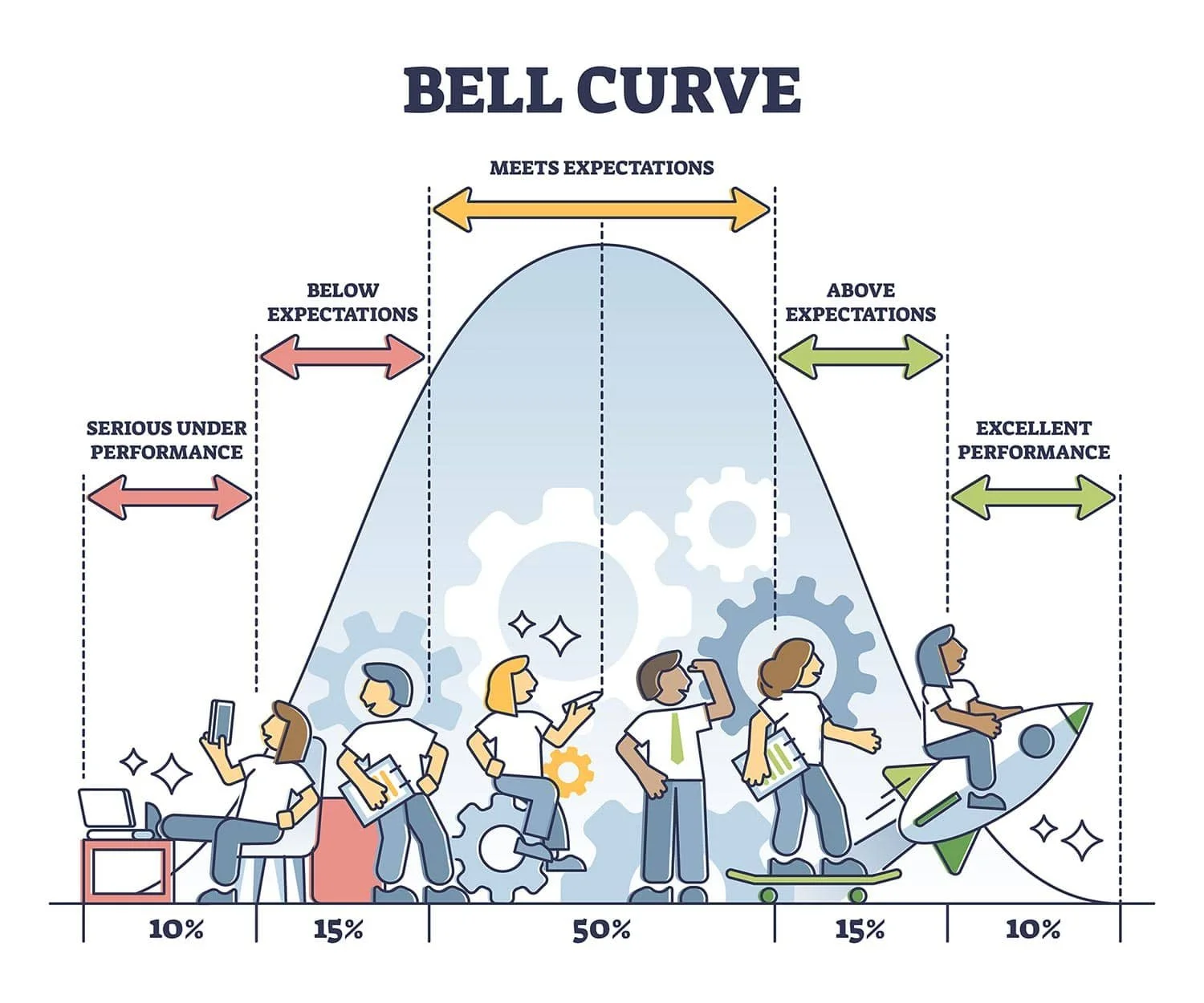
The Culture You're Actually Building in Your Gym
The culture you create is based on the people you attract and why having a free trial attracts the wrong people.
Long before I ever ran a crew, I watched foremen set their teams up for success or for drama.
The pattern was the same every time.
A good foreman looked at the job, looked at his guys, and paired them carefully. A-level with A-level. B-level with B-level. He might put a B with an A if the A was also a natural teacher and the job had some slack in it. But he never, ever put a C-level worker with an A and crossed his fingers.
The bad foremen did the opposite.
They subscribed to the nice theory: put a strong worker next to a weak one, and the strong one will pull the weak one up.
Mentorship by proximity.
Growth by osmosis.
It sounds good in a meeting.
On the jobsite, what actually happens is the A-level worker gets dragged down. He spends his day fixing mistakes instead of doing his own work. He loses momentum. He gets frustrated. And eventually, he stops caring, or he leaves.
I watched this play out dozens of times across decades in the trades. And when I walked into my first martial arts school and stayed there for nearly twenty years, I saw the same pattern in a different uniform.
The Three Skills Nobody Separates
Here's something I figured out on the jobsite that I've never heard a gym owner talk about: doing the work, teaching the work, and holding the standard for the work are three completely different skills.
Most people are good at one.
Some are good at two.
Almost nobody is good at all three.
The operator can do the work. Hand him a set of blueprints and he'll wire the building. Put him on the mat and his technique is clean, his timing is sharp, and when he rolls, you know you're dealing with someone who's put in the hours. He's an A-level performer. But ask him to teach what he's doing and he'll stare at you. He never broke it down. He just did it until it worked.
The teacher can break the work down and transfer it. She can watch a student struggle with a technique, isolate the missing piece, and communicate it in a way the student receives. She might not be the best performer in the room, but she can make other people better. Different skill entirely.
The leader holds the standard. He sees the gap between where the team is and where it needs to be, and he closes it. Not by doing the work for them. Not by teaching them technique. By reinforcing the expectation. By naming what's not acceptable and making sure everyone in the room feels it.
Most professional organizations suffer because the person in charge is good at one or maybe two of these. Rarely all three.
And more importantly, they don't know how to find and hire the ones they're missing.
They assume that a black belt who can execute a technique can also teach it and also hold a room to a standard.
That's three different people, and sometimes you get lucky and find two of them in one person.
But assuming all three come with the belt is how you end up with a school full of C-level students wondering why the culture feels off.
The Distribution Problem
Every gym, at every belt level, has a distribution.
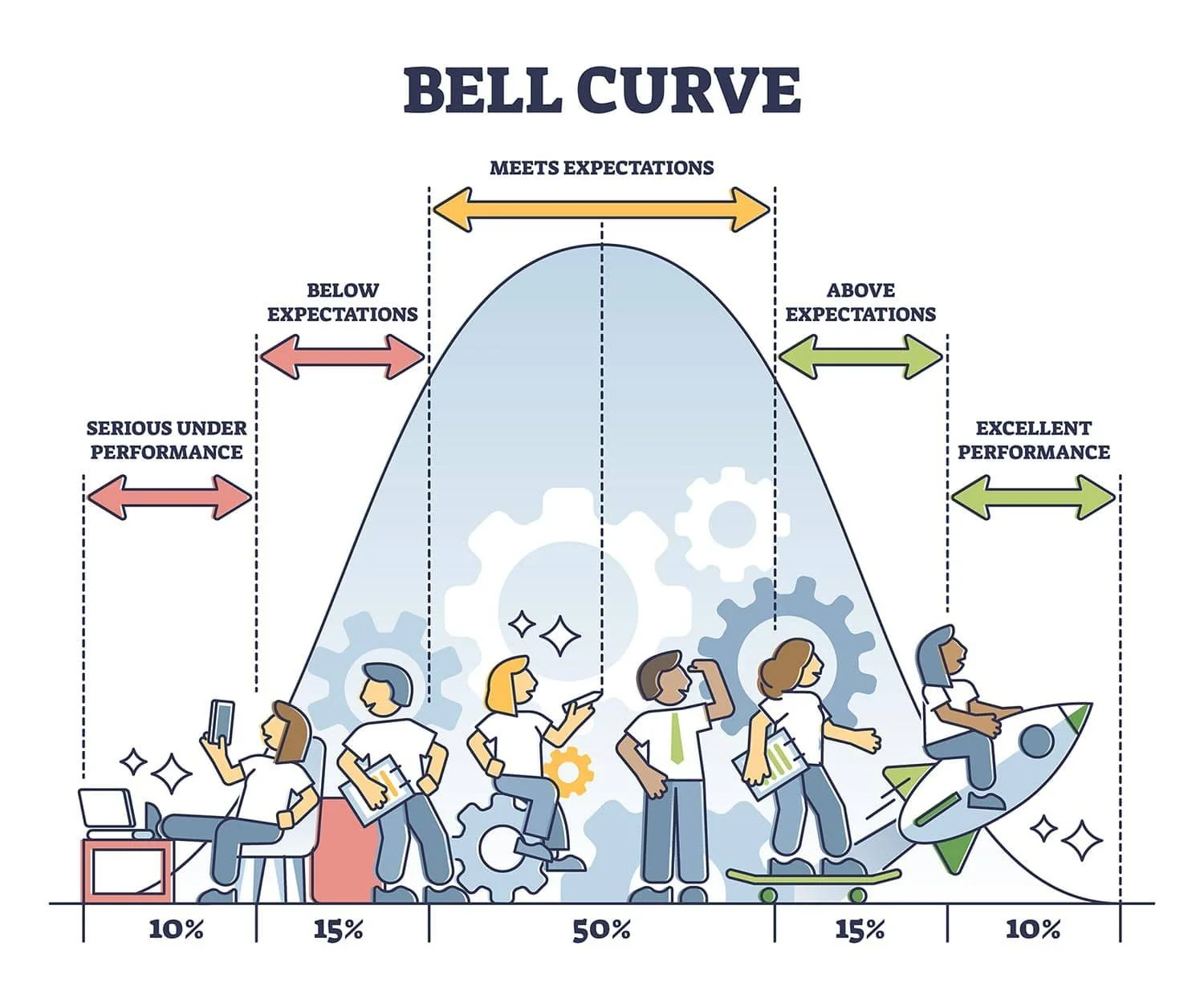
The Bell Curve of Social Demographics
Some percentage of your white belts are A-level. They show up early, they drill with intention, they ask questions between rounds.
Some are B-level. They're consistent, they work hard enough, they're pleasant to have in class.
Some are C-level. They drain energy from the room. They half-ass the warmup. They sit against the wall during drilling. They make excuses.
Same at blue belt. Same at purple. Same at brown and black.
Your school's culture is not your mission statement. It's not what's on your website. It's not the speech you give at the beginning of class.
Your school's culture is the weighted average of how many A, B, and C players you have on the mat on any given Tuesday night.
If your room has twelve A-level students, five B-level, and three C-level, the culture tilts toward excellence.
The A's set the tone. They're the first ones drilling, the last ones to leave, the ones asking for feedback. The B's rise to match them. The C's either get with the program or they self-select out, because the culture makes their behavior feel out of place.
If the distribution is flipped, if you've got three A's trying to hold the line while twelve C's text between rounds and skip the conditioning, the A's eventually stop trying. Or they leave for a school where the room demands more from them.
This is not a theory.
You've seen it. You've felt it.
You've walked into a class where the energy was electric and everyone was locked in, and you've walked into a class where the room felt dead and you had to manufacture enthusiasm from nothing.
The difference was the distribution.
Why Free Trials Make This Worse
Here's where it gets uncomfortable.
Most gyms run free trials because they think it lowers the barrier to entry. And it does.
The problem is that it lowers the barrier for everyone, including the exact people you don't want in your school.
The "something for nothing" crowd loves a free trial.
They're not betting on themselves. They're not putting skin in the game. They're sampling, the way you sample a free cheese cube at the grocery store.
No investment, no commitment, no intention.
They show up for two classes, feel mildly uncomfortable because learning anything hard is uncomfortable, and disappear.
And during those two classes, they were in your room. They were part of the distribution.
They dragged the energy down just by being there with no stake in the outcome.
A-level people don't operate like that.
An A-level person is looking for a challenge. They want to know that the thing they're signing up for is going to demand something from them. If your entry point signals that anyone can wander in off the street and try it for free, you're not signaling challenge. You're signaling desperation.
The gyms with the strongest cultures don't attract A-level people by being easy to join.
They attract A-level people by being worth joining.
What A-Level People Actually Want
Here's what I've learned about A-level people, both on the jobsite and on the mat.
They want to be challenged.
They want someone to set a standard that's slightly beyond where they are and hold them to it. They want to be surrounded by other people who take the work seriously. They want to feel like they're part of something that's going somewhere.
And here's the part most gym owners miss: after you challenge them, you support them.
Then you challenge them again.
Challenge without support is just being a hardass. Support without challenge is daycare.
The rhythm is challenge, support, challenge, support.
You push them past what they thought they could do, then you help them integrate what they just learned. Then you do it again.
When you build a school around that rhythm, something shifts. The A's feel seen. The B's rise toward A. And the C's either transform or leave. Either outcome improves your culture.
The gyms people can't imagine leaving are not the ones with the best facilities or the newest equipment or the most convenient class schedule. They're the ones where every time you show up, the room demands something from you. And you leave better than you arrived.
How to Audit Your Culture This Week
You don't need a consultant to tell you what your distribution looks like. You just need to look honestly.
Walk into your beginner class. Look at the room.
How many of those white belts are drilling with intention?
How many are just going through the motions?
How many are standing against the wall?
Do the same for your intermediate and advanced classes.
Do the same for your instructors.
Do the same for your front desk staff if you have them.
Now ask yourself: if your culture is the weighted average of the people in the room, what culture are you actually building?
This is not about judging people.
Some C-level students are just new. Some are going through something outside the gym that's showing up inside it. Some will become B's and A's with the right environment.
But if the distribution is skewed, if you've been lowering barriers to fill the room and you got exactly the room you invited, you need to make a change.
Not a dramatic one.
Just a deliberate one.
Raise the standard for entry. Not the price necessarily, though that's part of it.
The standard.
Make it clear that joining your school means committing to something.
Ask more of people at the trial stage.
Challenge them from the first conversation and see how they respond.
The A's will lean in. The C's will self-select out before they ever set foot on your mat.
Then look at who's running your classes.
Do you have operators trying to teach?
Teachers trying to lead?
Leaders who can't actually do the work?
Most schools do. The fix isn't firing people.
It's being honest about which of the three skills each person has, and putting them in the role that matches their actual strengths instead of the role that matches their belt.
A school with a strong culture isn't one where everyone is an A. That's not realistic.
It's one where the A's set the tone, the B's rise to meet it, and the C's are either on a path to becoming B's or they're somewhere else.
The foremen I watched succeed didn't try to turn C's into A's by pairing them with the wrong people.
They put people where they could do their best work, held the standard, and let the distribution sort itself out over time.
Your school works the same way.
You're the foreman now.
The culture you have tomorrow is the one you build today, one pairing, one class, one standard at a time.

The Easiest Sales Conversation You'll Ever Have
A simple 4-question conversation to make selling easy and not icky at all.
I didn't learn sales because I wanted to. I learned it because my marriage depended on it.
Twenty years ago, my wife was building a healing practice.
She was phenomenal at what she did.
Her clients got results.
Her technique was dialed in.
But the business was slowly going under, and we were going under with it.
She was spending all her time being great at healing.
But that's only one half of the business coin.
The other half is getting people into the room so you can do the healing.
Marketing
Selling
Finance
She had ignored those entirely.
Not because she was lazy.
Because she was focused on being badass at her craft, and nobody had ever told her that being badass at your craft is only two-fifths of running a business.
So I started studying.
Not because I had a passion for marketing.
Because the bills were mounting and there was no Plan B.
What I found changed everything.
The Five Parts of Every Business
Every business, including your martial arts school, breaks into five pieces:
1. Value creation (your curriculum, your teaching, your methodology)
2. Value delivery (the actual experience on the mat)
3. Marketing (getting people to know you exist)
4. Selling (helping them decide to walk through the door)
5. Finance (making sure the numbers work)
Most martial arts school owners are like my wife was.
They crush the first two.
They're phenomenal on the mat.
Their technique is legitimate.
When a student shows up, the experience is great.
But marketing, selling, and finance?
Those three get neglected.
Sometimes ignored entirely.
Sometimes outsourced to whoever seems willing to handle them.
And here's what I've noticed after decades in gyms: the people who are mediocre on the mat but good at those last three often have bigger schools than the best instructors in town.
You've seen it.
The guy down the street whose technique is sloppy but whose school has 300 students.
The chain McDojo with instructors you wouldn't trust to tie your belt but whose parking lot is always full.
It's not because the market rewards mediocrity.
It's because those people invested in the three pieces you've been ignoring.
They didn't get better at teaching.
They got better at marketing, selling, and finance.
And that stings.
It should.
But it also means the solution is right in front of you.
You Can Have Both
Here's the thing that took me years to understand.
You don't have to choose between being great on the mat and being great at business.
You can have both.
And when you do, the result isn't just a bigger school.
It's a school where the quality of the teaching and the quality of the business systems reinforce each other.
The trick is coming from a place of service, not from a place of selling.
When you think of sales as manipulation, of course you avoid it.
You're a martial artist.
Manipulation runs against everything you stand for.
But that's not what sales is when you're good at it.
Sales is helping someone make a decision they already want to make.
It's diagnosing, not convincing.
It's exploring, not pushing.
And the principles you used to become an expert on the mat are the same principles that make sales work.
You just haven't applied them to the conversation yet.
The 4-Step Diagnostic

Book Yourself Solid by Michael Port
Step 1: Where are you now?
You start with where they actually are, not where you wish they were.
Not where they think they should be.
Where they are.
A parent calls your school. Their kid is being bullied, or they lack confidence, or they're spending too much time on screens.
You ask: "Tell me a little about what's going on."
And then you listen.
You don't pitch.
You don't talk about your curriculum.
You find out where they are.
This is the same thing you do on the mat.
Before you teach a technique, you assess.
You watch them move.
You see what they already know and what they're missing.
You don't start teaching until you understand where they are.
Why would a sales conversation be any different?
Step 2: Where do you want to go?
Once you know where they are, you find out where they want to be.
"What would you want to see change for your son?"
"What kind of experience are you hoping for?"
"What would make you feel like this was the right decision?"
Most people have never been asked these questions by a gym owner.
Most gym owners lead with the trial class, the pricing, the schedule.
They skip the part where they understand what the person actually wants.
And then they wonder why they’re gone six months later.
Because they didn’t know what they wanted or worse, they did but didn’t help them to get there.
On the mat, this is the equivalent of asking a student what their goals are.
Competition?
Fitness?
Self-defense?
Confidence?
If you don't know where they want to go, you can't help them get there.
Same in the office.
Step 3: What's in the way?
This is where you name the gap.
You don't tell them what the gap is.
You help them see it themselves.
"So it sounds like your son is struggling with confidence at school, and you want him to feel more capable and self-assured. What feels like it's in the way right now?"
They'll tell you. They might say they're worried about time. They might say they tried another school and it didn't work out. They might say they're not sure their kid will stick with it. Whatever it is, they've just handed you the exact thing you need to help them through.
In the dojo, this is the moment you show a student the flaw in their technique. Not by criticizing. By letting them feel it. "See how your weight is on your back foot? You can't drive forward from there." Same principle. Help them see the obstacle. They'll be more motivated to clear it than if you just told them what to do.
Step 4: Do you want help, yes or no?
This is the whole thing. Four words: "Do you want help?"
Not a pitch. Not a close. Not a manipulation.
A simple question.
You've listened to where they are, where they want to go, and what's in the way.
You've built a genuine understanding of their situation.
Now you're offering to help them bridge the gap.
If they say yes, you tell them exactly what the next step is. "Great. Here's what I'd recommend: let’s get you enrolled in our 4-weeks anti-bullying class. I'll make sure your son gets paired with someone at his level. After the 4 weeks, we'll talk about how it went and figure out the right path forward."
If they say no, you thank them and you move on.
No pressure. No follow-up script designed to wear them down.
You were coming from a place of service, not a place of extraction.
A no just means this isn't the right person right now.
That's fine. There are plenty of people who do want help.
Why This Works in a Martial Arts School
This process works because it's not a creepy used car salesman script.
It's a diagnostic conversation.
It's the same thing you do every time a new student steps onto your mat for the first time.
You watch. You ask. You understand.
Then you offer guidance.
The difference is that on the mat, you do this naturally.
It's baked into how you teach.
In the office, you've been told sales is a separate skill set, something you have to learn from scratch, something that requires a personality you don't have.
It's not. It's the same skill set.
Applied to a different room.
When you come from a place of service, when you genuinely want to help the person in front of you figure out whether your school is the right fit, the conversation becomes easy.
There's just four diagnostic questions and a genuine offer to help.
My wife has used this exact process for over a decade.
She doesn't chase clients.
She doesn't run ads.
She doesn't do anything that feels pushy or salesy.
She finds out where they are, where they want to go, what's in the way, and whether they want help.
That's it.
And she's booked solid with clients she loves working with.
I use it with gym owners now.
When someone reaches out and says their school is stuck, I don't pitch my services.
I ask those four questions.
By the end of that conversation, both of us know whether we should work together.
No convincing required.
What to Do Monday Morning
Pick one person.
A prospect who calls this week.
A parent who emails about their kid.
A trial student who walks in.
Run the four steps.
Not as a script you're forcing.
As a conversation you're having.
Where are you now?
Where do you want to go?
What's in the way?
Do you want help?
That's it.
Try it once.
Notice how it feels.
Notice how the other person responds.
Notice how different it is from whatever you've been doing instead.
You already know how to do this.
You do it every time you step on the mat with someone who needs your help.
The only thing that changes is the room.
Stop thinking of sales as something separate from your art.
It's part of the same thing.
Helping people become better versions of themselves.
Some of that happens on the mat.
Some of it happens in the conversation that gets them there.
The four steps are the technique.
Now go drill them until they're automatic.

The Reps You're Not Doing
You drill reps on the mat until they’re automatic, so why don’t you do the same thing off of the mat?
Under GM Bong Soo Han, there was a sequence I drilled so many times I stopped counting.
Wrist grab.
Counter.
Opponent adjusts.
Redirect.
Opponent overcommits.
Throw.
It had maybe six, maybe seven, links in the chain, and if any one of them failed, the whole thing collapsed.
So we drilled it. Over and over.
Left side, right side, fast, slow, resisting partner, compliant partner.
Until I didn't have to think about step three.
My body just went there.
Fast forward thirty years.
Now I'm on the mat under Jason Hunt and Gutemberg Pereira, learning BJJ, and the same principle shows up.
You don't learn a single technique in isolation.
You learn a chain.
You learn what your opponent will probably do in response, and you learn what you do when they do it.
Then you drill the chain until it becomes automatic.
Every martial artist reading this knows exactly what I'm talking about.
You've lived it.
You teach it every week.
You've told a hundred white belts: "Don't think. Drill it until your body knows the answer before your brain asks the question."
So here's my question.
You know this works.
You've built your entire martial arts identity around it.
But when you walk off the mat and into the office, where does that discipline go?
The Office White Belt
Too many gym owners run their business the way a first-month white belt spars.
Reactive.
Emotional.
Hoping something works.
No chain, no sequence, no drilled response.
Just showing up and swinging.
A prospect calls. Do you have a script, or do you wing it?
They walk in for a trial class. Is there a deliberate sequence for that first experience, or does whoever's at the front desk improvise?
They finish the intro program. Is there a handoff, or do you just hope they ask about signing up?
If a blue belt told you they were "just winging it" on the mat, you'd correct them immediately.
But in the office, winging it is the default.
And it's costing you students, instructors, and years of growth you'll never get back.
This isn't a character flaw. It's a category error.
You think of the mat as the place where technique lives and the office as the place where you handle whatever comes up.
But the office has techniques too.
They're just called scripts, templates, workflows, and systems.
And if you don't drill them until they're automatic, you're leaving every student interaction to chance.
The Chain That Runs Your School
At The Leader's Dojo, we mapped out a 13-stage roadmap. It starts with a brand new prospect who has never heard of your school and walks them through the full arc:
1. They discover you somewhere (a referral, a Google search, a flyer).
2. They reach out. Someone follows a script, not a mood.
3. They book a trial. The scheduling is frictionless.
4. They show up. The first experience is deliberate, not accidental.
5. They take the intro program. Every class has a purpose, not just a lesson plan.
6. They sign up. There's a clear transition, not an awkward "so... you want to join?"
7. They stay. Retention isn't luck; it's a system of self-directed goals that show students their own progress.
8. They feel the benefits. Confidence. Fitness. Community. Not just stripes or belts or podium medals.
9. They become advocates. They tell friends because they want to, and you make it easy.
10. Some of those advocates want more. They ask about helping out.
11. You have a pathway for that. On the mat, in the office, or both.
12. They become staff. Not just warm bodies; people you trained deliberately.
13. Some of them, eventually, become partners. They open an affiliate school under your guidance, running the same system you built.
That's thirteen stages. Each one has scripts, templates, and methodologies.
Each one is a technique.
And like any technique, it only works if you drill it enough that your team executes it without thinking.
This isn't theory. It's the same principle you already believe in. You just haven't applied it to the business side of your school.
Why You Haven't Done It
Let me tell you what I think is actually happening.
On the mat, you're competent.
You've put in the hours.
When you demonstrate a technique, people listen.
When you roll, you know what you're doing.
The mat is home.
The office is not home.
In the office, you're a white belt again.
Email sequences, CRM workflows, sales scripts, retention systems — these feel foreign.
You didn't open a gym to sit at a desk.
You opened a gym because you're phenomenal on the mat and you wanted to share what you love.
So you avoid the office.
You tell yourself marketing is slimy.
Sales feel manipulative.
Systems are for corporations, not dojos.
These are stories you tell yourself to protect your ego from the discomfort of being a beginner again.
Here's the part that stings: you already know how to be a beginner.
You've done it. You earned a black belt in one art, then put on a white belt in another.
You know what it feels like to be lost, to struggle, to drill something a thousand times before it clicks.
You did it physically. You can do it in the office too.
The only difference is that on the mat, being a beginner is expected.
In business, you've convinced yourself you should already know this stuff.
So instead of drilling, you avoid.
Instead of learning a chain, you improvise.
And month after month, your school stays stuck because the most important sequences in your business are being run by someone who refuses to train them.
What It Costs
A prospect calls and gets voicemail because nobody was assigned to answer.
They call the school across town instead.
A trial student walks in and nobody greets them by name. They feel invisible. They don't come back.
A student finishes their intro program and nobody has the conversation about next steps. They drift away.
A student who's been training for two years feels stagnant because nobody helped them set a goal beyond the next belt. They quit.
A student who loves your school would tell ten friends, but nobody ever asked them to. Those referrals never happen.
An instructor would be great on your team, but there's no pathway. They eventually leave for a school that offered them one.
None of these are talent problems.
They're system problems.
And every one of them gets solved by doing the same thing you already do on the mat: learn the technique, drill the sequence, make it automatic, then teach someone else to run it.
The First Sequence
You don't need all thirteen stages tomorrow.
You need the first chain.
What happens when a new prospect contacts your school? Map it. Write down every step from "hello" to "here's your trial class time." Then write the script for each step. Then drill it with your staff until they can run it in their sleep.
That's one chain. One sequence.
One thing you make automatic instead of improvised.
After that, map the trial class experience. What does a student see, hear, and feel from the moment they walk in? Who greets them? What happens in the first five minutes? What happens at the end? Write it down. Drill it.
After that, map the transition from intro program to membership. What's the conversation? Who has it? When does it happen? Write the script. Drill it.
This is not complicated.
It's the same thing you do every time you teach a white belt a new technique.
Break it into parts.
Demonstrate each part.
Have them drill it. Correct.
Drill again. Until it's automatic.
The Shift
Here's the real shift you have to make, and it's harder than any technique you've ever learned.
You have to stop thinking of your business as something separate from your art.
The way you run your school is part of your teaching.
The systems you build are part of the experience.
The scripts your team follows are part of the culture.
When a student walks into a school where everything is improvised, they feel it.
They might not name it. But they sense the inconsistency.
The front desk person is warm one day and distracted the next.
The trial class is great with one instructor and aimless with another.
The follow-up email arrives sometimes and sometimes it doesn't.
Now imagine the opposite.
Every interaction is deliberate.
Every touchpoint is a technique someone drilled.
The experience is seamless not by accident but by design.
That's what students feel.
That's what keeps them coming back.
That's what turns them into advocates.
The mat teaches us that mastery comes from repetition.
The office is no different.
The question isn't whether you should apply the same rigor to your business.
You already know the answer.
The question is: why aren't you?

The 5 Systems Your Gym Can't Survive Without
GM Bong Soo Han was a phenomenal martial artist who attracted students that wanted to be badass. But there were never enough of them…
There are five systems that turn any venture into a business.
Josh Kaufman lays them out in The Personal MBA, and once you see them, you cannot unsee them.
Every business that thrives has all five.
Every business that struggles is missing at least one.
The five are Value Creation → Marketing → Sales → Value Delivery → Finance.
Value Creation is making something people want.
Marketing is making sure they know it exists.
Sales is turning interested people into paying customers.
Value Delivery is giving them what you promised.
Finance is making sure the numbers work.
Most martial arts gym owners have Value Creation locked down.
You know your art.
You have spent years, probably decades, on the mat.
You can teach technique.
You can run a class.
You can look at a student's form and correct it in seconds.
You are a black belt on the mat.
You earned it.
Nobody questions your Value Creation.
Here is the problem.
Your students are not buying your Value Creation.
They are buying your Value Delivery.
And most gyms deliver Value Delivery like an afterthought.
You Are Not Your Customer
This is the thing that most gym owners refuse to look at.
You are not your customer.
You are not even close.
You are the person who was willing to do whatever it took to succeed on the mat.
You showed up early and stayed late.
You trained through injuries.
You competed.
You got smashed and came back the next day.
Something in you was wired differently.
You are a rare breed.
Or maybe you were the second type.
You joined a gym that was supportive and progressive, a place that built and nurtured that spirit in you over time.
The drive was there, but it was cultivated rather than all-consuming.
Either way, you became someone who trains seriously.
You became a martial artist.
Most of your students will never be either of those things.
Especially now. Especially in the digital age.
Most of the people who walk through your door are not badasses.
They are not competitors. They are not even particularly tough.
They are healthy hobbyists who want to feel like they belong somewhere, make some progress, and enjoy themselves while they do it.
And here is the uncomfortable part.
Even the ones who think they are badasses, the ones who talk a big game about wanting to compete or wanting to be fighters, most of them still just want to feel like they belong, like they are getting better, and like they are having a good time.
They just want to feel tough while they do it.
I saw this play out over decades.
My senior instructors, the first cohort who went from white belt to black belt under Grandmaster Bong Soo Han, they started training in the 1970s.
That era was about kicking ass, not spiritual development.
They were tough in a way that is hard to describe.
GM Han himself came up through the battles and wars in Korea, through a ravaged land that produced a kind of hardness most of us will never know.
I came up in construction. I had a harder edge than many of my classmates and certainly more than the students who came later.
But I was not as tough as my senior instructors, and I was nowhere near GM Han.
Each generation steps down in intensity.
That is not a criticism. That is a fact.
The pool of people who want to be warriors is small.
The pool of people who want to feel capable, connected, and confident is enormous.
If you build your gym for the first pool, you will always be small.
If you build your gym for the second pool, you can be as big as you want to be.
The Lineage Trap
Here is where most gyms signal the wrong thing without realizing it.
They put their competition wins on the website.
They list their instructor's name and their instructor's instructor's name.
They frame the whole operation around the art and the history and the legacy.
This positions you for the 5% of people who care about that stuff.
The 5% who know who your instructor is.
The 5% who are impressed by a medal count.
The 5% who choose a gym based on lineage.
What about the other 95%?
The people who just want a place where they feel welcome?
Where they feel like they are part of a community?
Where they can see that they are making progress, even if the instructor thinks it is happening at a snail's pace?
Where they actually enjoy showing up?
Those people do not care about your lineage.
They care about how they feel when they walk through your door.
This is Value Delivery.
And it is where most martial arts gyms fail.
The System That Is Killing You
Your Value Creation is excellent.
Your technique is sharp.
Your curriculum is solid.
You know your art cold.
Your Marketing might be decent.
You post on social media.
You run a trial offer.
You get some people through the door.
Your Sales might be okay.
You close some trial students.
You convert some walk-ins.
It could be better, but it is not the thing that is killing you.
Your Value Delivery is the thing that is killing you.
It is why your retention numbers are bad.
It is why students sign up, show up for a few months, and then quietly vanish.
It is why you are constantly running on the hamster wheel of new student acquisition instead of building a community that feeds itself.
Most students do not quit because the technique was bad.
They quit because they did not feel like they belonged.
They quit because they did not feel like they were making progress.
They quit because training started to feel like a chore instead of the highlight of their week.
You know how to teach martial arts.
Do you know how to make someone feel like they belong in your gym?
Do you know how to make a forty-year-old accountant with no athletic background feel like he is winning, even if his side control still looks terrible?
Do you know how to make a mom of three feel like her hour on the mat is the best hour of her week?
That is Value Delivery.
And most black belts have never thought about it once.
What GM Han Knew

GM Han’s office on the 2nd floor of 3201 Santa Monica Bl.
I remember sitting in GM Han's office one day. He was talking about his school compared to the ATA.
The American Taekwondo Association. He talked about how many students they had. How many black belts they promoted. The scale of the thing.
I told him that was not what he wanted from hapkido.
I told him he wanted to make sure his black belts were not paper tigers.
He agreed. He had standards. He had integrity. He did not want to hand out rank to people who had not earned it.
But he also knew how much he struggled to keep his business going.
He knew the tension between standards and survival.
He felt it every month when the bills came due.
That is the lesson. I am not telling you to water down what you offer.
I am not telling you to promote students who have not earned it.
I am telling you that you can have additional benchmarks for your students to strive for besides belt promotions.
Stripes on the belt for attendance milestones.
Community events that have nothing to do with technique.
Progress tracking that shows a student they are improving even when they cannot feel it themselves.
Recognition that is not tied to rank.
A belt promotion can takes years.
A student needs to feel like they are winning this week.
If the only win you offer them is a black belt that is six to ten years away, most of them will be gone in six months.
The Five Systems Audit
Take out a piece of paper.
Rate your gym on each of the five systems.
Be honest. Nobody else will see this.
Value Creation: Do you have something people want? You are a martial arts school. You probably score high here. But ask yourself: is what you offer what people actually want, or is it what you think they should want? There is a difference.
Marketing: Do people know you exist? Are you reaching the 95% or only the 5%? Is your website talking about lineage and competition wins, or is it talking about community and confidence and how students will feel when they train with you?
Sales: When someone walks through your door, do they become a student? Do you have a process for that, or are you just hoping they sign up? Do you know what to say and when to say it, or are you winging it every time?
Value Delivery: Once they sign up, do they stay? Do they feel welcome? Do they feel progress? Do they enjoy themselves? Do they bring friends? Do they become advocates? This is the system that separates gyms that thrive from gyms that are constantly bleeding students. Most gym owners have never given it a single hour of focused thought.
Finance: Do the numbers work? Do you know your cost per student? Your churn rate? Your lifetime value? Your breakeven point? Or do you just look at the bank account at the end of the month and hope there is enough to cover rent?
Most gym owners have one A (Value Creation) and four Fs.
They excel at the thing nobody is buying and ignore the four things that determine whether the gym survives.
The Fix Is Not Complicated
You do not need to change your art.
You do not need to lower your standards.
You do not need to become a McDojo that hands out black belts like Halloween candy.
You need to pay attention to Value Delivery.
You need to build a student experience that makes people want to stay, want to bring friends, want to be part of the community.
You need milestones that are not belts.
You need wins that happen every month or quarter, not every three years.
You need to make people feel like they belong from the moment they walk in, not after they have proven themselves on the mat for a decade.
The martial artists who trained in the 1970s did not need any of that.
They were self-selected badasses who would have trained in a basement with no heat if that was the only option.
Your students are not those people. They never will be. And that is okay.
GM Han knew it.
He saw what the ATA was doing.
He understood the tradeoff. He chose standards over scale, and he struggled because of it.
You do not have to make the same choice. You can have standards and scale.
You can have integrity and revenue.
You can have a gym full of healthy hobbyists who will never compete and never earn a black belt and still love every minute they spend on your mat.
Those students will pay your bills. They will bring their friends. They will stay for years.
They will become the community that makes your gym feel alive.
And the 5% who are serious, the future black belts, the competitors, the ones who remind you of yourself, they will still find you.
They always do.
But they cannot find you if your gym is not there anymore.
---
The five systems are not complicated. Value Creation. Marketing. Sales. Value Delivery. Finance.
You probably have one of them figured out. You need all five.
Start with Value Delivery.
Look at your gym through the eyes of a forty-year-old who has never thrown a punch and is terrified of looking stupid.
What does he see?
What does he feel?
What would make him come back tomorrow?
Fix that. Then move to the next one. Then the next.
And let's build.
Your Students Aren't Quitting Because of the Price
The Leader’s Dojo Student Roadmap lays out every step of your student’s journey, from a cold prospect not knowing anything about you, all the way to possibly being an instructor or even business partner.
When you're sparring and someone starts to pass your guard, you don't wait until they've got side control to react.
You feel the pressure shift.
You see the hip drop.
You sense the space getting smaller.
And you move before the position is lost.
Most gym owners wait until the cancellation email lands in their inbox.
Then they shrug and tell themselves the same story every time:
"It's the economy."
"There's a cheaper school down the street."
"He said money was tight."
That's not retention.
That's an autopsy.
By the time a student says the words "I need to cancel my membership," they quit weeks ago.
You just didn't notice because you were too busy teaching class to see who wasn't in it.
The lie every gym owner believes
Here's the story I hear from gym owners constantly:
"People can't afford it right now."
They say it with conviction, like it's a fact they discovered rather than an excuse they adopted.
And I get it. It's easier to believe the problem is external.
The economy
The competition
The pricing
Anything that lets you off the hook.
But I've looked at the numbers at gyms and spoken with past classmates, and the data tells a different story.
When a student quits and you actually get them on the phone — not a text, not an email, a real conversation — price is almost never the real reason.
The real reasons sound like this:
"I wasn't really getting better anymore."
"I didn't feel like I fit in with the other students."
"I kept missing classes and then it felt too late to come back."
"I didn't know what I was working toward."
Notice what none of those sentences contain: a dollar amount.
A student with a clear path, a reason to show up next week, and someone at the gym who knows their name doesn't quit over thirty bucks a month.
They cut something else.
They find a way.
Because the dojo isn't an expense on their spreadsheet.
It's a non-negotiable part of their life.
The student who quits over price already quit mentally weeks earlier.
The price just gave them a clean exit.
What the last 30 days actually look like
I want you to do something uncomfortable this week.
Pull up your list of students who cancelled in the last six months. Now look at their attendance in the final 30 days before they quit.
Here's what you're going to find, and I can tell you this before you even look because I've seen it across martial arts gyms, yoga studios, CrossFit boxes, and every membership-based business I've ever studied:
They didn't disappear overnight.
They faded.
Week four before cancellation: they missed a class. Normal. People get busy.
Week three: they missed two. Maybe three.
Week two: they showed up once, if at all.
Final week: they didn't walk through the door. They sent the email instead.
By the time the cancellation lands, their last real training session was probably three weeks prior.
They'd been gone for almost a month before they made it official.
And nobody reached out.
That's not a pricing problem. That's a detection problem.
I trained at a gym where the owner was world-class on the mat and completely absent from the business side.
Students would vanish and he wouldn't notice for weeks.
When I asked him about someone who'd been a regular for two years, he'd squint and say, "Huh. I wondered where he went."
That was the entire retention strategy: wondering where people went after they were already gone.
Here's what I learned on billion-dollar construction projects that applies directly to your dojo: you don't inspect what you don't measure and test.
On a job site, if a crew is falling behind schedule, you don't find out on the final deadline.
You find out at the Tuesday morning standup when the numbers don't match the plan.
You catch the drift early and you correct it.
The same principle applies to your students.
If you're not measuring attendance weekly, you're not managing retention.
You're just hoping.
The three reasons students actually quit
After two decades on martial arts mats and even longer in leadership roles where I had to keep teams together, I've seen students leave for exactly three reasons.
None of them are price.
Reason one: they stopped seeing progress.
This is the biggest one and the most preventable. A student who can feel themselves getting better doesn't quit.
But most gyms have no visible progression outside of belts, and belts come once a year if you're lucky.
That leaves eleven months of "just keep showing up."
The "just keep showing up" philosophy works for maybe ten percent of your students.
The ones who are intrinsically motivated, who would train in an empty garage if they had to.
The other ninety percent need to see progress.
They need milestones.
They need to know that last month they couldn't escape side control and this month they can, even if it's still ugly.
Most gym owners are the ten percent.
They were the kid who would have trained in a garage.
And they assume everyone else is like them.
They're not.
You are not your students.
You are one in a hundred, maybe one in a thousand.
Most of your students are healthy hobbyists who need a reason to keep lacing up the shoes.
If you don't give them one, the Netflix couch will.
Reason two: they stopped feeling connected.
This one kills gyms quietly.
A student misses a week because work got crazy.
Then they miss another week because they felt awkward coming back after missing the first one.
Then they miss a month.
And nobody said a word.
Most students won't tell you they feel disconnected.
They'll just disappear and you'll assume it was the price.
The fix isn't complicated.
It's a thirty-second check-in.
"Hey, missed you this week. Everything okay?"
Not a sales call. Not a guilt trip.
A human being noticing another human being wasn't there.
That message, sent at the right time, is worth more than any retention script ever written.
Reason three: they didn't know what was next.
Human beings are goal-directed creatures.
We need something to aim at.
White belt to blue belt in BJJ is a great goal, but it's two years away for most students.
That's too far.
The gap between "today" and "two years from now" is where students fall into the void.
A curriculum with clear, short-term milestones solves this.
Not more belts.
Just visible markers.
"This month you're learning guard retention.
Here's what competent looks like.
Here's what good looks like.
Let's get you to competent."
Now the student knows what they're working toward this month.
They can feel the progress.
They have a reason to show up Tuesday.
What you do about it this week
You don't need a full retention system by Friday.
You need to start.
Two things.
First, pull the list. Go through every student who cancelled in the last six months.
Look at their attendance in the final thirty days.
Count how many showed the fade pattern — the gradual drop-off before the official exit.
Now you know how big your detection gap really is.
Most gym owners are shocked by this number.
It's usually north of seventy percent of cancellations.
Second, build the check. If a student misses two weeks of classes without any contact, someone at your gym reaches out.
Not you personally — you're the bottleneck, remember?
A staff member.
An instructor.
Someone who knows the student's name.
The message is simple:
"Hey, haven't seen you on the mat lately. Just wanted to make sure everything's okay."
That's it. No pitch.
No "we miss you, here's a discount."
Just a human check-in.
You'd be stunned how many students respond to that message with some version of "Life got crazy.
I've been meaning to come back.
Thanks for checking in."
Most of them want to come back.
They just needed someone to notice they were gone.
This is the difference between retention and an autopsy.
Retention is catching the drift when it's still a drift.
An autopsy is reading the cancellation email and telling yourself it was the price.
Inside the 90-Day Dojo Growth System, we build the full Student Retention Roadmap — milestone markers so students always know what's next, check-in scripts that sound like a human being instead of a retention bot, and a re-engagement sequence that catches the drift before it becomes a departure.
The Leader’s Journey Student Roadmap
We map your entire student journey from first trial class to black belt and install the checkpoints that keep people on the mat for years instead of months.
But you don't need the full system to start.
You need the list and the check.
The list shows you what you've already lost and why.
The check stops you from losing the next one the same way.
Your students aren't quitting because of the price.
They're quitting because nobody gave them a reason to stay. You can fix that this week.
You Didn't Build a Dojo. You Built Yourself a Job.
GM Bong Soo Han showing Sean Connery how to use a thumb to attack a person for the movie, The Presidio
There's a question nobody asks you when you open a martial arts school, and it's the only one that matters:
"If you got hit by a bus tomorrow, does your dojo survive?"
Most gym owners don't have a good answer.
They've never been asked.
They've been too busy teaching classes, handling billing questions, and posting on Instagram to notice that the entire operation runs through them.
I trained at a gym for over 20 years where the owner was a phenomenal martial artist on the mat but a not-so-good business owner off of it. He survived for one reason: a movie made him famous.
That film brought him students from around the world and through his door to keep the lights on for decades. Without it, he would have gone under years earlier.
He never knew it.
The movie bailed him out.
Most gym owners don't get a movie.
They get 60-hour weeks, students who ghost after three months, revenue that swings feast-to-famine depending on whether they're on the mat, and the creeping realization that they can't take a vacation because the whole thing collapses without them.
Here's what nobody tells you when you open a dojo: you didn't build a business.
You built yourself a job.
A job stops when you stop. A business runs whether you're there or not. If you can't answer the bus question with a yes, you don't have a martial arts business. You have a class schedule that pays you to teach.
The difference isn't passion.
It's not talent.
It's not how good your martial arts training or experience is.
The difference is systems.
Most martial arts gym owners default to what they know: teaching.
More classes, more privates, more time on the mat.
It feels productive.
It's what they're good at.
But every hour you spend teaching a class someone else could teach is an hour you didn't spend building the thing that keeps the class running when you're gone.
You're not the owner.
You're the most overworked employee in your own company.
I learned this the hard way on construction sites, not on the mat.
When I was a new foreman, I tried to do everything myself.
I thought that was leadership.
It wasn't. It was ego dressed up as work ethic.
A real foreman doesn't turn every wrench.
He builds the system so the wrenches get turned on time, by the right people, to the right standard, whether he's standing there or not.
Your dojo is the same job site.
Here's how you start fixing it this week
First, write down every decision you made at your gym this week.
Not the big ones.
All of them.
Who covers the Friday night class.
What to post on Instagram.
How to handle the billing question from the parent of the 12-year-old.
Whether the mats need cleaning.
Every single one.
Now circle the ones that only you could make.
The decisions that genuinely require your expertise, your judgment, your relationships.
Be honest.
If you circled more than five, you're the bottleneck.
Your gym doesn't have a leadership team.
It has a permission structure, and you're the gatekeeper for everything.
Second, pick one of those circled items and write a three-step process anyone could follow to handle it without you.
Not a 20-page manual.
Three steps.
If it's a billing question:
(1) check the student's account in the system,
(2) apply the late-payment policy we already have posted,
(3) if they want an exception, it goes to the monthly owner review, not to you at 9pm on a Tuesday.
That's it. Now someone else can do it.
Most gym owners never write down a single process because they think it's not "their thing" or it feels corporate.
But you drill techniques on the mat until they're automatic.
An SOP is just a technique you write down instead of demonstrate.
Same principle. Different domain.
You don't need to systematize everything this week.
You need to start.
One process.
One decision you no longer have to make.
That's how a job becomes a business: one handoff at a time.
In the 90-Day Dojo Growth System, we build these processes for every function in your gym — curriculum, onboarding, retention check-ins, instructor training — so you go from bottleneck to owner in one quarter.
The systems don't just free up your time.
They make your gym more valuable, more consistent, and more capable of growing without breaking.
But that's the full build.
For now, start with the list and the three steps.
Because right now, you're the most talented instructor in a dojo that can't survive a bus.
And that's not a business.
That's a job with a gi.

Why You Need to Charge More Than You're Comfortable With
Charge a discounted price and all you’re able to provide is a discounted service. Charge a premium price and you’re able to offer premium services.
The Four Seasons Math

The Four Seasons Hotel in Las Vegas
My wife, Amy had not even finished her certification when she got a job at the Four Seasons.
She was still a student. A hundred hours into whatever the requirement was back then, and the hotel brought her on as a massage therapist.
This was the first modality of her somatic healing practice.
Before she started her business that would eventually change our lives and before it nearly end our marriage.
Before I learned how to help her by taking business, marketing and entrepreneurship classes and reading every book I could get my hands on.
This was just Amy, still in school, watching and listening.
She talked to the other therapists at the hotel. She asked about their work. Their training. How much they made as full-time employees. And she compared what they earned to what the hotel charged the clients for those same sessions.
The math did not add up. The hotel was billing clients a premium rate. The clients were getting, by Amy's assessment, mediocre work. The therapists were taking home a fraction of it.
So when she graduated, she set her rate at $150 an hour.
That number was three times what her instructor charged. Her instructor had years, maybe a decade, more experience. Her instructor had the credentials and the reputation and the established client base.
Amy had none of that.
But $150 an hour was also about 25 percent of what those same clients had been paying at the Four Seasons for sessions that, in Amy's opinion, were not very good.
She was not competing with her instructor. She was competing with the hotel.
And she was charging a quarter of their price for work she knew was better.
That was the first time I saw what happens when you charge more than you are comfortable with.
The Resentment Nobody Talks About
Most martial arts gym owners charge too little.
They do it for noble reasons.
They want the art to be accessible.
They remember being a broke student themselves.
They do not want money to be the reason someone cannot train.
And then a strange thing happens. Slowly. Over time. They start resenting their own students.
The student who complains about the mat condition. The student who asks for a discount on an already low rate. The student who shows up late, trains halfheartedly, and treats the gym like a drop-in center.
Every interaction starts to feel like a loss.
The owner cannot name what is happening.
They just know that something feels off. They are tired. They are frustrated.
They are working harder than ever and the numbers are not moving.
Here is what is happening: every sale feels like a loss because the exchange of value is out of balance.
The student is getting world-class instruction. A clean facility. A community. A place to belong. Physical and mental transformation.
The owner is getting $99 a month and a slow burn of resentment that they cannot explain.
This is not the student's fault. The student did not set the price. The owner did. And the owner set it too low.
When you charge too little, you rob yourself of the ability to feel good about the transaction.
Every month that membership payment hits and you think,
"They are getting way more than they are paying for."
That thought, repeated across a hundred students, becomes resentment.
Resentment becomes burnout.
Burnout becomes a gym that closes or, worse, a gym that stays open and feels dead inside.
Charge more and something shifts.
You look at your students differently.
You feel grateful for them because the exchange feels fair. You go out of your way to keep them.
You reinvest in the experience because you have the resources to do it.
The price you set does not just affect your bank account. It affects your relationship with every person who walks through your door.
What People Actually Pay For
Here is what I learned from the marketing classes I was taking while helping Amy build her business.
People do not pay based on what something costs you to provide.
They pay based on a handful of things that have almost nothing to do with your overhead:
How they value themselves
How much value they perceive they are receiving
Who you are focused on serving
Whether you are solving a specific issue they face
Whether you are making their life easier, better, and happier
Notice what is not on that list:
Your rent
Your belt rank
How many hours you spend on curriculum
How hard you worked to earn your black belt
None of that sets your price. The market sets your price based on perceived value.
Amy understood this before she ever hung her shingle. She was not selling massage. She was selling what the Four Seasons sold: a premium experience that makes you feel taken care of. She just charged less than the hotel and delivered more.
Your gym is not selling martial arts classes.
Your gym is selling confidence to people who have never felt strong.
Community to people who have never belonged anywhere.
Discipline to people whose lives feel chaotic.
Peace of mind to parents who want their kids to grow up with grit.
That is worth more than $99 a month.
The Professor With Broken Equipment
I know a professor. BJJ Sixth dan. Decades of training.
A small dojo with equipment that has been held together by tape and hope for as long as anyone can remember.
The mats are thin. The equipment is older than most of his students. The space is cramped and there is never quite enough room when class is full.
He is a phenomenal martial artist. He is also stuck. He cannot raise his rates because he is terrified of losing the students he has.
And because he cannot raise his rates, he cannot replace the mats.
He cannot buy new equipment.
He cannot expand into a bigger space.
He cannot afford to bring in other instructors or host seminars or do any of the things that would make his gym better.
So the mats stay thin. The bag stays old. The space stays cramped.
And his students, the ones who do stay, eventually leave for gyms with better facilities. Not because the instruction is better.
Because the room feels like the owner has given up.
He has not given up. He just never gave himself permission to charge what he is worth.
You cannot provide premium value on a discount budget.
The math does not work. If you charge cut-rate prices, you get cut-rate resources.
Cut-rate resources mean a cut-rate experience.
And that experience drives away the exact students you are trying to keep.
What Happens When You Charge More
Here is what actually changes when you raise your rates beyond what feels comfortable.
You become more grateful for your customers. When someone is paying you a fair price, you want to earn it. You show up sharper. You prepare more. You follow up. You remember their name. You notice when they miss a class. The exchange feels honest and you rise to meet it.
You reinvest in the business. With the added revenue, you take classes to know more. You buy better equipment. You upgrade your mats. You use services that provide additional value for your students: email service providers, nutrition programs, supplements, hosting outside experts for seminars. Every dollar that comes in above survival becomes a dollar that makes the gym better for everyone.
You attract a different kind of student. This is the part I still cannot fully explain, but I have seen it play out in too many industries to deny it.
People who pay less complain more. People who pay more do more work, need less help, and get better results.
The student who negotiated a discount is the student who shows up late. The student who pays your full rate without blinking is the student who takes notes. The discount student emails you at 11 p.m. about the mat schedule. The full-rate student asks how they can help clean up after class.
I do not know why this happens. Maybe paying more makes people take themselves more seriously. Maybe it filters for people who are ready to commit. Maybe there is some deep psychology around self-worth and investment that I am not smart enough to unpack. But the pattern holds.
And here is the bonus: even when you do get a difficult client, the added income gives you more resources to handle them. You can afford to spend extra time. You can afford to go above and beyond. The math works in your favor either way.
The Position You Take in the Market
There is one more thing that happens when you charge more than your competition.
You stop being compared to them.
When your rate is in the same range as every other gym in town, prospects compare you on features. Schedule. Location. How nice the locker room is. Whether you have parking. They treat you like a commodity because your price told them you were one.
When your rate is higher, the conversation changes. The prospect stops asking "which gym is cheapest" and starts asking "what makes this gym different."
A higher price is a signal.
It says: we take this seriously. We believe in what we do. We are not for everyone.
That last part matters. The goal is not to convert every person who walks through the door. The goal is to convert the right people. The people who will stay. The people who will bring their friends. The people who will become the culture.
When you charge more, the wrong people self-select out. They see the price and move on. That is a feature, not a bug. The people who stay are the ones who value what you do. They are easier to serve. They get better results. They stay longer.
How to Do It
Start with one number. The number you are comfortable charging. Write it down.
Now look at it.
That number is too low. Not because you are not worth it. Because you have been taught that martial arts should be cheap. That making money from your art is somehow impure. That if you really cared about your students, you would charge as little as possible.
That thinking is a trap. It keeps you broke. It keeps your equipment broken. It keeps your gym small. And it keeps you from reaching the students who actually need what you have.
Now set a new number. One that makes you a little uncomfortable. One that makes you think, "I do not know if anyone will pay this."
That is your number. Charge that.
Here is what you do with the margin:
Replace your mats. Your students' knees will thank you.
Take a course. Learn something that makes your instruction better.
Buy software that helps you communicate with your students between classes.
Host a seminar. Bring in outside expertise.
Hire an assistant instructor so you are not doing everything yourself.
Put money aside so you are not one slow month away from panic.
Do those things and your gym gets better. Your gym gets better and your students get more value. Your students get more value and they tell their friends. Their friends join and pay your new rate. The flywheel turns.
Charging more than you are comfortable with is not greedy. It is generous.
It is generous because it lets you build a gym worth training at.
It is generous because it lets you show up as your best self instead of a resentful, burnt-out version of who you used to be.
It is generous because it lets you serve your students for years instead of shutting down in year three because the numbers stopped working.
The professor with the broken equipment is not helping anyone by staying cheap. He is just slowly going out of business while his students train on mats that hurt their backs.
Back then Amy set her rate at $150 an hour before she had a single client. She was uncomfortable. She was nervous. She did it anyway. And that number gave her the resources to build a practice that changed lives.
Years later, with a full roster of happy satisfied clients and a waiting list, she charges $500/hour.
Your number is higher than you think.
Charge it.

Why Free Trials Are Killing Your Business
Free trials attract tire-kickers and comparison shoppers, not people willing and committed to transforming their lives.
Playing With Someone Else's Money
I learned this lesson in a pool hall, not a dojo.
When you play pool with your own money, you play careful.
You line up your shots. You think three balls ahead. You do not take the low-percentage bank shot unless you have no other choice.
Every dollar on the table is yours, and you feel each one when it disappears.
When you play with someone else's money, you play different.
You take shots you have no business taking. You go for the hero runout instead of the smart safety. You play like the dollars are unlimited because, for you, they are.
That is what a free trial does to your gym.
You invite someone in with no skin in the game. They did not pay to be there. They did not commit to anything. They are playing with your money. And they play like it.
Most gym owners do not see it this way.
They think the free trial is a harmless on-ramp. A friendly handshake. A no-pressure way to get people through the door.
What they do not see is everything the free trial costs them, long after the trial is over.
What the Free Trial Actually Costs You
Let us start with the obvious cost.
Your time and your instructors' time.
Every free trial student walks into a class and takes attention away from your paying students. The instructor slows down to explain basics.
A paying student gets paired with the trial student and spends the round babysitting instead of training.
The energy in the room shifts. Instead of a room full of committed people working on their craft, you have a room with a tourist in it.
One tourist is not a big deal. Ten tourists a month is.
Multiply that across a year and you have spent hundreds of hours accommodating people who never paid you a dollar.
But the time cost is just the start.
The real cost is who you attract.
A free trial is a magnet. The question is what it attracts.
It attracts tire-kickers. People who are curious but not committed. They saw a YouTube highlight and thought, "That looks cool."
They will try your free class, then try the CrossFit gym's free class, then try the yoga studio's free class. You are a stop on their tour.
It attracts comparison shoppers. People who are gathering data, not making a decision.
They want to know what each gym offers before they commit to nothing. They will take your free week, ask a dozen questions, and you will never see them again.
It attracts the low-hanging fruit. The people who sign up because it was easy and quit because it was easy. Easy to join, easy to quit.
When you lead with free, you build a funnel full of people who were never going to stay.
And here is the part nobody talks about. Your free trial students cannot evaluate what you are selling.
A beginner walking into their first martial arts class has no frame of reference.
They do not know what a good roundhouse kick looks like. They do not know if your instruction is world-class or average.
They cannot tell the difference between a well-structured class and a disorganized one.
They have never done this before.
So what do they judge? They judge whether they liked you.
That is it. Did the instructor seem friendly? Did the other students make them feel welcome? Was the room clean? All of that matters.
None of it tells them whether your gym is worth $150 a month.
You are asking the least qualified person in the room to evaluate your product, and you are giving them a week, or even just a day, to do it.
That is not a sales strategy.
That is a bet that your personality will carry the day.
Sometimes it does.
Most of the time, it does not.
And even when it does, you have not sold them on the training. You have sold them on you.
The first time you are out sick and someone else teaches class, their reason for staying disappears.
The Commodity Trap
Here is the other thing.
When you offer a free trial, you are doing what every other gym in town does.
The big box gym. The yoga studio. The CrossFit box. The spin studio down the street.
Everyone is offering a free first class.
Everyone is saying, "Just try it. No commitment."
You know what that makes you? A commodity.
A commodity is a product where the only difference between one option and another is price.
When every gym in town offers the same free trial, the prospect's only question becomes:
Which one is closest?
Which one is cheapest?
Which one has the best schedule?
You did not get into this to compete on price.
You got into this because martial arts changed your life and you want to pass that on.
But the free trial positions you as just another fitness option in a sea of fitness options.
You look the same.
You sound the same.
You get treated the same.
The free trial is a race to the bottom.
The next gym over offers a free week. You offer two free weeks to compete.
They offer a free uniform. You offer a free uniform and a free private lesson.
Everyone keeps adding more free until the whole thing collapses under its own weight.
And the whole time, you are attracting exactly the kind of student who will leave the moment a cheaper gym opens down the street.
Because that is what comparison shoppers do. They compare.
And price is the easiest thing to compare.
The Beginners Who Actually Stay
Let me tell you who stays at a martial arts gym.
Healthy hobbyists.
People who join for community, confidence, and to overcome their fears and laziness.
They do not join because they saw a highlight reel.
They join because something in their life is missing.
They want to feel strong. They want to feel like they belong somewhere.
They want to prove to themselves that they can do something hard.
These people are not comparison shopping.
They are looking for a home.
And the free trial gives them exactly the wrong signal.
A free trial says: this is casual.
This is low-stakes. This is something you can try and walk away from with no cost.
That message appeals to the tire-kicker.
It repels the person who is actually ready to change their life.
The person who is ready to change their life wants to know that you take this seriously.
They want to know that you are going to hold them accountable.
They want to know that there is a path and that you can get them there.
A free trial communicates none of that.
The Math Nobody Does
Here is the math that most gym owners never run.
When you offer a free trial, you are asking a prospect to make three decisions at once:
Is martial arts for me?
Is this gym the right gym?
Is now the right time?
Three decisions.
All stacked on top of each other.
All riding on the experience of a single free class taught to someone who cannot evaluate what they are watching.
When you replace the free trial with a paid starter program that has a clear goal, you collapse those three decisions into two:
Am I willing to invest in myself for the next 30 days?
Do I trust this gym to get me a result?
Notice what changed.
You stopped asking them to evaluate your teaching. You started asking them to believe in a specific outcome.
You are not selling classes. You are selling a transformation.

Martial arts can transform your life if you commit to it
And when they pay for it, even a small amount, they show up differently.
They have skin in the game.
They pay attention.
They take notes.
They ask questions.
They do the work.
Because they are playing with their own money now.
At the end of those 30 days, you point to a result.
A before and after.
"When you started, you could not do a forward roll. Now you can."
"When you started, you were winded after warmups. Now you finish the class."
"When you started, you did not know anyone here. Now you have training partners you look forward to seeing."
That is a conversation. That is retention.
That is how you build a gym full of people who stay.
What to Do Instead
Kill the free trial.
Replace it with a paid introductory program.
Call it something simple.
The 30-Day Foundations Program
The Beginner's Jumpstart
30 Days to a Better You
The name does not matter. The structure does.
Here is what it looks like:
A clear start and end date. Thirty days. Not an open-ended trial. Not "come whenever you want." A defined window with a defined goal.
A specific result you can point to. Not "learn some martial arts." Something concrete. By the end of this program, you will be able to perform basic footwork, breakfall safely, escape bad positions, and complete a full class without stopping. Name the result upfront so you can point to it at the end.
A price that asks for commitment. This does not need to be your full membership rate. But it needs to be enough that the person feels it. Enough that they think twice before skipping a class. Enough that they treat the program like an investment instead of a tryout.
A graduation moment. At the end of 30 days, you sit down with them. You review what they learned. You point to the result. And then you offer them the next step: full membership. The conversation is completely different from "so, did you like it?" The conversation is "here is what you achieved. Here is what comes next."
The wrong people leave fast. Some people will hear "paid program" and walk away. That is a feature, not a bug. The tire-kickers are gone before they ever walk through your door. The comparison shoppers move on to the next free trial. The people who stay are the ones who were serious enough to invest in themselves. Those are the students who become your best members. Those are the students who bring their friends.
A free trial makes you feel busy. People coming through the door. Classes looking full. The owner feeling like something is happening.
But busy is not the same as building.
The gym down the street with 50 free trial students this month is going to have five of them next month.
You with 10 paid starter program students this month are going to have eight of them next month, and they are going to bring two more.
The math is not complicated.
The math just requires you to stop playing with someone else's money and start asking people to invest in themselves.
The students worth keeping are the ones willing to pay with their own dollars.

The Hidden Black Belt Inside Your Gym
Most martial arts schools are sitting on a gold mine they never built the systems to unlock.
Most martial arts schools are sitting on a gold mine they never built the systems to unlock.

Your student’s journey from stranger to student to possible staff and maybe even to potential business partner…
Right now, most gym owners are trapped.
Not because they lack talent.
Not because they’re bad instructors.
Not because the martial arts industry is “too competitive.”
They’re trapped because they built a gym…
…but never built the systems around the gym.
So the school depends on:
The owner’s energy.
The owner’s personality.
The owner’s memory.
The owner’s hustle.
The owner’s sacrifice.
And eventually?
That becomes a prison.
You can’t take time off.
You can’t scale.
You can’t trust staff.
You can’t consistently grow.
You can’t predict income.
And worst of all…
You start realizing the gym owns YOU.
Not the other way around.
Most Gym Owners Think Growth Means “More Work”
It doesn’t.
That’s the lie.
The real answer is:
Better systems.
Better pathways.
Better leadership development.
Better student journeys.
Better team structure.
A black belt doesn’t randomly happen.
Neither does a successful gym.
Both are built through:
Structure
Repetition
Standards
Progressions
Accountability
Culture
The problem is most schools only apply those principles ON the mat…
…but not to the business itself.
Imagine If Your Gym Worked Like This
A local person sees your gym online.
Instead of confusion…
They immediately understand:
Who you help
What you offer
Why your gym matters
What their next step is
They book a trial.
Automatically:
They receive reminders.
They receive onboarding instructions.
They receive confirmation messages.
Staff know they’re coming.
The experience feels organized and professional.
They walk in nervous…
…but your systems guide them smoothly.
The trial class is intentional.
The follow-up is intentional.
The enrollment process is intentional.
The onboarding is intentional.
And because of that…
Students stay longer.
Attendance improves.
Retention improves.
Referrals increase.
Culture strengthens.
Staff emerge naturally.
Leadership develops organically.
And suddenly…
You’re no longer “running classes.”
You’re building a real organization.
Here’s What Most Gym Owners Never Realize
The best gyms in the world are not built on techniques.
They’re built on:
Systems
Leadership
Culture
Retention
Student experience
Staff development
Consistency
Because technique alone does not build a business.
A great armbar doesn’t fix:
Poor onboarding
Weak follow-up
Inconsistent attendance
Instructor burnout
Staff confusion
Student drop-off
Lack of referrals
Owner overwhelm
Systems do.
The Real Goal Isn’t “More Students”
That’s amateur thinking.
The real goal is:
Building a student journey that naturally creates long-term members, leaders, staff, and ambassadors.
That’s the difference between a struggling school…
…and a legacy academy.
The Leader’s Dojo Growth Path
Most schools only think about:
“How do I get more students?”
But the real path looks like this:
Stranger → Lead
A local person notices your gym.
Lead → Trial
They raise their hand and show interest.
Trial → Member
They experience the culture and enroll.
Member → Long-Term Student
They build habits and identity.
Long-Term Student → Advocate
They bring friends, leave reviews, promote the gym.
Advocate → Leader
Some students begin helping others.
Leader → Staff
Reliable students become assistants and coaches.
Staff → Managers
Systems allow leadership responsibilities.
Managers → Expansion
Now your gym can scale without crushing the owner.
That’s the hidden black belt.
Most gyms never build it.
The Hidden Cost of NOT Building Systems
Without systems:
Every problem becomes YOUR problem.
Every fire requires YOUR attention.
Every student issue depends on YOUR memory.
Every absence hurts the business.
Every new staff member creates chaos.
Every promotion feels stressful.
Every growth phase creates overwhelm.
You become the bottleneck.
And bottlenecks eventually burn out.
But With Systems…
You create:
Predictable onboarding
Better retention
Clear expectations
Leadership pathways
Reliable communication
Staff accountability
More referrals
Stronger culture
Better student experiences
More freedom for the owner
Not because you’re working harder…
…but because the gym finally stops depending on chaos.
This Is What Real Martial Arts Leadership Looks Like
Most people think leadership means:
Motivation speeches
Toughness
Intensity
Authority
Real leadership is simpler than that.
Real leadership is:
Creating systems that help ordinary people consistently do extraordinary things.
That applies:
On the mat
In the classroom
In the front office
In sales
In onboarding
In retention
In culture
In staff development
The Best Part?
You do NOT need:
Fancy funnels
Viral videos
Huge ad budgets
Complex tech stacks
Corporate nonsense
You need:
Clear pathways
Simple systems
Defined standards
Repeatable processes
Leadership development
Consistent communication
Friction reduction
That’s it.
Small hinges swing big doors.
Most Gym Owners Already Have Enough Students To Build Something Great
They just leak people everywhere because there’s no structure holding it together.
Students disappear after:
The first class
The first month
The first injury
The first life interruption
The first awkward experience
The first schedule conflict
Not because martial arts failed them.
Because the system failed them.
The Future Of Martial Arts Schools Belongs To The Organized
Not necessarily the toughest.
Not necessarily the most technical.
Not necessarily the oldest.
The winners will be the schools that:
Create exceptional experiences
Build leadership internally
Retain students longer
Develop community
Reduce friction
Build systems that scale culture
Because systems preserve culture.
Chaos destroys it.
The Leader’s Dojo
I help martial arts gym owners:
Get more students
Keep them on the mat longer
Build systems and staff
Reduce overwhelm
Create leadership pathways
Build a stronger culture
Create a gym that runs smoother without relying on brute force
Not with corporate fluff.
Not with fake guru nonsense.
But with real-world systems forged from:
35 years on construction sites
Decades training and teaching martial arts
Leadership under pressure
Building systems that actually work in the real world
Because a gym should not feel like survival.
It should feel like a dojo.
Structured.
Calm.
Intentional.
Strong.
That’s the black belt most gym owners never earn.
But once you see it…
You can never unsee it.