Stop Building a White-Belt Factory
If your martial-arts school is always chasing more leads but still feels thin, overworked, and dependent on the owner, the problem may not be acquisition.
It may be where students keep falling off the path from beginner to committed student, leader, and eventual steward of the school.
Why more leads won’t fix a school that keeps losing people on the way from beginner to leader.
If you run a martial-arts school and something feels off, there’s a good chance you’ve already diagnosed the problem as:
I need more leads.
More Facebook ads
More Google traffic
More trial students
More people walking through the front door
And sometimes that’s right.
If nobody knows you exist, acquisition is absolutely your constraint.
You cannot retain people who never walked in.
But I keep talking to gym owners who have a different problem hiding underneath the one they named.
They are getting people through the door.
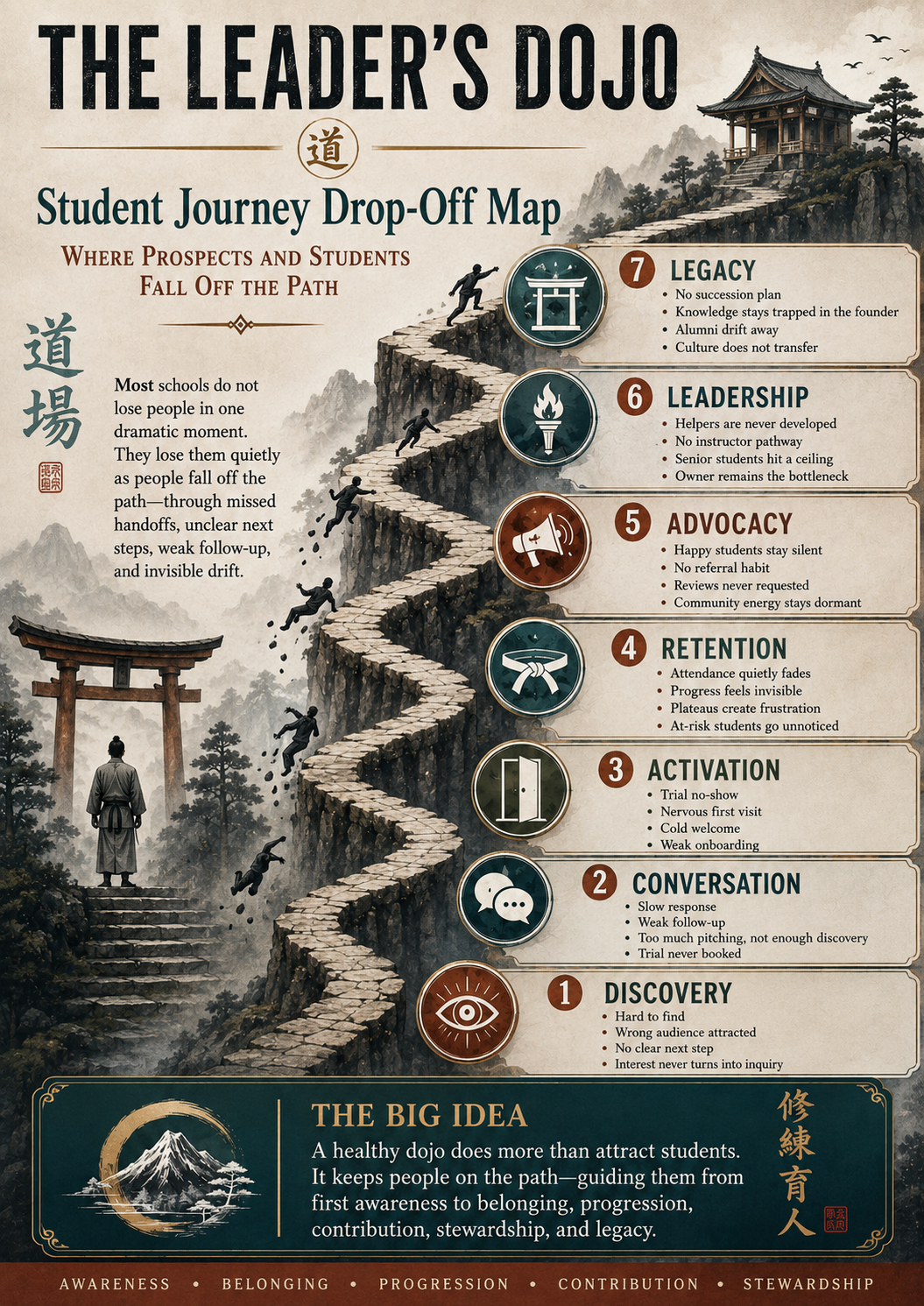
They just are not keeping enough of them moving up the mountain.
And then they wonder why the owner is exhausted, the staff is stretched thin, the culture feels weaker than it used to be, and there never seem to be enough senior students around to help carry the school.
They keep pouring more people into the bottom.
But people keep falling off the path.
So they pour even more.
That can create what I think of as:
The White-Belt Factory
Lots of beginners.
Lots of trials.
Lots of onboarding.
Lots of repeating the same basic explanations.
Lots of hand-holding.
Lots of people who need attention.
Very few people who have been around long enough to give some of that attention back.
Beginners are not the problem.
Beginners are the lifeblood of a school.
A healthy school should always have new people discovering the art and starting their journey.
The problem is a system that can only produce beginners.
Because here is what happens next.
A beginner consumes significant attention:
explanation;
reassurance;
correction;
supervision;
relationship-building.
There is nothing wrong with that.
It is necessary.
But over time, healthy students should become progressively more capable and more contributive.
Some become trusted training partners.
Some become mentors.
Some become culture carriers.
Some become assistant instructors.
Then instructors.
Then program leaders.
Then senior leaders.
A few become stewards of the school itself.
That creates organizational capacity.
The school develops the human infrastructure to help the next generation of beginners without the owner personally carrying every handoff.
If students continually fall off before reaching those stages, the owner starts the development process from zero, over and over.
The academy ends up with many beginners and a thin middle and upper bench.
The owner remains responsible for far too much.
That is an exhausting way to build a school.
More Leads Can Make a Bad System Hurt Worse
Imagine a bucket with holes in it.
The water level is low.
You decide the answer is:
Pour water faster.
Technically, that may raise the water level for a while.
But you have not fixed the bucket.
And now you need to keep pouring forever.
That is what some martial-arts schools are doing with leads.
They lose people between awareness and inquiry.
Between inquiry and conversation.
Between conversation and trial.
Between trial and enrollment.
Between enrollment and becoming a regular.
Between regular and committed practitioner.
Between practitioner and contributor.
Between contributor and instructor.
Between instructor and senior leader.
Between senior leader and eventual steward of the school.
Every one of those transitions is a handoff.
And every handoff is a place where someone can fall through.
If enough people fall off early enough, the owner eventually creates a structural problem.
There are always new people at the bottom.
Almost nobody reaches the top.
Before you assume your next problem is more leads, understand what is happening to the people already entering your school.
If the path is badly broken, adding more traffic may amplify the underlying operational problem.
It may give you more work without giving you more depth.
Look at Your Mat
Here is a question worth asking:
What does the belt distribution in your academy actually look like?
Not what you hope it looks like.
Not what it looked like three years ago.
Right now.
How many brand-new people?
How many students have trained six months?
A year?
Three years?
Five years?
How many senior students?
How many people can safely help a nervous beginner?
How many people can:
lead a warm-up;
help teach fundamentals;
welcome somebody new;
model the culture;
run a class if you are not there;
mentor somebody through the frustrations they experienced themselves three years ago?
And then go another step.
How many of those people can eventually become:
instructors;
program leaders;
managers;
location leaders;
business partners;
your successor?
If the answer gets thinner and thinner the farther up the journey you go, that is information.
Your school may not simply need more people entering.
It may need more people surviving the journey.
Every Drop-Off Creates More Work for the Owner
Retention is not only about keeping tuition revenue.
It is about building capacity.
A student who stays becomes more capable.
Then more independent.
Then potentially useful to other students.
Eventually, some become culture carriers.
Some become mentors.
Some become instructors.
A few become senior leaders.
Maybe one day somebody becomes capable of running the place without you.
That is how a school compounds.
But when students constantly disappear, that compounding never happens.
The owner stays stuck doing beginner-level work.
Another inquiry.
Another sales call.
Another trial.
Another orientation.
Another person who does not know how to tie their belt.
Another person who needs to learn the etiquette.
Another person who needs reassurance that being terrible at martial arts during their first month is normal.
There is nothing wrong with that work.
But a healthy ecosystem cannot be only that work.
Imagine a construction company where every employee had been on the job for three weeks.
Who trains them?
Who catches mistakes?
Who leads the crew?
Who teaches the shortcuts that are not written in the manual?
Who becomes the next foreman?
Eventually the owner is doing everything.
That is not a team.
That is one person surrounded by apprentices.
The Journey Does Not End at Enrollment
This is one of the biggest mistakes I think school owners make.
Marketing thinks the finish line is:
Enrollment.
It is not.
Enrollment is barely the beginning.
A healthy martial-arts school should be able to help someone travel a much longer road.
Discovery
They learn you exist.
The website is findable.
The next step is clear.
The right people recognize themselves in what you say.
Conversation
They raise their hand.
Someone responds.
Someone learns what they actually need, not just what you want to sell.
Activation
They cross the threshold and begin training.
The first visit is not cold.
Onboarding is not just paperwork.
Someone learns their goal and introduces them to the room.
Retention
Training becomes something they do, and eventually part of who they are.
Attendance is noticed.
Progress is visible.
Plateaus are met with support, not silence.
The student who starts fading does not go unnoticed.
Advocacy
They begin telling other people.
They leave reviews.
They bring friends.
They make the community stronger without being asked because they genuinely want other people to experience what they experienced.
Leadership
They become mentors, instructors, staff members, and culture carriers.
There is a visible pathway.
They know what the next step is.
They know what they are building toward.
Legacy
Some eventually become senior leaders, partners, successors, or lifelong members of the extended dojo family.
The knowledge does not die with the founder.
The culture transfers.
That is a radically different way to think about the business.
The question stops being:
How many leads did we get this month?
And becomes:
How well are we helping people move along the path?
The Leak at the Top of the Mountain
This does not only apply to white belts.
Some established schools have a hidden leak much farther up the mountain.
They have students.
They have black belts.
They have instructors.
They may even have multiple locations.
But they have not created an obvious next mountain for the people who have already succeeded.
What does a great assistant instructor become next?
What does an instructor become?
What does a senior instructor become?
Can they:
lead a program;
manage a location;
develop other instructors;
help design curriculum;
participate in strategy;
share economically in growth they helped create;
become a partner;
eventually own a location;
become a successor?
Or is the roadmap basically:
Student → Black Belt → Teach Classes → Teach More Classes → Teach Even More Classes → End
If your capable, ambitious people cannot see a future inside your organization, don’t be surprised when they eventually create one outside of it.
That is not simply a retention problem.
That is a leadership and legacy drop-off.
It just happens higher up the mountain.
How This Creates Owner Burnout
Now trace the whole thing from the owner’s perspective.
If nobody stays long enough to become capable, then capable students do not become contributors.
If contributors are not developed, they do not become leaders.
If leaders are not given meaningful pathways, the owner never develops real organizational depth.
So who carries everything?
You do.
You answer the leads.
You teach the beginner.
You teach the advanced student.
You handle the upset parent.
You chase the late payment.
You notice somebody disappeared.
You clean up after class.
You post on Instagram.
You organize the seminar.
You train the new hire.
You answer every important question.
You make every meaningful decision.
And then, when you are exhausted, somebody tells you:
You need more leads.
More leads into that system may just give you more work.
The deeper constraint may be that the organization is failing to develop enough people who can eventually help carry the organization.
Fix the Path, Not Just the Front Door
This does not mean stop marketing.
It means stop pretending marketing can repair operational and leadership problems.
Acquisition matters.
But acquisition is only the first stage of a much longer journey.
You need to see the entire mountain.
Where are people falling off?
Where is the handoff weak?
Where is the next step confusing?
Where does somebody stop feeling seen?
Where does progress become invisible?
Where does belonging disappear?
Where does a senior student hit a ceiling?
Where does an instructor realize there is nowhere else to go?
Where does everything eventually flow back to the owner?
Those are business questions.
They are also leadership questions.
Because a martial-arts school should not merely acquire students.
It should develop people.
And if you develop people well enough and long enough, some of those people eventually help develop the next generation.
That is the flywheel.
A nervous beginner walks through your door.
Someone welcomes them.
Years later, maybe they are the person welcoming the next nervous beginner.
Maybe they are teaching them.
Maybe they are leading the program.
Maybe someday they are protecting the culture you created when you are no longer standing on the mat every day.
That is legacy.
Look for the Missing People
Here is a simple exercise.
Stand at the edge of your mat this week and do not teach for a moment.
Just look.
Ask yourself:
Who is here?
Who is not?
Where are the people who joined last year?
Who made it?
Who disappeared?
Where did they disappear?
Who are your emerging leaders?
Do they know they are emerging leaders?
What happens next for them?
Who can run a class when you are gone?
Who can carry the culture?
Who can develop the next person?
Who could eventually help carry the school?
Then ask yourself:
Where are people falling off the path?
Because if you do not know where the path is breaking, buying more traffic for the bottom of the mountain is not a strategy.
It is just pouring faster.
Maybe you do not need another hundred leads.
Maybe you need to help more of the people already inside your school make it to the next stage.
Then help some of them reach the stage after that.
Then a few become mentors.
A few become instructors.
One becomes a real leader.
And someday, maybe one becomes the person who helps carry the school forward.
That is how you stop building a white-belt factory.