The Culture You're Actually Building in Your Gym
Long before I ever ran a crew, I watched foremen set their teams up for success or for drama.
The pattern was the same every time.
A good foreman looked at the job, looked at his guys, and paired them carefully. A-level with A-level. B-level with B-level. He might put a B with an A if the A was also a natural teacher and the job had some slack in it. But he never, ever put a C-level worker with an A and crossed his fingers.
The bad foremen did the opposite.
They subscribed to the nice theory: put a strong worker next to a weak one, and the strong one will pull the weak one up.
Mentorship by proximity.
Growth by osmosis.
It sounds good in a meeting.
On the jobsite, what actually happens is the A-level worker gets dragged down. He spends his day fixing mistakes instead of doing his own work. He loses momentum. He gets frustrated. And eventually, he stops caring, or he leaves.
I watched this play out dozens of times across decades in the trades. And when I walked into my first martial arts school and stayed there for nearly twenty years, I saw the same pattern in a different uniform.
The Three Skills Nobody Separates
Here's something I figured out on the jobsite that I've never heard a gym owner talk about: doing the work, teaching the work, and holding the standard for the work are three completely different skills.
Most people are good at one.
Some are good at two.
Almost nobody is good at all three.
The operator can do the work. Hand him a set of blueprints and he'll wire the building. Put him on the mat and his technique is clean, his timing is sharp, and when he rolls, you know you're dealing with someone who's put in the hours. He's an A-level performer. But ask him to teach what he's doing and he'll stare at you. He never broke it down. He just did it until it worked.
The teacher can break the work down and transfer it. She can watch a student struggle with a technique, isolate the missing piece, and communicate it in a way the student receives. She might not be the best performer in the room, but she can make other people better. Different skill entirely.
The leader holds the standard. He sees the gap between where the team is and where it needs to be, and he closes it. Not by doing the work for them. Not by teaching them technique. By reinforcing the expectation. By naming what's not acceptable and making sure everyone in the room feels it.
Most professional organizations suffer because the person in charge is good at one or maybe two of these. Rarely all three.
And more importantly, they don't know how to find and hire the ones they're missing.
They assume that a black belt who can execute a technique can also teach it and also hold a room to a standard.
That's three different people, and sometimes you get lucky and find two of them in one person.
But assuming all three come with the belt is how you end up with a school full of C-level students wondering why the culture feels off.
The Distribution Problem
Every gym, at every belt level, has a distribution.
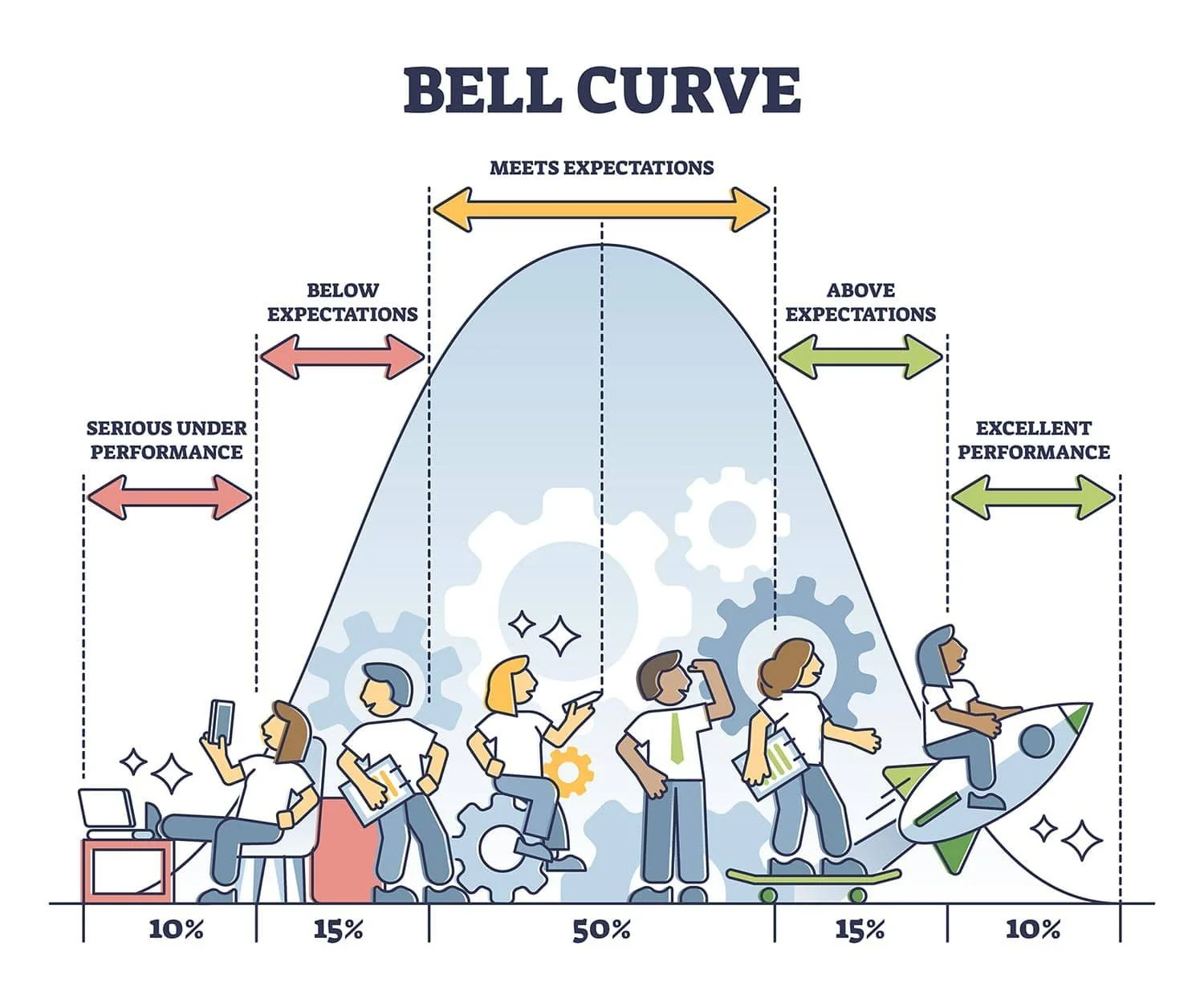
The Bell Curve of Social Demographics
Some percentage of your white belts are A-level. They show up early, they drill with intention, they ask questions between rounds.
Some are B-level. They're consistent, they work hard enough, they're pleasant to have in class.
Some are C-level. They drain energy from the room. They half-ass the warmup. They sit against the wall during drilling. They make excuses.
Same at blue belt. Same at purple. Same at brown and black.
Your school's culture is not your mission statement. It's not what's on your website. It's not the speech you give at the beginning of class.
Your school's culture is the weighted average of how many A, B, and C players you have on the mat on any given Tuesday night.
If your room has twelve A-level students, five B-level, and three C-level, the culture tilts toward excellence.
The A's set the tone. They're the first ones drilling, the last ones to leave, the ones asking for feedback. The B's rise to match them. The C's either get with the program or they self-select out, because the culture makes their behavior feel out of place.
If the distribution is flipped, if you've got three A's trying to hold the line while twelve C's text between rounds and skip the conditioning, the A's eventually stop trying. Or they leave for a school where the room demands more from them.
This is not a theory.
You've seen it. You've felt it.
You've walked into a class where the energy was electric and everyone was locked in, and you've walked into a class where the room felt dead and you had to manufacture enthusiasm from nothing.
The difference was the distribution.
Why Free Trials Make This Worse
Here's where it gets uncomfortable.
Most gyms run free trials because they think it lowers the barrier to entry. And it does.
The problem is that it lowers the barrier for everyone, including the exact people you don't want in your school.
The "something for nothing" crowd loves a free trial.
They're not betting on themselves. They're not putting skin in the game. They're sampling, the way you sample a free cheese cube at the grocery store.
No investment, no commitment, no intention.
They show up for two classes, feel mildly uncomfortable because learning anything hard is uncomfortable, and disappear.
And during those two classes, they were in your room. They were part of the distribution.
They dragged the energy down just by being there with no stake in the outcome.
A-level people don't operate like that.
An A-level person is looking for a challenge. They want to know that the thing they're signing up for is going to demand something from them. If your entry point signals that anyone can wander in off the street and try it for free, you're not signaling challenge. You're signaling desperation.
The gyms with the strongest cultures don't attract A-level people by being easy to join.
They attract A-level people by being worth joining.
What A-Level People Actually Want
Here's what I've learned about A-level people, both on the jobsite and on the mat.
They want to be challenged.
They want someone to set a standard that's slightly beyond where they are and hold them to it. They want to be surrounded by other people who take the work seriously. They want to feel like they're part of something that's going somewhere.
And here's the part most gym owners miss: after you challenge them, you support them.
Then you challenge them again.
Challenge without support is just being a hardass. Support without challenge is daycare.
The rhythm is challenge, support, challenge, support.
You push them past what they thought they could do, then you help them integrate what they just learned. Then you do it again.
When you build a school around that rhythm, something shifts. The A's feel seen. The B's rise toward A. And the C's either transform or leave. Either outcome improves your culture.
The gyms people can't imagine leaving are not the ones with the best facilities or the newest equipment or the most convenient class schedule. They're the ones where every time you show up, the room demands something from you. And you leave better than you arrived.
How to Audit Your Culture This Week
You don't need a consultant to tell you what your distribution looks like. You just need to look honestly.
Walk into your beginner class. Look at the room.
How many of those white belts are drilling with intention?
How many are just going through the motions?
How many are standing against the wall?
Do the same for your intermediate and advanced classes.
Do the same for your instructors.
Do the same for your front desk staff if you have them.
Now ask yourself: if your culture is the weighted average of the people in the room, what culture are you actually building?
This is not about judging people.
Some C-level students are just new. Some are going through something outside the gym that's showing up inside it. Some will become B's and A's with the right environment.
But if the distribution is skewed, if you've been lowering barriers to fill the room and you got exactly the room you invited, you need to make a change.
Not a dramatic one.
Just a deliberate one.
Raise the standard for entry. Not the price necessarily, though that's part of it.
The standard.
Make it clear that joining your school means committing to something.
Ask more of people at the trial stage.
Challenge them from the first conversation and see how they respond.
The A's will lean in. The C's will self-select out before they ever set foot on your mat.
Then look at who's running your classes.
Do you have operators trying to teach?
Teachers trying to lead?
Leaders who can't actually do the work?
Most schools do. The fix isn't firing people.
It's being honest about which of the three skills each person has, and putting them in the role that matches their actual strengths instead of the role that matches their belt.
A school with a strong culture isn't one where everyone is an A. That's not realistic.
It's one where the A's set the tone, the B's rise to meet it, and the C's are either on a path to becoming B's or they're somewhere else.
The foremen I watched succeed didn't try to turn C's into A's by pairing them with the wrong people.
They put people where they could do their best work, held the standard, and let the distribution sort itself out over time.
Your school works the same way.
You're the foreman now.
The culture you have tomorrow is the one you build today, one pairing, one class, one standard at a time.