The Easiest Sales Conversation You'll Ever Have
I didn't learn sales because I wanted to. I learned it because my marriage depended on it.
Twenty years ago, my wife was building a healing practice.
She was phenomenal at what she did.
Her clients got results.
Her technique was dialed in.
But the business was slowly going under, and we were going under with it.
She was spending all her time being great at healing.
But that's only one half of the business coin.
The other half is getting people into the room so you can do the healing.
Marketing
Selling
Finance
She had ignored those entirely.
Not because she was lazy.
Because she was focused on being badass at her craft, and nobody had ever told her that being badass at your craft is only two-fifths of running a business.
So I started studying.
Not because I had a passion for marketing.
Because the bills were mounting and there was no Plan B.
What I found changed everything.
The Five Parts of Every Business
Every business, including your martial arts school, breaks into five pieces:
1. Value creation (your curriculum, your teaching, your methodology)
2. Value delivery (the actual experience on the mat)
3. Marketing (getting people to know you exist)
4. Selling (helping them decide to walk through the door)
5. Finance (making sure the numbers work)
Most martial arts school owners are like my wife was.
They crush the first two.
They're phenomenal on the mat.
Their technique is legitimate.
When a student shows up, the experience is great.
But marketing, selling, and finance?
Those three get neglected.
Sometimes ignored entirely.
Sometimes outsourced to whoever seems willing to handle them.
And here's what I've noticed after decades in gyms: the people who are mediocre on the mat but good at those last three often have bigger schools than the best instructors in town.
You've seen it.
The guy down the street whose technique is sloppy but whose school has 300 students.
The chain McDojo with instructors you wouldn't trust to tie your belt but whose parking lot is always full.
It's not because the market rewards mediocrity.
It's because those people invested in the three pieces you've been ignoring.
They didn't get better at teaching.
They got better at marketing, selling, and finance.
And that stings.
It should.
But it also means the solution is right in front of you.
You Can Have Both
Here's the thing that took me years to understand.
You don't have to choose between being great on the mat and being great at business.
You can have both.
And when you do, the result isn't just a bigger school.
It's a school where the quality of the teaching and the quality of the business systems reinforce each other.
The trick is coming from a place of service, not from a place of selling.
When you think of sales as manipulation, of course you avoid it.
You're a martial artist.
Manipulation runs against everything you stand for.
But that's not what sales is when you're good at it.
Sales is helping someone make a decision they already want to make.
It's diagnosing, not convincing.
It's exploring, not pushing.
And the principles you used to become an expert on the mat are the same principles that make sales work.
You just haven't applied them to the conversation yet.
The 4-Step Diagnostic
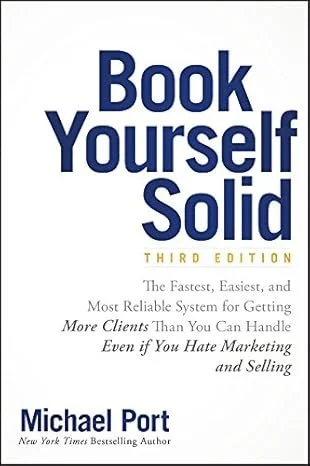
Book Yourself Solid by Michael Port
Step 1: Where are you now?
You start with where they actually are, not where you wish they were.
Not where they think they should be.
Where they are.
A parent calls your school. Their kid is being bullied, or they lack confidence, or they're spending too much time on screens.
You ask: "Tell me a little about what's going on."
And then you listen.
You don't pitch.
You don't talk about your curriculum.
You find out where they are.
This is the same thing you do on the mat.
Before you teach a technique, you assess.
You watch them move.
You see what they already know and what they're missing.
You don't start teaching until you understand where they are.
Why would a sales conversation be any different?
Step 2: Where do you want to go?
Once you know where they are, you find out where they want to be.
"What would you want to see change for your son?"
"What kind of experience are you hoping for?"
"What would make you feel like this was the right decision?"
Most people have never been asked these questions by a gym owner.
Most gym owners lead with the trial class, the pricing, the schedule.
They skip the part where they understand what the person actually wants.
And then they wonder why they’re gone six months later.
Because they didn’t know what they wanted or worse, they did but didn’t help them to get there.
On the mat, this is the equivalent of asking a student what their goals are.
Competition?
Fitness?
Self-defense?
Confidence?
If you don't know where they want to go, you can't help them get there.
Same in the office.
Step 3: What's in the way?
This is where you name the gap.
You don't tell them what the gap is.
You help them see it themselves.
"So it sounds like your son is struggling with confidence at school, and you want him to feel more capable and self-assured. What feels like it's in the way right now?"
They'll tell you. They might say they're worried about time. They might say they tried another school and it didn't work out. They might say they're not sure their kid will stick with it. Whatever it is, they've just handed you the exact thing you need to help them through.
In the dojo, this is the moment you show a student the flaw in their technique. Not by criticizing. By letting them feel it. "See how your weight is on your back foot? You can't drive forward from there." Same principle. Help them see the obstacle. They'll be more motivated to clear it than if you just told them what to do.
Step 4: Do you want help, yes or no?
This is the whole thing. Four words: "Do you want help?"
Not a pitch. Not a close. Not a manipulation.
A simple question.
You've listened to where they are, where they want to go, and what's in the way.
You've built a genuine understanding of their situation.
Now you're offering to help them bridge the gap.
If they say yes, you tell them exactly what the next step is. "Great. Here's what I'd recommend: let’s get you enrolled in our 4-weeks anti-bullying class. I'll make sure your son gets paired with someone at his level. After the 4 weeks, we'll talk about how it went and figure out the right path forward."
If they say no, you thank them and you move on.
No pressure. No follow-up script designed to wear them down.
You were coming from a place of service, not a place of extraction.
A no just means this isn't the right person right now.
That's fine. There are plenty of people who do want help.
Why This Works in a Martial Arts School
This process works because it's not a creepy used car salesman script.
It's a diagnostic conversation.
It's the same thing you do every time a new student steps onto your mat for the first time.
You watch. You ask. You understand.
Then you offer guidance.
The difference is that on the mat, you do this naturally.
It's baked into how you teach.
In the office, you've been told sales is a separate skill set, something you have to learn from scratch, something that requires a personality you don't have.
It's not. It's the same skill set.
Applied to a different room.
When you come from a place of service, when you genuinely want to help the person in front of you figure out whether your school is the right fit, the conversation becomes easy.
There's just four diagnostic questions and a genuine offer to help.
My wife has used this exact process for over a decade.
She doesn't chase clients.
She doesn't run ads.
She doesn't do anything that feels pushy or salesy.
She finds out where they are, where they want to go, what's in the way, and whether they want help.
That's it.
And she's booked solid with clients she loves working with.
I use it with gym owners now.
When someone reaches out and says their school is stuck, I don't pitch my services.
I ask those four questions.
By the end of that conversation, both of us know whether we should work together.
No convincing required.
What to Do Monday Morning
Pick one person.
A prospect who calls this week.
A parent who emails about their kid.
A trial student who walks in.
Run the four steps.
Not as a script you're forcing.
As a conversation you're having.
Where are you now?
Where do you want to go?
What's in the way?
Do you want help?
That's it.
Try it once.
Notice how it feels.
Notice how the other person responds.
Notice how different it is from whatever you've been doing instead.
You already know how to do this.
You do it every time you step on the mat with someone who needs your help.
The only thing that changes is the room.
Stop thinking of sales as something separate from your art.
It's part of the same thing.
Helping people become better versions of themselves.
Some of that happens on the mat.
Some of it happens in the conversation that gets them there.
The four steps are the technique.
Now go drill them until they're automatic.